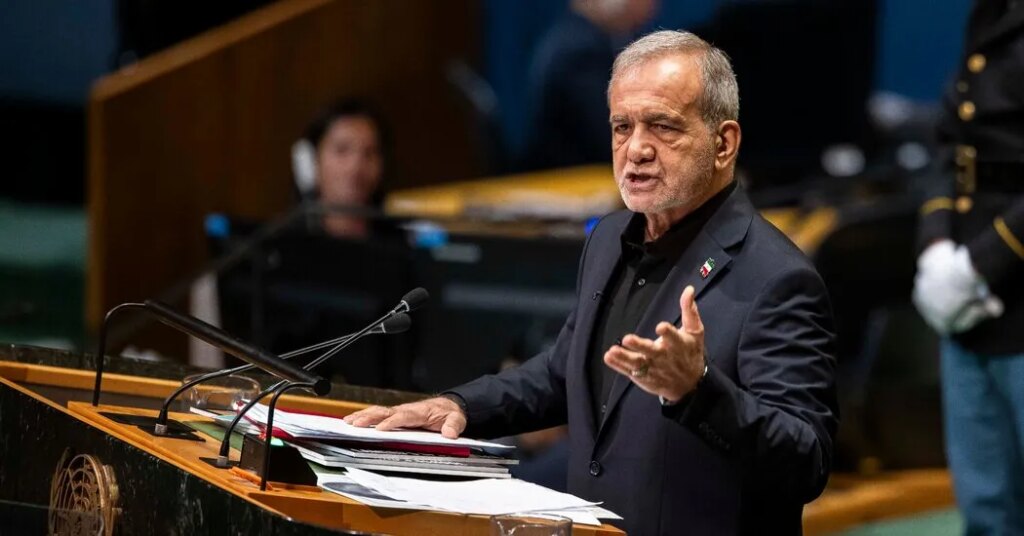
Iran’s president delivered a defiant speech at the United Nations General Assembly on Wednesday, vowing his country would defend itself until “its last breath” and would not give up its civilian nuclear program. At the same time, he left the door open for negotiations with the United States.
Directly addressing President Trump, who on Tuesday called Iran a leading sponsor of terrorism and threatened to annihilate it unless a deal was struck, President Masoud Pezeshkian said his country would not succumb to bullying.
“Iran must be understood by Mr. Trump and those who seek to bully us that we are ready for dialogue, diplomacy and negotiations without accepting the language of force,” Mr. Pezeshkian said at the end of his speech.
Iran is the first country to have a head of government attend the General Assembly in New York while that nation is at war with the United States, the host of the U.N. headquarters. Mr. Pezeshkian used the diplomatic stage to present Iran’s point of view.
“We need power, because a people who doesn’t have power will be crushed in this war,” he said. “We will not ask permission from anyone for defending our country.”
Mr. Pezeshkian held up photographs of Ayatollah Ali Khamenei, who was killed by an Israeli strike on the first day of the war; elementary schoolchildren killed in Minab by American airstrikes; and athletes and children killed in a U.S. strike on a sports stadium.
“Iran must be powerful to avoid being threatened, to avoid its future being threatened,” he said. “Our defensive systems have been built so that no one can think that bombing Iranian cities will go unanswered.”
The United States and Israel launched a surprise attack on Iran in February amid negotiations between Tehran and Washington over Tehran’s nuclear program. A big sticking point in the talks had been whether Iran would get to keep a civilian nuclear program, enriching uranium at a very low level. Mr. Trump had said he wants zero enrichment and facilities closed.
The war has created new flash points, including the Strait of Hormuz, the critical waterway that Iran effectively closed, resulting in a spike in oil and energy prices and disruptions in global supply chains.
Mr. Pezeshkian reiterated that Iran would not give up its right to a peaceful nuclear program. “For our country, peaceful nuclear technology is part of our inherent progress,” he said.
Mr. Pezeshkian slammed Israel, saying the country had nuclear weapons, conducts cross-border attacks on other countries, including his own, yet faced no punishment.
“Then they call us the terrorists?” he said, adding, “Israel kills and Iran is sanctioned.”
Mr. Pezeshkian contended that Iranians had been demonstrating “every night” over the past seven months in support of their country. While hard-line supporters of the Islamic Republic have held nightly rallies since the start of the war, the same crowds have attacked the president and negotiating team and have opposed a deal with the United States.
A large number of Iranians who oppose the government also took to the streets in a nationwide uprising in January and were gunned down, with security forces killing at least 4,200 protesters, rights groups say.
Despite the heated rhetoric by Mr. Trump and Mr. Pezeshkian, their representatives worked on the sidelines of the U.N. session to find a way forward.
On Tuesday, Iran’s foreign minister, Abbas Araghchi, held an hourslong meeting, mediated by Qatar, with Mr. Trump’s special envoys, Steve Witkoff and Jared Kushner, and they discussed resuming negotiations and a way to de-escalate.
Ismael Baghaei, the spokesman for Iran’s foreign ministry, who is also in New York, said Iran had also talked about its conditions for reviving diplomacy, which includes ending the U.S. naval blockade on Iran, releasing the country’s frozen assets and ending hostilities on all fronts.
These conditions were the backbone of a 14-point peace agreement that Iran and the United States signed in June, but it quickly fell apart after Iranian hard-liners, in an attempt to upend the deal, launched attacks on ships crossing the Strait of Hormuz.
Mr. Trump has since said that the Memorandum of Understanding he signed with Iran is invalid and he wants a more comprehensive deal.
The post Iran Will Not Be Bullied, President Says in Defiant U.N. Speech appeared first on New York Times.