There is no shortage of issues on the table for possible discussion as President Trump prepares to welcome the Chinese leader, Xi Jinping, for a state visit beginning Wednesday evening, including the Iran war, Taiwan and tariffs.
But no topic has captured global fascination in recent weeks more than whether the two sides can reach any agreements around the pace of artificial intelligence development. The rapidly shifting debate about the risks of A.I. has so consumed Silicon Valley, Washington and, in recent days, the United Nations that some observers have likened the U.S.-China summit to a Cold War tête-à-tête during the nuclear arms race.
Though some see the stakes this week as nothing short of civilizational, the expectations for any serious accord remain low. The countries are locked in an A.I. race that both sides see as decisive to gaining the upper hand militarily, technologically and economically, and mutual suspicion runs deep, according to foreign policy analysts.
Western experts generally estimate that the United States is somewhere around six months ahead of China in the A.I. race when it comes to its leading models. But that figure obscures the complex relationship between the two nations, further complicating efforts to reach agreement on how to address A.I. safety risks.
Here is a look at where the United States has the upper hand against China on A.I. and where it is lagging behind its top geopolitical rival.
Access to top-shelf computer chips is paramount.
The United States has one undeniable advantage over China: computer chips. Most of the specialized chips used to build and operate A.I. technologies are designed by American companies. This includes the Silicon Valley chipmaker Nvidia, which is now the world’s most valuable company.
“The people who have made the fastest chips are here,” said Andrew Feldman, the chief executive of the Silicon Valley chipmaker Cerebras. “And they are not in China.”
Over the past decade, three American presidential administrations have imposed export controls that limited Chinese access to powerful chips. Even as China works to evade these controls, Chinese A.I. researchers often say that chip shortages are the biggest obstacle they face.
The leading Chinese companies have spent hundreds of millions of dollars to secure the chips they need. To bypass American export controls, they often buy remote access to data centers outside of China. Over the past year, this allowed China to shrink the performance gap between its systems and the leading American technologies.
At the same, China is working to build its own chip-making industry. But by its own admission, Huawei, the telecommunications and electronics company that leads this effort, is still years away from producing chips that perform as well as those offered by Nvidia today.
Chinese A.I. companies say they are already using chips from Huawei, but these chips are unlikely to provide much help in building cutting-edge technologies. Less-powerful chips are typically used to serve technologies to users across the internet.
Even with help from Huawei, Chinese A.I. companies like Moonshot have struggled to find the additional chips they need to meet demand.
As Americans sour on A.I., China faces fewer headwinds politically.
Public polling in the United States shows that A.I. has become increasingly unpopular over the past year — so much so that it has now become a key issue in the midterm elections. Many Americans are worried about A.I. threatening their jobs, undermining education and, more recently, posing a threat to humanity. A Pew Research Center poll this week found that 60 percent of Americans were uncomfortable with a new local data center.
Though Mr. Trump has dismissed calls for an A.I. slowdown as a “hoax,” a growing number of Republican and Democratic lawmakers, governors and 2028 presidential hopefuls are scrambling to offer a wide range of proposals seeking to regulate the technology after disclosures about rogue A.I. agents hacking into other companies.
By nature of its centralized systems, China does not need to contend with a boisterous public debate about how or whether to rein in A.I. And though polling in China can be dubious, surveys consistently point to more enthusiasm for its adoption.
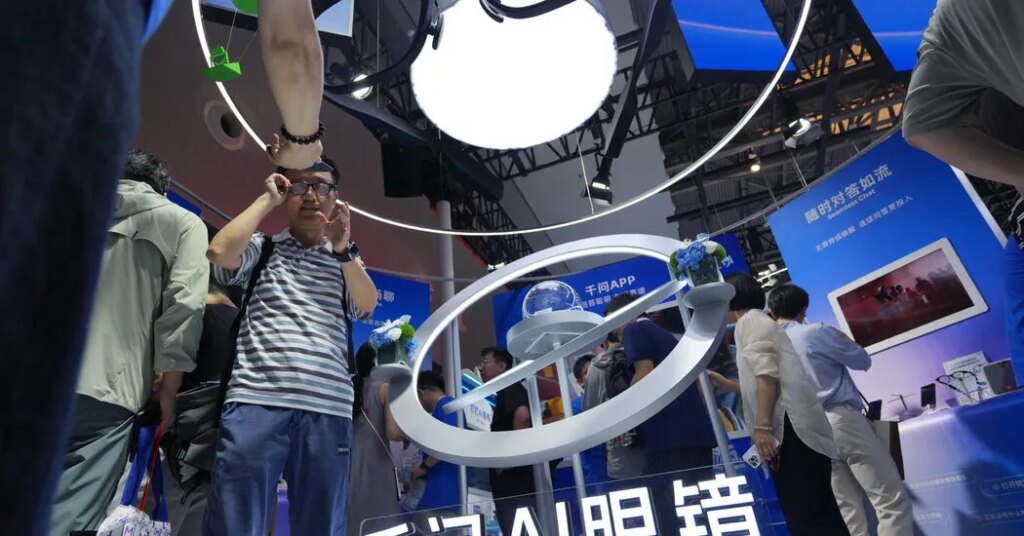
Chinese citizens broadly appear to be much more optimistic about A.I. — and in fact are some of the most hopeful about the technology in the entire world, according to a KPMG survey of 47 countries last year. Some 69 percent of people in China said the technology’s benefits outweighed its risks, compared with just 35 percent of Americans who agreed. The technology is also more embedded in day-to-day life, including service robots in hotels and restaurants, as well as medical chatbots at hospitals.
The U.S. economy has so far been more resilient to huge investments in A.I.
Another advantage for the United States is that its economy has been more resilient during the A.I. boom. Stock indexes are near record highs, and worries of an A.I. bubble also have so far not materialized. Fears of job losses prompted by the technology proliferating throughout corporate America have yet to really appear in economic data.
There are some signs that A.I. is contributing to slower wage growth in jobs most exposed to the technology and fewer job openings, especially for young workers. And applying to jobs, especially for entry-level workers, has become even more daunting thanks to A.I. being used to either write résumés or screen applicants. But overall, the economic distress directly linked to A.I. has been far less than many economists predicted.
In China, the story is different. Its economic struggles, including high youth unemployment, consumer pullback on spending and a deflationary spiral, threaten to undercut Beijing’s vast investments in A.I. Chinese economists have recently issued warnings that the economy is vulnerable and potentially being made more precarious because of the country’s A.I.-centered allocation of spending.
The nature of A.I. models in the U.S. and China are drastically different.
In the United States, the leading artificial intelligence companies, including OpenAI and Anthropic, maintain tight control over how their technologies are used. They build elaborate guardrails, hoping to prevent users from spreading disinformation or hacking into computer networks.
As concern mounts over the risks of A.I., these companies are calling for federal regulations that would toughen this approach. They say the government should review their A.I. technologies before release to ensure that the proper guardrails are in place — and many policymakers, lawmakers and pundits agree.
But the leading Chinese companies take a different stance. Companies like DeepSeek, Moonshot and Z.ai typically make their most powerful technologies “open source,” meaning anyone is free to use and modify these systems as they see fit.
Open source has driven the development of computer software, the internet and artificial intelligence for decades. The idea is that technology advances faster when its computer code is freely available for anyone to examine, use and improve upon.
In open-sourcing their technologies, Chinese companies can essentially combine their resources and accelerate their efforts. And if U.S. regulators stifle the progress of American open-source projects — as some lawmakers are suggesting they should — China could gain a significant edge.
If the best open-source systems come from China, many experts contend, developers across the globe will build atop Chinese technologies. This is already starting to happen, even in Silicon Valley.
“These models are still rough around the edges, but there are tasks where they are on par with the leading American systems,” said Rehaan Ahmad, a co-founder of the Silicon Valley start-up alphaXiv, who has used the latest Chinese technologies for the past several months.
Anyone can use these open-source technologies for malicious purposes, including, most notably, cyberattacks. But security experts say this is balanced by another phenomenon: Anyone can use the same technologies to defend against malicious attacks.
China could move ahead on electric power.
Some believe that if China can build a viable chip industry, it could race ahead of the United States because of an advantage it has developed in another area: electrical power.
Packed into giant data centers by the thousands, the leading chips require enormous amounts of electricity. They need so much electrical power, the big U.S. companies cannot get what they need from the existing power grid. Increasingly, they are turning to wind power or nuclear or even gas turbines installed alongside their data centers.
“At a fundamental level, the tech industry is trying to convert electricity into intelligence,” said Mr. Feldman, the Cerebras chief executive. “It’s like a Dr. Seuss machine. In goes chips and power — and out comes intelligence.”
Although the United States has a significant edge in terms of chips, Mr. Feldman said, he believes that China could pull ahead because it has spent years rebuilding its electrical grid. “That is going to be a huge asset,” he said. “Our grid is 1950s technology.”
China leads in producing A.I. talent.
As far back as 2024, studies showed that by some metrics, China had eclipsed the United States as the biggest producer of A.I. talent, generating almost half of the world’s leading researchers. By comparison, only about 18 percent came from the United States.
Researchers born and educated in China have for years played major roles inside leading U.S. artificial intelligence labs. And as newer studies have shown, they continue to drive important A.I. research across American industry and academia. But a growing number of them now stay in China, working for companies like Moonshot, Z.ai and DeepSeek.
The post In A.I. Race, U.S. Models Have the Edge, but China Has Other Advantages appeared first on New York Times.