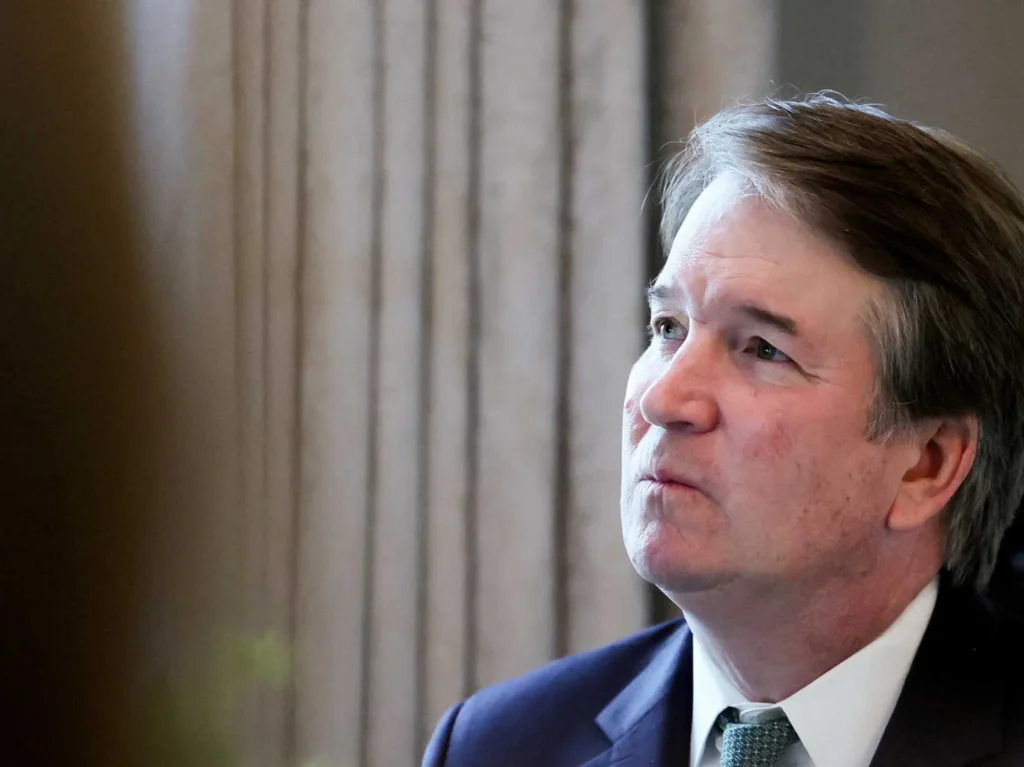
A panel of Republican-appointed federal judges drew accusations of defying U.S. Supreme Court Justice Brett Kavanaugh after ordering Missouri to switch congressional maps while voting was already underway.
The accusation came in an emergency filing submitted to the high court on Tuesday by attorney Abha Khanna, who represents the group behind a referendum challenging the new map.
A three-judge panel of the 8th U.S. Circuit Court of Appeals ruled Monday that Missouri must use districts favored by President Donald Trump in November. Missouri used those districts in its August primary, but its own Supreme Court later ruled the map invalid under state law, and officials have since printed ballots under the older 2022 map, the filing said.
The panel consists of Judge James Loken, an appointee of former President George H.W. Bush, and Judges David Stras and Justin Smith, both Trump appointees, according to the Associated Press.
Smith joined the appeals court in June. Before that, the AP reported, he represented Trump in an unsuccessful Supreme Court appeal of a $5 million jury verdict won by the writer E. Jean Carroll.
“This Court’s stays are not invitations for a lower court to repackage the same relief and try again,” Khanna wrote.
The Supreme Court stayed the district court’s first order requiring the new map on Sept. 10. The appeals panel then directed the same judge to issue a new, permanent order using nearly identical wording, according to the filing.
Khanna also argued the panel had no authority to decide the case at all, because federal law sends challenges to congressional maps to a special three-judge district court.
“The panel cannot manufacture jurisdiction by treating the same order as a preliminary injunction on one page and a [temporary restraining order] on the next,” the filing said.
The filing leaned on Purcell, a principle that discourages federal courts from changing election rules close to an election.
Election officials from all 116 of Missouri’s local jurisdictions told the appeals court that reverting to the new map is now “impossible,” Khanna wrote.
“Instead of crediting local election officials’ own assessment that they cannot switch maps at this late hour, the Eighth Circuit deemed the changes ‘feasible’ based entirely on its own speculation,” the filing said.
“That is the electoral disorder Purcell exists to prevent—on steroids,” Khanna noted in the filing.
Reprinting ballots would cost from a few hundred dollars in small jurisdictions to between $15,000 and $30,000 in larger ones, and not every jurisdiction would need new ballots, the panel found, according to a brief filed Wednesday by the Republicans who sued.
Ballots for military and overseas voters went out on Sept. 18, and in-person absentee voting began Tuesday, Khanna wrote. Richard von Glahn, the referendum group’s executive director, cast his own ballot that day under the 2022 map.
The opinion was unsigned and joined by Loken and Smith. Stras, one of the two Trump appointees, wrote separately that the referendum group and von Glahn have no legal right to bring the appeal, Courthouse News reported.
“For that reason, I would dismiss the appeal,” Stras wrote.
The Republicans who sued built their opposition on that point, telling the justices the group’s interest in the referendum is a general grievance shared by any citizen, not a personal injury.
The panel put its order on hold until 5 p.m. Central Time on Sept. 28, the opposition brief said.
It chose that date so the referendum group could not wait until the Dec. 21 filing deadline and run out the clock on the election, according to the brief.
The post GOP judges ripped at Supreme Court for pro-Trump midterm hijinks: ‘Electoral disorder’ appeared first on Raw Story.