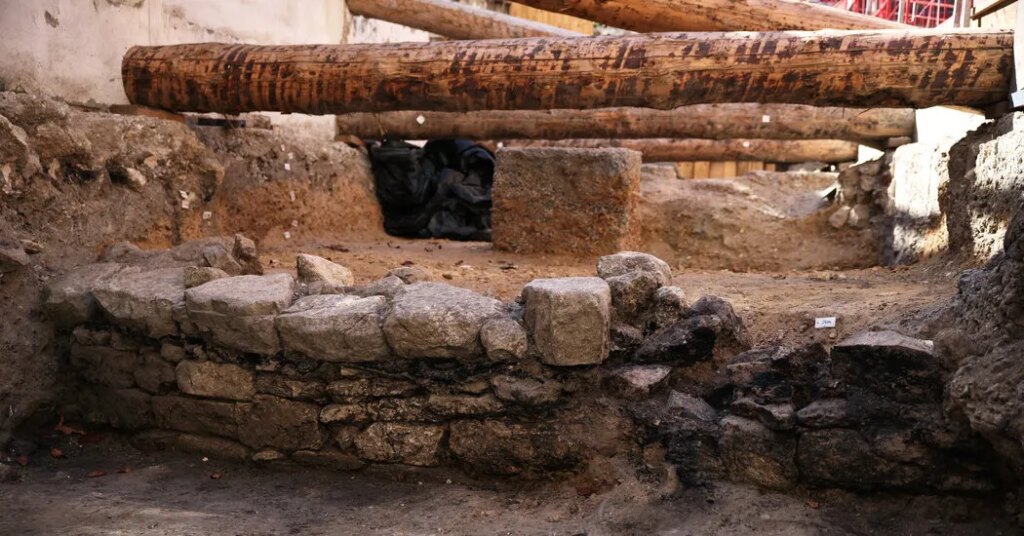
An ancient wall, discovered recently during excavations to shore up a hospital in Paris, could help clarify the location of the city’s original settlements around the time that Julius Caesar chronicled the Roman conquest of Gaul, according to experts.
The stone and wood wall, which measures 72 feet, is characteristic of Gallic fortifications dating from the late Iron Age, which ended around the first century B.C. The structure was found this summer, along with a Gallic spearhead, at a construction site inside the hospital Hôtel Dieu, on the Île de la Cité, an island on the Seine River in the heart of Paris.
The French culture minister, Catherine Pégard, described it in a statement on Wednesday as “one of the most important archaeological remains ever discovered for understanding Gallic Lutetia.”
Lutetia, the Latin name for the city that would eventually become Paris, was built by a Gallic tribe that lived along the Seine River probably as early as the 4th century B.C. Julius Caesar, in his chronicle of the Gallic Wars — the Roman campaigns fought between 58 and 50 B.C. against tribes in Gaul — described Lutetia as a fortification built on an island in the Seine. Rome conquered the city in 52 B.C.
In his account, Caesar describes Roman legions moving “for Lutetia, a town of the Parisii, situated on an island in the river Seine.” He adds that Gallic tribes, learning of the Roman advance, had “ordered Lutetia to be set on fire and the bridges belonging to the town to be cut down.”
Until now, Caesar’s vague description and the lack of archaeological evidence made the location of a Gallic city on the Seine a source of debate among French scholars. Many questioned whether Lutetia was located in the heart of Paris or somewhere else. Some argued that the settlement was actually in Nanterre, a suburb west of Paris, citing archaeological discoveries there in the 1990s.
“I was among the colleagues who wrote that Lutetia was probably not located on the Île de la Cité, since at the time — in the 1990s — the evidence was really very, very scant,” said Matthieu Poux, an archaeology professor at the University of Lyon II.
But the finding of the wall had changed his mind, Mr. Poux said, adding that he now had no doubt that the location of the ancient city was on the Île de la Cité.
While Ms. Pégard, the culture minister, said further scientific research was needed to verify the wall’s “function and its chronology,” initial carbon dating of wood fragments indicates that the wall dates back to between 200 B.C. and 10 B.C., which matches the period chronicled by Julius Caesar.
Moreover, the wall bears traces of a fire, potentially in keeping with Caesar’s account. “Charred seeds and the remains of a burned wooden building were also unearthed,” the culture ministry said, which may correspond to Caesar’s account that the Gauls set fire to their settlement before fleeing the advancing Romans.
Archaeological finds have shed significant light on the development of Roman-era Lutetia. Roman artifacts have been found under what is today the Latin Quarter, and a Roman residential area was uncovered under the Luxembourg Gardens, roughly a mile south of the Île de la Cité.
Much less was known about Gallic Lutetia. But, as Mr. Poux said, this discovery under the hospital “increases the amount of data available on this topic tenfold in a single excavation campaign.”
The finding, he said, could be a “starting point” for other archaeological discoveries on the Île de la Cité, though he noted that digs are limited to ongoing refurbishment of buildings, slowing the progress.
The culture ministry said further excavations would take place in the vicinity of the site, and that the entire wall would ultimately be moved to be studied and displayed. Emmanuel Grégoire, the mayor of Paris, said the city would “share this heritage with the people of Paris and all of those who cherish the city.”
The post An Ancient Wall Sheds Light On an Old Question: Where Did Paris Begin? appeared first on New York Times.