Executives from America’s leading A.I. companies warned on Wednesday that the technology they helped create could pose severe challenges to society, telling world powers that international cooperation was needed to control its future development.
The U.N. Security Council, the diplomatic body tasked with safeguarding stability and peace, convened its first meeting on artificial intelligence amid rising global concerns that the technology is spiraling out of control.
But the Council has been divided over which global A.I. measures, if any, should be enforced, with the United States and China showing little interest in slowing down development amid deep mutual suspicion.
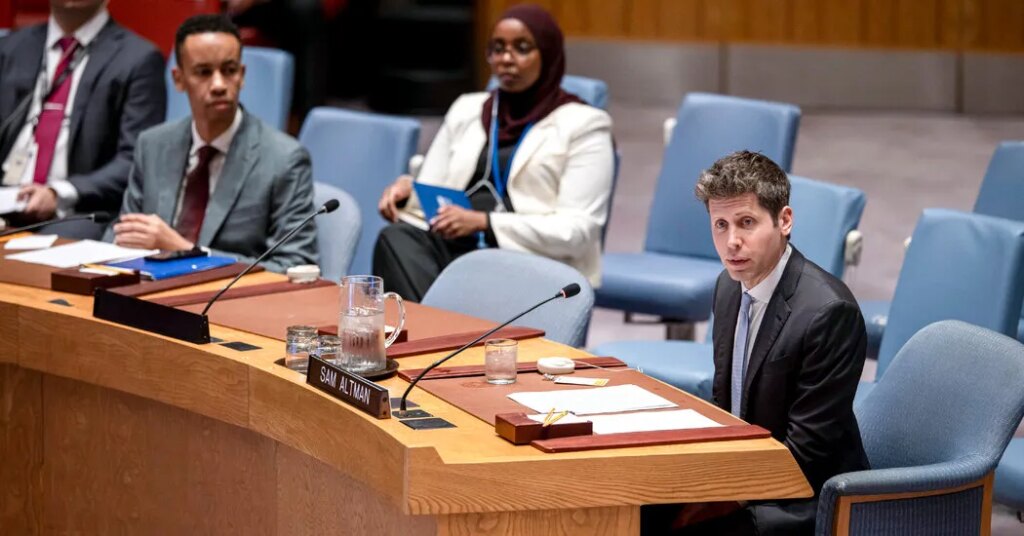
The meeting, during the General Assembly, featured remarks from OpenAI’s Sam Altman and the head of Anthropic, Dario Amodei.
Speaking separately, the A.I. executives said that the fears about the technology were not misplaced, and pleaded for urgent attention from the world’s governments to ensure that it progressed safely and remained under human control into the future.
Their dire assessments stood in stark contrast to President Trump’s remarks to the U.N. a day earlier, in which he condemned a “globalist scheme” to strangle and control A.I. and vowed to not rein in the technology.
Mr. Altman, appearing in person and speaking for about 10 minutes, said the conversation around A.I. had shifted markedly in recent weeks as rapid progress in the technology’s development had made its “upside more tangible, but also the stakes and risks more immediate.”
Speaking in a measured tone as he read from prepared notes, Mr. Altman said the world had a choice. It could harness the power and promise of A.I. to usher in a “new renaissance of creativity and discovery, or more like a new industrial revolution of upheaval and disarray,” he said.
Acknowledging the recent frenzied debates about whether A.I. could threaten human existence, Mr. Altman said: “It doesn’t matter whether people put the risk of catastrophe at 10 percent or 1 percent or 12 percent or 0.1 percent. None of these levels are remotely acceptable.”
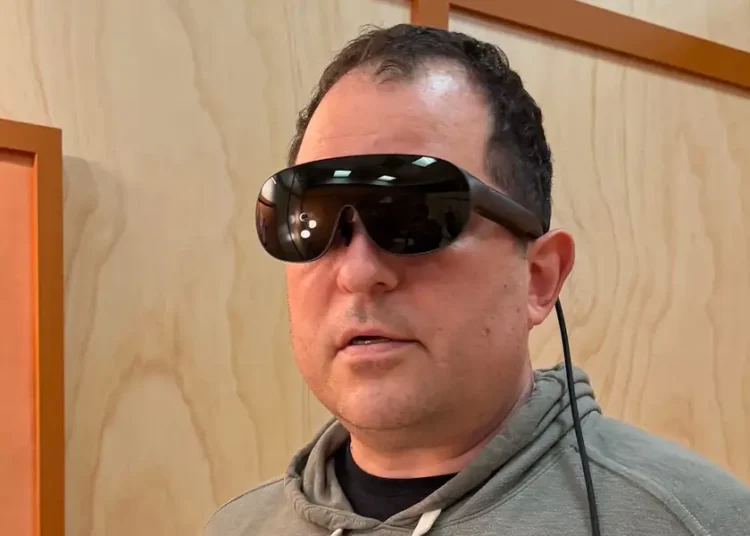
Mr. Amodei, speaking after Mr. Altman, warned in more vivid terms that A.I. could soon pose a threat to the human race and called for a global slowdown of the technology’s pace of advancement, echoing some of his own recent statements on A.I. safety.
Mr. Amodei’s push for restraints on A.I. was embraced by Mr. Altman as well as the SpaceXAI chief Elon Musk and other senior figures in the A.I. industry.
“I believe that this is the most important global security issue facing the world today,” said Mr. Amodei, who appeared remotely via video. “If managed poorly, I even believe that A.I. could be a risk to humanity as a whole.”
He urged the Security Council to begin by supporting “narrow agreements,” including a ban on using A.I. to make biological weapons, and standards for evaluating and verifying A.I. capabilities. Finally, he called for common global standards for testing A.I. models for their risks of loss of control, and a notification system for misuses that are “significant to global security.”
Mr. Altman and Mr. Amodei, whose rival companies are both heading toward initial public offerings that are expected to tally into the trillions of dollars, stressed the need for global collaboration with the A.I. industry to ensure that the technology remains safe and that its powers are not concentrated in too few hands.
While they have each vowed to commit their companies to a range of safeguards, including voluntary reviews of powerful new models by the U.S. government before their public release, both said their industry needed support from democratic countries to build stronger rules going forward.
“No leader, no company and no nation can manage this alone,“ Mr. Amodei said. Mr. Altman, striking a similar chord, said that “if A.I. is to be democratic, the most important decisions cannot be made by labs in San Francisco alone.”
The U.N. conversation took place just hours before the Chinese leader, Xi Jinping, was scheduled to arrive in Washington for a state visit with Mr. Trump. The two men, leaders of the world’s A.I. powerhouses, were expected to discuss the technology’s advancement, alongside a host of other issues.
Despite a fevered interest in recent weeks in the potential for A.I. to pose catastrophic risks to humanity, expectations for a major breakthrough between the two countries on A.I. remain low.
Neither Mr. Altman nor Mr. Amodei mentioned China or specifically discussed the U.S. race against the country during their addresses. Both countries are permanent members of the Security Council and have veto power.
Artificial intelligence jumped to the top of the agenda this year at the United Nations General Assembly. Secretary General António Guterres held a conference on global governance for A.I. on Monday and urged countries leading the technology to cooperate on developing safeguards “that protect us all.”
The U.N. has said it considers A.I. technology and the need for oversight as urgent as other global issues that it has taken leadership in tackling such as climate change.
But the United States told the Council on Wednesday that while it supported dialogue and diplomacy on A.I., it rejected attempts to regulate it.
Michael Kratsios, who leads the White House Office of Science and Technology Policy, said the Council could not oversee a technology that it did not understand and that dialogue could not be allowed “to drift toward global governance.”
“As President Trump said before the General Assembly yesterday, the United States totally rejects any attempt to construct a global scheme of control of super intelligence,” Mr. Kratsios said, using the new term for A.I. that Mr. Trump adopted this week.
China told the Council that the international community should work tougher to steer A.I. in positive directions but forcefully rejected any attempts to regulate it, saying countries had the right to develop technology based on their needs.
Russia questioned whether A.I. was relevant to the Security Council’s mandate, suggesting that it should be discussed in forums with expertise on the topic.
France and Britain, two of the five permanent members of the Council, both called for global oversight.
“We cannot abdicate our responsibility to our citizens, because we cannot outsource to private companies the first duty of government to protect our people, whatever the issue,” said Edward Miliband, the British foreign minister.
The post America’s A.I. Leaders Warn U.N. of Possible Peril Absent a Global Response appeared first on New York Times.