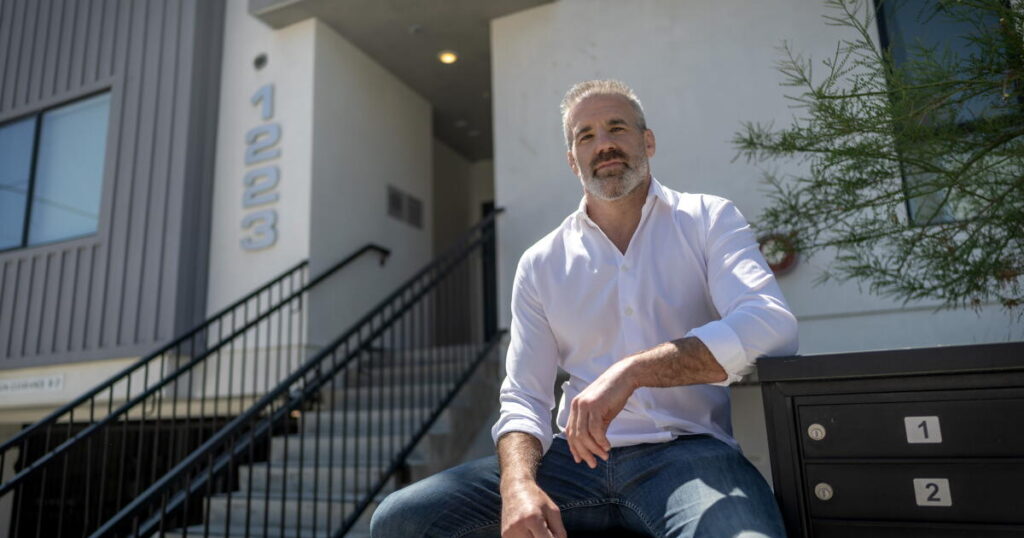
In 2021, developer Paul Schon was paid $6.5 million for a 14-unit Hollywood apartment building he constructed. Over the next five years, much of Los Angeles’ multifamily market imploded.
Schon just bought the building back for $4.75 million.
“This is a live example of what happened to L.A. apartment building values in the last few years,” he said.
A 30% drop in half a decade seems shocking, but it’s now the norm. In 2022, the average sale price per unit in new and existing multifamily buildings in L.A. County was $397,289, according to commercial real estate firm Kidder Mathews. In 2026, it’s down to $280,591.
The city of L.A. is suffering from a housing shortage. The state is practically begging it to build more homes, and Mayor Karen Bass implemented a faster permitting process earlier this year. But Schon and a growing number of developers across L.A. say that building new apartments simply isn’t an option at the moment.
Projects don’t pencil. Taxes eat through profits. And the few developers still building are often opting for smaller, safer projects such as ADUs and townhouses as opposed to the taller, denser developments that experts say the city desperately needs to help solve the housing crisis.
It’s leading to a market where no one is thriving. Developers aren’t making money, and tenants are still dealing with rents higher than in most other cities.
There was a bit of relief earlier this year, when rents dropped to a four-year low, but pent-up demand and decades of underbuilding ensure that housing in many neighborhoods is still expensive for renters and out of reach for aspiring buyers.
“People are scared to build in L.A. right now,” Schon said. “All my developer colleagues and friends are sitting on the sidelines because new development doesn’t make sense.”
Construction has slowed across the board. According to Kidder Mathews, in the first half of the year, 2,376 new apartment units were completed in L.A. County — a nearly 9% drop compared with the same stretch last year. In addition, only 25,636 apartment units were under construction — about a 15% drop from last year.
“We’ve been tracking an overall decline in construction for years now, and we expect that to continue,” said Darin Beebower, executive vice president at Kidder Mathews. “Most developers I speak to are ‘pencils down.’ And they have been for a while.”
Paige Sterling, a spokesperson for Bass, said the mayor has passed multiple directives to address the concerns of developers, including Executive Directive 1, which expedites homeless shelters and affordable housing projects, and the faster permitting process she announced in April.
“In the face of a growing affordability crisis, Mayor Bass has been laser-focused on slashing red tape and eliminating the bureaucratic barriers that have stalled housing production in Los Angeles for decades,” Sterling said in a statement. “Nearly 50,000 units of affordable housing are now being fast-tracked because of her Executive Directive 1.”
So why is building housing in L.A. — a city with seemingly infinite demand — such a slog? A few reasons, developers say.
The first and most obvious is a factor affecting the industry nationwide: interest rates, which skyrocketed in 2022 and never went back down. Developers often borrow money from investors to finance projects, but margins get much tighter when you borrow at 7% compared with 2%.
“Large developers would love to break ground on projects around L.A., but the numbers have to make sense. Right now, they simply don’t,” Beebower said.
The second factor, Schon said, is policies dating back to the pandemic. The city and the county instituted tenant protections such as rent freezes and eviction moratoriums for years, a vital aid for renters during an uncertain time. But developers claim the moves flattened revenues by keeping rents lower than what the market demanded and also creating a backlog of eviction cases. Even though the protections have expired, their ripple effects continue today, at the same time that expenses, such as construction costs, have shot up.
Developers said the third factor making projects harder is Measure ULA, the so-called mansion tax passed by city voters in 2022 that levies a 4% or a 5.5% tax on all L.A. property sales above $5.4 million — not just mansions, but parking lots, offices and apartment buildings. Over the summer, there was a push to exempt multifamily buildings from the tax within 10 years of construction, but the City Council shelved it.
“Right off the top, you’re subtracting 4 to 5% of the sale price, which is a big piece of your profit,” Schon said, adding that it’s a tough sell when pitching projects to investors, many of whom are more comfortable parking money in the stock market.
All of this is leading to less housing, experts say.
Developer Yoni Chriqui said that many of his friends who once built projects with 20 to 30 units are now sticking to four units or less in order to stay under the mansion tax’s $5.4-million threshold.
“People are building two or three stories on parcels that could hold six or seven stories,” Chriqui said.
Chriqui spent much of his career building apartments and single-family homes. In 2023, he switched exclusively to small-lot single-family projects.
“I only saw downsides from renting apartments. Expenses increase, rent revenue stays flat, and all of a sudden you’re upside down,” he said.
When he started building 15 years ago, “soft costs” — such as city permits and inspections that aren’t related to the actual construction — were around 10% to 12% of a project’s budget. Now, he estimates they’re 20% to 25%.
Chriqui said permit costs increase 4% to 5% per year, along with other regulations and fees sprinkled in that make projects harder to justify. For example, in 2016, L.A. started charging park fees to multifamily developers in lieu of making them provide actual park space. In 2026, those fees climbed to $8,929 per unit — so the developer of a 50-unit complex would owe $446,450 in park fees.
Schon and Chriqui both said that density bonuses and incentives are great, but they’re not enough to make large projects financially viable.
In July, SB 79 took effect in cities across California. The historic upzoning bill allows developers to override local zoning laws and build taller, denser projects near transit stops. As of this month, not a single project has been proposed under SB 79 in L.A., according to the city planning department.
Paul Darrow, managing director of commercial real estate company Walker & Dunlop, handled the sale of the Hollywood apartment building Schon purchased, in which the seller took a $1.75-million loss. He said there are plenty of recent sales where developers or investors have taken losses of $10 million to $30 million.
“There was a lot of interest in the sale, but buyers have gotten picky,” Darrow said.
He said it’s a tale of two cities: developments in trendy neighborhoods like Westwood and Playa Vista are in demand, while buildings in neighborhoods with more crime or homelessness, such as Hollywood, are losing value.
But every free fall has a floor. Darrow said some buyers are seeing how far values have dropped and deciding to jump back into the market.
“Investors across the country are trying to figure out L.A.,” he said. “Lots of eyes are looking.”
For Schon, buying back the property he sold five years ago is a contrarian bet.
“I’m excited but nervous,” he said. “I hope L.A. has bottomed out and there’s upside now, but there’s still a lot of risk.”
In the meantime, parcels that could house hundreds are instead home to a few people — or no one at all. Chriqui owns a 14,000-square-foot lot that could potentially hold 40 to 50 units, but he’s building 10 single-family homes on it instead.
He has another project with plans for 56 units. He could get the permits in six months, but the numbers just don’t work. In the last few years, the property’s appraised value has gone from $6 million to $3 million.
It currently serves as a parking lot.
The post Why L.A. developers aren’t building more apartments, despite epic housing shortage appeared first on Los Angeles Times.