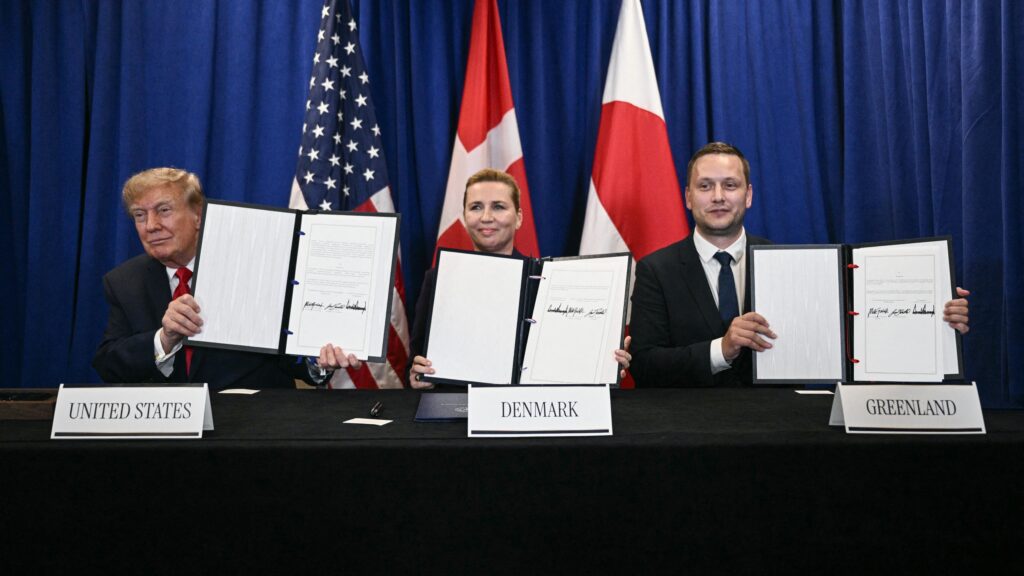
President Donald Trump on Tuesday signed a deal on the security of the semi-autonomous Danish territory of Greenland, in a bid to end the standoff over the strategic island. Danish Prime Minister Mette Frederiksen and Greenland’s Prime Minister Jens-Frederik Nielsen joined Trump at the United Nations General Assembly in New York for the trilateral signing ceremony.
The deal follows Trump’s repeated threats to annex Greenland—a move he insisted was a matter of “national security,” on account of the mineral-rich Arctic territory’s positioning between the U.S., Russia, and Europe. Trump has long argued that Denmark cannot be relied upon to protect the island. Tensions reached a critical point earlier this year, when he threatened to tariff European allies until Greenland fell under U.S. control, and suggested he may pull the U.S. out of NATO over the tussle.
The signed agreement notably stops short of Trump’s call for the U.S. to take over Greenland as a U.S. territory.
Instead, in a speech at the U.N. gathering, Trump said the deal gives the U.S. “permanent control over security and all other needs on that territory” and emphasized that “no U.S. adversary will ever be permitted to establish a military presence in Greenland any more, or make sensitive investments there without our express written approval.”
Upon the announcement of the deal on Friday, Trump had said the U.S. will “immediately begin the process of developing a large military presence in the appropriate part of Greenland, of which there are many” and specified that this is an “infinite life agreement, there is no end.” A State Department official previously told TIME the deal ensures Greenland will forever be a part of the strategic defense area of North America.
Danish and Greenlandic officials have expressed hope over the agreement, while emphasizing that the U.S. military arrangement will not compromise the territory’s sovereignty—a fear among Greenlanders following Trump’s pressure campaign.
Some critics have questioned whether the differs all that much from the existing 1951 defense agreement that gave the U.S. military extensive rights in Greenland.
The U.S. already has one base in Greenland, the Pituffik Space Base, which is located in the northwest of the territory and provides missile warning and space surveillance capabilities. Per the new deal, the U.S. will be allowed to establish additional “defense area[s]” on the island, specifically at Narsarsuaq and Mestersvig.”
Torrey Taussig, director of the transatlantic security initiative at the Atlantic Council, says the deal is a positive step for U.S. relations with its Western allies.
“This is a significant feat for Danish diplomacy in that they got this deal, in this form. They’ve taken the temperature down with this [Trump] Administration in a way that I don’t see it really flaring up again, because the President is viewing it as a win,” she tells TIME.
Here’s what to know about the high-stakes agreement, what it means for Greenland’s sovereignty, and if it stands to end the standoff over the island.
What do we know about Trump’s Greenland deal?
Trump has stressed that the agreement gives Washington “permanent control” over Greenland’s security, concerns over which he has positioned at the center of his campaign for U.S. to control the island. “World peace is at stake,” he claimed, earlier this year, insisting that “China and Russia want Greenland, and there is not a thing that Denmark can do about it.”
Russia and China have eyed up emerging shipping routes in the Arctic and possibly new avenues to critical minerals.
The new agreement ensures that no American “adversary” can establish a base in Greenland, have a military presence on the island, or make “sensitive investments” in the territory without written approval from the U.S.
The agreement, according to a State Department official, establishes “permanent” guarantees that “only the U.S. and our allies can make sensitive investments in Greenland, eliminating the previous status quo in which adversaries have been investing in Greenland’s sensitive sectors without investment screening.” Furthermore, China and Russia are explicitly prohibited from having a base in Greenland and cannot send troops to Greenland.
The permanence of the deal is a development from what was in place before, experts tell TIME.
“The old 1951 agreement was tied to the NATO treaty, and therefore contained the possibility that either NATO disappears, or Greenland or Denmark leave, and the agreement ends,” says Ole Wæver, a professor of international relations at the University of Copenhagen.
Meanwhile, the new agreement’s provisions regarding future investments in Greenland are noteworthy, but not groundbreaking, according to Taussig.
“On paper, it has advanced a few important security interests on behalf of the [Trump] Administration,” says Taussig of the terms. “But in substance, it’s not like the Danes were looking to move out on significant Russian or Chinese military infrastructure projects in the near term.”
Some previous attempts at foreign investments in Greenland were reportedly thwarted by the U.S.
According to a 2019 report from the Wall Street Journal, the U.S. urged Denmark to finance airports in Greenland to counter a Chinese proposal for two airport projects, which was ultimately withdrawn.
What have Denmark and Greenland said?
Officials from Denmark and Greenland showed support for the new agreement ahead of the signing ceremony.
In a statement to TIME, Frederiksen’s office said the deal “recognizes the sovereignty and territorial integrity of the Kingdom and the right of the Greenlandic people to self-determination” and “strengthens our common security in the Arctic and the North Atlantic area and is therefore also great for NATO and Europe.”
Denmark, over the weekend, continued to reaffirm its position on the issue of sovereignty. The deal “respects the red lines we have set up and that respects our sovereignty,” said Rasmussen, asserting that such red lines are “something we have insisted on from the start… in a long and difficult series of meetings,” pointing towards previous discussions with Washington over the issue.
Nielsen said the “agreement recognizes Greenland’s interests and our place in international cooperation” and is a “benefit” to all involved parties.
Ahead of travelling to New York, the Greenlandic leader acknowledged the fresh start and said he hopes there can now be more “peace around our country.”
How is NATO set to be involved?
The agreement highlights NATO’s significance, stipulating that “through enhanced presence, improved surveillance and increased cooperation and interoperability with NATO-Allies, the Kingdom of Denmark shall continue to address emerging threats and contribute to collective stability and security in the Arctic region.”
“The Arctic and the North Atlantic are essential for our collective security, and this agreement will help advance security, stability, and cooperation in this vital region,” NATO spokesperson Allison Hart told TIME.
No state that is not a member of NATO will be allowed to establish its own manned or unmanned military installations in Greenland, per the agreement text, nor shall they be allowed a persistent presence of military forces in Greenland, unless otherwise agreed by the parties.
“I do not see much changing for NATO with this deal,” says Taussig. “This is a good news story for the alliance—the fact that we now have a deal that takes away the political irritant [of annexation threats].”
NATO has bolstered its posture in the Arctic this year, with the launch of the Arctic Sentry in February, bringing military drills, surveillance, and presence in the region under one command.
In June, the alliance also established Forward Land Forces (FLF) Finland. Led by framework nation Sweden, “FLF Finland will enhance deterrence and the defence on NATO’s northeastern flank and contribute to the security of the Arctic and the High North,” NATO said at the time of the launch.
Taussig says she expects this increased NATO presence in the Arctic to continue, not just because of this deal, “but because of the [Trump] Administration’s rightful attention on Greenland, and also the reality of the security environment,” as Russia has ramped up operations in the region in recent years.
What did the 1951 agreement between the U.S. and Denmark give Washington?
Barring the permanence of the fresh agreement, and its tighter restrictions on investments from adversaries, Wæver says: “The reality is that the new deal is indeed very close to the 1951 treaty.”
The 1951 deal, titled the Defense of Greenland Agreement, was signed two years after both the U.S. and Denmark joined NATO as founding members. It provides the basis for Washington’s military operations and presence in the Arctic territory.
Per the agreement, the U.S. can establish and operate military bases on the island that Washington and Denmark both agree is “necessary for the development of the defense of Greenland and the rest of the North Atlantic Treaty area.”
The Pituffik Space Base, the last active American military installation in Greenland, has around 150 troops stationed there, according to the Wall Street Journal. Vice President J.D. Vance visited the base in March 2025, weeks after key elections in Greenland and amid heightened U.S. interest in the territory. He was met with signs of protest and opposition from residents of the territory.
Alongside general military operations, the 1951 arrangement also stipulated that the U.S. can station and house U.S. military and civilian personnel within said bases, control related aircraft and shipping, as well as develop necessary infrastructure. “The 1951 agreement already gave the United States relatively unfettered military access to Greenland,” says Taussig.
The 1951 agreement also confirmed Greenland’s and Denmark’s sovereignty over the island, and stated that military operations must follow local laws and regulations.
The terms of U.S. military presence were developed further in 2004 under the Igaliku agreement, in which Washington committed to consulting with and informing Greenland and Denmark of any significant changes to military facilities or operations within the territory.
The post Understanding Trump’s Deal With Denmark—and What It Means for Greenland’s Sovereignty appeared first on TIME.