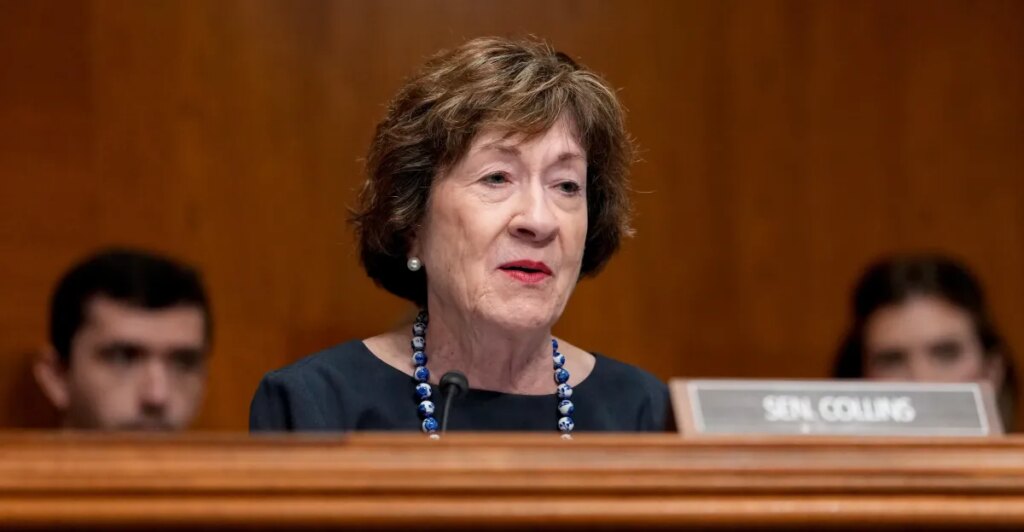
Nationally, abortion has faded as a campaign issue. Four years after it helped Democrats stave off a red wave, candidates in battleground races are focusing their attention on cost-of-living issues, immigration, and policing. As of mid-August, abortion was mentioned in less than 5 percent of Democratic Senate ads, a key difference from the past two cycles, according to the Wesleyan Media Project.
Maine is different. As of September 16, Democratic advertisers had spent roughly 15 percent of their $40.8 million broadcast TV and streaming dollars on ads focused on abortion rights, according to Nate Schwartz from AdImpact. It’s one of the biggest topics there, he told me, after ads about President Donald Trump and healthcare. Planned Parenthood’s political arm is also making its biggest ad buy of 2026 against Susan Collins, at $600,000, and WinSenate, a super PAC aligned with Senate Democratic leadership, has spent 70 percent of its TV, streaming, and digital money in Maine on abortion-focused ads.
The target is Collins, the only Republican senator up for reelection in a state Trump lost in 2024, and one of Democrats’ best chances to flip a seat. Seeking her sixth term, Collins is running in a year when Democrats lead the generic congressional ballot by about 9 points. It’s also the first time she will face voters since Roe v. Wade was overturned — a decision Justice Brett Kavanaugh helped deliver after Collins, who has long described herself as “pro-choice,” cast the deciding vote to confirm him in 2018.
Key takeaways
- Abortion has receded as a campaign issue nationally, but Democrats in Maine are spending heavily on it against Susan Collins, who cast the deciding vote for Supreme Court Justice Brett Kavanaugh’s confirmation.
- Few Maine voters name abortion as their top issue, but Democrats believe Collins’s Kavanaugh vote can motivate their base and persuade older women who have supported her before.
- A Collins loss would let abortion rights groups argue the issue still moves voters. A win would likely be explained by other factors, leaving the question unresolved.
For the abortion rights movement, this is the race that has to work. Groups are pouring their biggest investments of the cycle into a state where fewer than half a percent of voters call abortion their top issue, in a year when Democrats have opportunities to win nearly everywhere. If a blue wave arrives and lifts every Democrat except the one running to avenge Roe v. Wade and remove the senator who famously sealed its fate, the organizations will have a harder time telling donors the issue still moves voters, and a harder time arguing that Republicans will pay a political price — even in blue states — for votes that restrict access to abortion.
“We know that abortion is the number one negative in Maine voters’ mind,” Lisa Margulies, a Maine spokesperson for Planned Parenthood Votes, told me. “It’s really the No. 1 dealbreaker.”
The first job for Democrats and abortion rights advocates is convincing Mainers the issue is still a pressing one. Seventy-two percent of Maine adults say abortion should be legal “in all or most” circumstances, and since Democrats took control of Maine’s government in 2018, the state has expanded who can provide abortions, required and subsidized insurance coverage for the procedure, eliminated most patient cost-sharing, loosened restrictions on care after viability, and shielded patients and providers from prosecution and lawsuits.
Collins has made that her defense. The Dobbs v. Jackson decision, she said in June, “has not had an impact on the state of Maine in that Maine actually expanded its law.” Advocates call that the central misunderstanding.
“There’s this perception — and Sen. Collins herself has said it — that somehow Maine is immune, and that’s just not true,” Margulies said, pointing to their state-level efforts to keep access intact and to federal Medicaid cuts that have already hit Maine providers.
Also muddying the waters is the senator’s Democratic opponent. Collins is facing off against Troy Jackson, a longtime fixture in Maine politics who rose from the state House to the Senate presidency but fell short in bids for Congress in 2014 and governor this year. Early in his career, Jackson said that abortion “should never be legal” and that women should be required to view an ultrasound if they want to end a pregnancy. He has since renounced those positions and has earned 100 percent ratings from Planned Parenthood since 2017. (Jackson replaced Graham Platner, the original Democratic Party nominee, who quit the race after being accused of rape, an allegation he denies.)
While Collins prevailed for reelection in 2020 despite voting to confirm Kavanaugh, Democrats say her decision is much more salient for voters now that Americans live in a post-Roe world, one where more than 15 states have near-total abortion bans.
If Collins loses, Democrats and abortion rights groups will say her Kavanaugh vote is no doubt partly why. A win for Collins would be harder to read, though the explanations that leave out abortion are already being prepared, including a messy nomination process that produced a candidate fewer voters were excited about, and a “unicorn” incumbent with decades of personal relationships across a small state and a long record of bringing federal money back home.
The abortion rights bet hinges on two things: that the Kavanaugh vote cost Collins something on top of what an unpopular president and rising gas prices already have, and that voters will judge Jackson by the positions he’s renounced rather than the ones he once held.
The vote Collins won’t apologize for
When Collins voted to confirm Kavanaugh, she said she believed his assurances that he considered Roe v. Wade settled precedent. She had previously said that she would not vote for any nominee who expressed “hostility” toward the 1973 decision that established the constitutional right to an abortion.
As many observed at the time, Kavanaugh’s record gave strong signals that he would in fact vote to overturn Roe v. Wade. In her floor speech announcing her vote, Collins dismissed those warnings, suggesting opponents had been whipped into a “frenzy” by advocacy groups. When he ultimately did side with the conservative majority in Dobbs, Collins issued a statement calling the ruling “ill-considered.”
Four years later, though, Collins is doubling down on her vote for Kavanaugh, telling local media this summer that she does “not regret” it. “Given what subsequently happened to Roe, I don’t think that simply fades into the background,” Robert Glover, a political scientist at the University of Maine, told me.
Democrats are zeroing in on the fact that Collins has continued to confirm anti-abortion federal judges, even as recently as this month. Last fall she voted to confirm Joshua Dunlap, a Maine attorney, to the US Court of Appeals for the First Circuit over objections from 20 Maine organizations citing his record on abortion and marriage equality.
“Susan Collins says she has no regrets about confirming the judges who overturned Roe v. Wade, and has proved it by continuing to vote for Trump’s right-wing judges,” Maine Democratic Party spokesperson Misha Linnehan told me in an emailed statement. “Now, her approvals are underwater, and she’s trailing with women voters because Maine women have had enough of being betrayed.”
George Hill, the president and CEO of Maine Family Planning, told me Collins “defied” them with her vote for Kavanaugh, causing “irreparable harm” across the country. He emphasized how vulnerable Mainers are if Republicans retake control of state government.
Blake Kernen, a spokesperson for Collins’s campaign, dismissed the criticism about anti-abortion judges, emphasizing that her pro-choice boss also voted for 188 judges nominated by President Joe Biden, including Julie Rikelman, who served as litigation director of the Center for Reproductive Rights. Collins, she noted, is the only Republican who voted to confirm all three of the court’s liberal justices, and she voted against Amy Coney Barrett. “There’s no one vote that could take away or validate her views on this issue,” Kernen said.
Margulies rejects this accounting. “We deserve better than, ‘Well, she’s not as bad,’” she said. “When it comes to reproductive rights, she’s not a moderate anymore.”
While her judicial votes are facing scrutiny, Collins has also spent decades building up a brand as a Republican willing to buck her party on abortion when the issue comes up in the Senate.
In May 2025, Margulies and her Planned Parenthood colleague Lisa Newcomb published a memo online titled, “Senator Susan Collins’ long history of supporting Planned Parenthood and access to essential health care.” Among other things, the memo highlighted Collins for speaking out against proposed Medicaid cuts, for co-sponsoring a bill in 2022 to codify Roe v. Wade, and for opposing a 20-week abortion ban bill in the Senate. This past summer, the memo was quietly taken down from their website.
Asked about the removed page, Margulies didn’t say when or why it was taken down, but pointed to what she described as a sharp shift in Collins’s record over the past year, particularly on judicial confirmations. “There are times when she’s been true to her word and put Mainers ahead of politics, but she closed that chapter this year,” she told me.
“Because she is a Republican, the national groups continue to twist themselves into a pretzel to support these male candidates with terrible records,” Kernen said, referring to Platner and Jackson.
So far, Mainers appear to have split Collins in two in their minds: There’s the dedicated public servant who puts her state first on one side, and the partisan Republican who sometimes disappoints them on the other. A University of New Hampshire poll over the summer found Collins rated far better on bringing federal dollars home to Maine than on her Supreme Court confirmation votes. Maine voters, Glover said, “have historically been willing to separate Collins from the national Republican Party and evaluate her through a broader lens of incumbency, independence, and constituent service.”
The turnout math
Even if Democrats can win the argument on abortion around Collins, it’s an open question how much it will move votes. “Right now, I feel quite confident that affordability, healthcare, and good jobs trump abortion access by a long shot,” Dan Shea, a political scientist at Colby College, told me.
But abortion rights advocates believe the ranking obscures how the issue actually works. Mini Timmaraju, president of Reproductive Freedom for All, said her group has spent years testing how to talk to voters about abortion, consistently finding that it overperforms as an attack. “If you go to a voter in Maine and you say, what are your top three or five issues, they may not name abortion,” she told me. “But if you say to them, Susan Collins took the following vote — and one of them is Brett Kavanaugh, which led to overturning Roe — it is extremely salient, and it moves that voter.”
The Kavanaugh vote works, she argued, as a character verdict — “an indicator that you’re willing to side with extremism over your own constituents.” That, she said, is the piece that’s missing in the analysis of what voters say they care about. “It is one of the most salient attacks in Maine and in a lot of other parts of the country.”
Ashley Kirzinger, a pollster at KFF based in Maine, said priority rankings are a weak guide anyway, noting “the economy” means different things to different voters, and issues compete with candidate dynamics and party loyalty. What has changed since Roe’s overturn, she told me, is who the single-issue abortion voter is.
“Before the Dobbs decision, abortion was a motivating issue for Republican conservative voters,” Kirzinger said. “Now what we’ve seen is a complete shift.” Those voters are more likely to be Democrats, younger women and women of color, and include more people who don’t reliably show up in midterms.
Abortion messaging, therefore, is doing two jobs. The first is turnout. Kirzinger said the Kavanaugh vote is aimed at Democratic women “who are not as enthusiastic about Jackson as a candidate” and who “may be more motivated to turn out as a vote against Collins’ record on abortion rather than for Jackson.” In a tight race inside the margin of error, a couple of points of turnout could make the difference.
The second job is persuasion, and the target is older women, who reliably vote. Women made up nearly 60 percent of Maine’s turnout in 2020, and Collins won them by 3 points. What Democrats need from them is a switch, which is why many of the abortion ads are built around regret. One Planned Parenthood ad features a woman who voted for Collins and “will not make the same mistake twice”; WinSenate’s features a voter who “felt [Collins] was the better choice” and doesn’t anymore.
Jackson’s change of heart
Complicating the race is Collins’ opponent, Troy Jackson, who is in some ways a mirror image of her own political persona: a Democrat with a history of culturally right-leaning positions to appeal to voters in the other party.
Jackson, who started his political career in the rural and fairly conservative county of Aroostook, used to earn 100 percent ratings from Maine Right to Life. In 2010, as CNN’s KFILE reported, when he filled out the group’s candidate questionnaire saying he thought abortion should never be legal, he declined to say whether there should be exceptions even to protect the life of the mother, for rape or incest, or because of fetal disability. Maine Right to Life, which has not issued an endorsement in the Senate race, did not return requests for comment.
Jackson told MS NOW he evolved on the issue thanks to “a lot of conversations over time” with women, doctors, and community members. “It became more and more clear to me that abortion access was healthcare,” he said.
In 2023, while serving as Senate president, he co-sponsored a bill allowing abortions after fetal viability when a physician deems them necessary, one of the most expansive such laws in the country. In 2024, he shepherded through the Senate a shield law protecting Maine providers and patients of reproductive and gender-affirming care from other states’ bans, despite bomb threats that emptied the statehouse and a letter from 16 Republican attorneys general threatening to sue. “Troy stood up for and never wavered in his commitment to reproductive rights during some really harrowing moments,” Margulies said, “when it would have been a lot easier to step down.”
“I’m rock solid on this now, and Susan has been the opposite,” Jackson said in an interview with Maine Public Radio this summer. Kernan, Collins’s spokesperson, has charged Jackson with flip-flopping for “political convenience.”
The national environment is looking strong for Democrats, and Jackson has been narrowly ahead in recent polls, though all have been within the margin of error. A CNN poll released this month found nearly two-thirds of Mainers feel negatively about the Dobbs decision, including about half saying it makes them angry. A Fox News poll in August found 55 percent worried Collins votes with Trump too often.
Whatever happens, the explanations are ready. If Collins loses, abortion rights groups will cast it as proof that the issue still moves voters even where it doesn’t top their lists, and as a warning to all Republicans running in 2028. Timmaraju previewed the argument in our conversation: A loss would signal “a crack in the armor” of so-called moderates, and show that voters “are not going to tolerate” incumbents complicit with an extremist administration.
If Collins wins, the groups that spent millions on abortion ads are unlikely to conclude that doing so was a mistake. Kirzinger pointed to the turmoil that followed the Democratic primary and the late swap of Platner for Jackson, which she said benefited Collins “in a way that is hard to capture in polls.” Glover, the political scientist, noted the things Mainers have always weighed alongside her votes, including decades of relationships, the Senate Appropriations gavel, and federal money. Even Timmaraju, the abortion rights leader, offered the same hedge in advance: A Collins win, she told me, “says more about Susan Collins and Maine than it does about 2028.”
A win wouldn’t show that judicial votes carry no consequences, Glover added. But if Collins holds substantial support among voters who support abortion rights despite the Kavanaugh vote and the fall of Roe, “that would certainly suggest limits” for retrospective accountability for downstream consequences of Supreme Court confirmations.
Though the race is supposed to clarify whether voters will punish elected officials for taking actions that restrict abortion access, it probably can’t — at least not definitively. It will decide, though, who holds the seat, and reproductive rights leaders have been clear that without a Democratic Senate, nothing they want gets a vote.
The post Susan Collins is the abortion rights movement’s biggest test of 2026 appeared first on Vox.