
Good morning. Half a century after its founding, Apple’s financial transformation is best told through data that captures how thoroughly the company has reinvented its business. And the numbers suggest capital discipline will remain a big focus in its next era.
As John Ternus became CEO on Sept. 1, taking over the reins from Tim Cook, Fortune takes a look at the past 50 years and the data behind the shift from device dependency to recurring revenue, a global sales base, and profit growth that has rewarded patient shareholders beyond almost any comparable stock.
The iPhone remains Apple’s single most powerful engine, accounting for roughly half of 2025 sales. But the more revealing trend is services, which include the App Store, iCloud, Music, TV, payments, advertising, and more. It’s a division that barely existed 15 years ago and is now projected to generate more than a quarter of this year’s revenue. That’s the clearest evidence that Apple has successfully layered a high-margin, recurring-revenue business on top of its device sales, insulating it somewhat from the hardware upgrade cycles that worry investors.
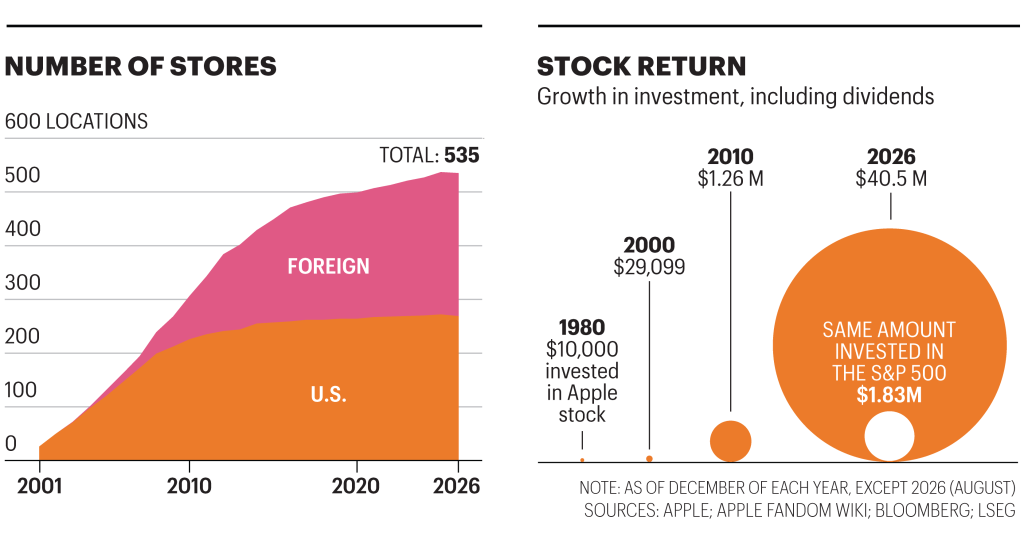
Apple has truly gone global. While the U.S. remains its largest market, a substantial share of Apple’s sales now comes from Europe, Greater China, Japan, and the broader Asia-Pacific region. Its retail footprint tells a similar story: Apple now operates more than 500 stores worldwide.
The bottom-line trajectory is the starkest number of all: annual profit rose from roughly $2 billion in 2006 to about $112 billion in 2025, a nearly 60-fold increase in under two decades. The long-term performance of the stock has been even more remarkable: a $10,000 investment in Apple’s 1980 IPO, held through its subsequent stock splits and decades of growth, would be worth approximately $40.5 million by mid-2026, Fortune reported.
These figures form the financial foundation Ternus inherited from Cook, who built Apple into a $5 trillion company through supply-chain discipline and cash-flow strength rather than Steve Jobs-style stage presence. “Cook ultimately built his own respected legacy, not in spite of being unlike Jobs, but because of it,” Fortune’s Phil Wahba writes.
That inheritance now faces its sharpest test yet: while Microsoft, Google, Meta, Amazon, and Oracle pour tens of billions into data-center buildouts for the AI race, Apple has deliberately avoided the hyperscaler arms race, betting instead on privacy-first, on-device AI delivered through premium hardware.
Whether that restraint proves prescient or costly will determine whether Ternus’s Apple keeps growing. You can view more of Apple’s history in charts here. Read more about Cook’s tenure at Apple here.
Sheryl Estrada [email protected]
The post From $2 billion to $112 billion in annual profit: How Apple transformed its business appeared first on Fortune.