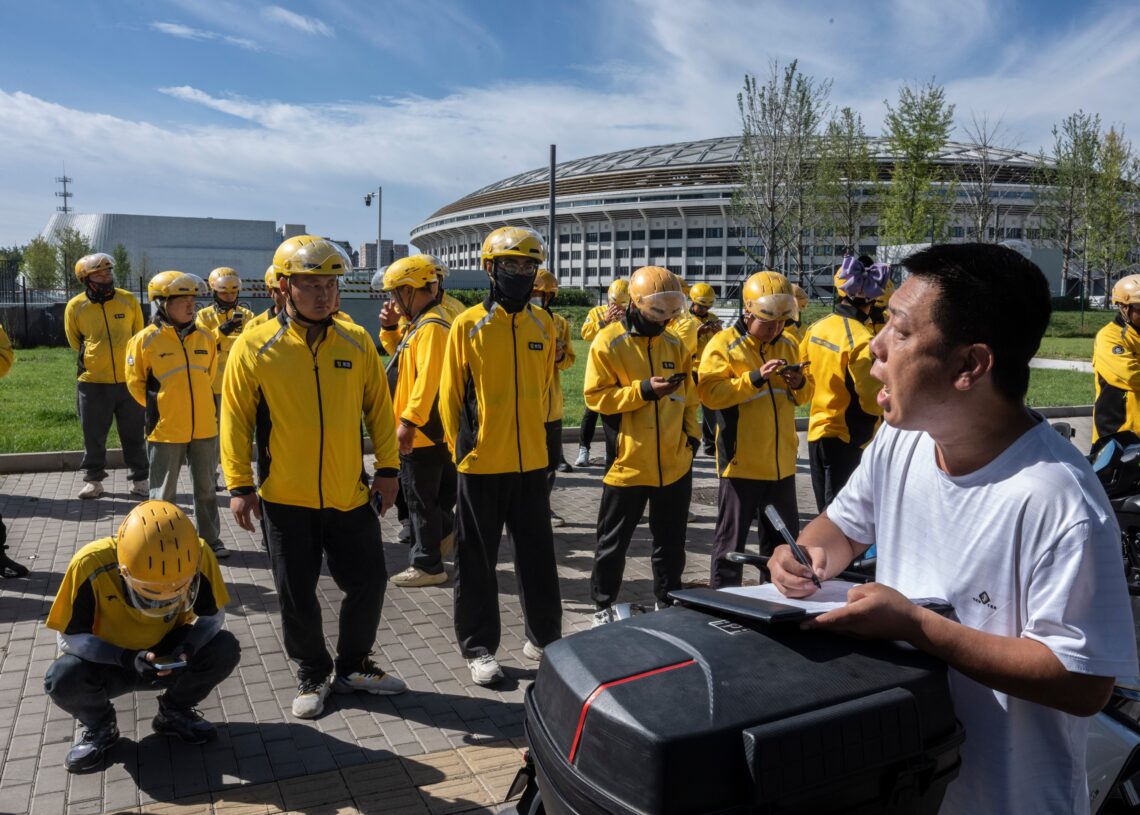
BEIJING — The young man standing outside the shopping mall would prefer to be writing poetry or acting in a play. Instead, he’s waiting to pick up a plastic bag containing someone else’s lunch.
Tu Xuxin (pronounced Shoo-shin), 30, has been making deliveries by electric scooter for six grueling years. He works up to 14 hours a day, six days a week, balancing boredom and exhaustion. In a good week, he earns the equivalent of $500 — a healthy income here — but is left with no time to read the Ernest Hemingway novels he enjoys.
“If you want to earn money, you need to spend a long time on the road,” Tu said, adjusting his orange safety helmet. “I’d like to switch to another career. More and more people are competing in this industry.”
Anemic job growth has pushed more than 280 million Chinese into gig economy jobs, up 75 percent from 2019, according to the China New Employment Forms Research Center. While China’s factories and technology labs are global stars, many people are stuck in such dead-end jobs, struggling to find cause for optimism in a stunted domestic economy.
This week, Chinese President Xi Jinping is set to arrive at the White House with Chinese global influence on the upswing: China is seen more positively than the United States in most of the 36 nations the Pew Research Center surveyed this summer, a turnabout from 2025. Xi’s host, President Donald Trump, meanwhile, is mired in an unpopular Middle East war and may lose his congressional majorities in the November elections.
But Xi has his own problems. The most notable: a split-screen economy that has the Chinese people settling for less in their daily lives while Xi invests in matching the U.S. in the advanced technologies — such as semiconductors and artificial intelligence — considered essential for global power.
“Even if the economy isn’t growing in the way that it used to in the past, he thinks that the people will take it because that’s what’s necessary,” said Joseph Torigian, author of “The Party’s Interests Come First” and an expert on Xi’s family history. “But it’s really expensive to compete in this [technology] area. And that’s one of the reasons that Chinese people aren’t seeing their pocketbooks grow in ways that their fathers’ did.”
To be sure, public discontent poses no immediate threat to Xi, the most powerful Chinese leader since Mao Zedong. But his management of China’s economy amounts to a high-stakes wager that his citizens — and China’s trading partners — will tolerate the costs of his strategic ambitions.
Tu’s plight, after all, is a reminder that the 10 percent annual growth rates China posted in previous decades are long gone. This year, the Chinese government expects the economy to grow at less than half that pace, its weakest performance since 1991. Some independent economists, who doubt the official statistics, say China is barely growing at all.
An epic property bubble that collapsed five years ago and destroyed $10 trillion in household wealth helps explain why domestic consumption is in a funk. But the lopsided economy is also the result of government policy that subsidizes factory production and futuristic technologies while leaving the typical Chinese consumer to fend for themselves, economists said.
Lacking a national retirement program, for example, the average Chinese household saves roughly half its earnings. But the government keeps interest rates low to ensure companies can get low-cost loans — which makes it hard for people to earn much on their savings. Household consumption accounts for just 40 percent of the economy, well below the global average of 64 percent, according to the World Bank.
Other government policies funnel support to favored industries. During the 2008 financial crisis, China invested heavily in infrastructure, building roads, bridges, airports and high-speed rail lines all over the country. Investment then pivoted to the property sector, fueling an enormous bubble and bust that continues to depress consumer spending and sentiment.
“The Chinese people have largely taken prosperity and high growth almost for granted because this is the only game they know,” said Wang Zichen, deputy secretary general of the Center for China and Globalization. “People are adjusting their expectations and in the process they are keeping tight [hold] of their wallet and their purse and not spending that much.”
Since 2021, the central government has pointed its investment fire hose toward manufacturing. China’s state-owned enterprises have increased their financing of new capacity by 9 percent a year compared with just 1 percent by private companies, according to a June study by the McKinsey Global Institute. China now adds three times as much new production capacity each year as the U.S. and Europe combined, most of it funded with savings trapped inside the country by capital controls.
That investment has catapulted China to global supremacy in an ever-lengthening list of industries and is moving Beijing closer to its goal of self-sufficiency in technologies that the U.S. now dominates. But much of the money has been wasted: Each dollar of additional output in China requires 70 percent more capital than in the U.S. or Europe, McKinsey found.
Local governments and state-owned companies borrowed from banks or sold bonds to finance much of that industrial support, leading to a debt burden that calls into question China’s ability to afford its economic plans. Total debt now exceeds 300 percent of China’s economy, according to the Institute of International Finance, an industry group.
“Chinese growth is incredibly over-reliant on debt, and this has left them with the fastest-growing debt burden in history,” said Michael Pettis, an American economist who has lived in Beijing since 2002.
All those new factories equip China to produce far more automobiles, chemicals, solar panels, steel and cement than it could possibly sell at home. Amid ruinous competition among Chinese firms, prices in some sectors, such as electric vehicles, have been driven so low that companies sell at or near cost just to stay in business. Some enterprises operating at a loss are kept alive by government support.
Starved of sales at home, Chinese producers increasingly sell abroad at “artificially low prices,” according to a recent European Parliament report. But China’s growing dependence upon foreign markets to keep its factories humming — and its workers employed — is prompting a backlash among its trading partners.
The Trump administration is expected soon to announce new tariffs to target “excess capacity” in several nations, including China. Likewise, European officials plan to decide by next month whether to impose new trade barriers to prevent a rising tide of inexpensive Chinese electric vehicles from swamping the German car industry.
“There’s pretty much universally a recognition that in many industries Europe is facing an existential challenge,” said Jens Eskelund, president of the European Union Chamber of Commerce in China, who has worked here since 1998. “It’s inconceivable that China would allow something similar to happen to China.”
Almost half a century has elapsed since Deng Xiaoping launched China’s historic policy of “reform and opening,” transforming an isolated, impoverished nation into a prosperous global power.
Contemporary Beijing is visibly more affluent and modern than even a few years ago. Glass-walled skyscrapers have remade the skyline. Fleets of Chinese-made electric vehicles glide along thoroughfares lined with fashionable stores, restaurants and a seemingly endless number of coffee shops. Everyday commerce is nearly entirely cash-free as consumers rely on the mobile payment systems WeChat and Alipay.
Annual income per person is about $14,000 today compared with $1,100 when China entered the global trading system in 2001, according to the World Bank.
But the domestic economy is subdued. Wage growth has slumped. Retail sales in July were almost unchanged from one year ago. Earlier this year, Ikea closed seven stores in China, including one in Shanghai, saying it would establish smaller outlets instead.
“The whole economy is bad. China developed so quickly; now we’re at a bottleneck,” said Yu Zewei, 29, an office worker, who said he has not had a raise in two years. “I never think of buying a house or a car. You could randomly pick anyone and they will say the same thing.”
Addicted to exports and debt, economists said, China finds itself in an economic cul-de-sac. The government recognizes the need to abandon its investment-led model in favor of promoting greater household spending; then-Premier Wen Jiabao warned two decades ago that China’s economy was “unstable, unbalanced, uncoordinated, and unsustainable.” But little has been done to develop the social safety net that would make Chinese consumers feel comfortable spending more of what they earn.
Xi has scorned calls to pivot to a consumption-first approach as “welfarism.” Born in 1953, Xi — like other Chinese leaders who came of age when China was far weaker — is more concerned with reducing vulnerability to outside pressure than improving living standards that are already far better than he endured, said economist Li Daokui of Tsinghua University, a former adviser to China’s central bank.
“Our policymakers, especially at the senior level, are still people who suffered in the years of extreme shortage, who suffered in the years of famine. So for them, production is the most important part of the economy,” he said. “When you have enough supply of products, you feel safe.”
But while the “new productive forces” of AI and other advanced technologies may fuel higher economic growth, they are unlikely to satisfy the need for millions of new jobs.
The consequences of these choices are being felt by Chinese workers like Tu.
Tu shares an apartment with another driver, Cai Rui, also 30 years old. Cai graduated from a three-year college and worked briefly in a factory, where he chafed against the regimentation, before moving to Beijing. Cai misses his wife and daughter, who remain in Jiangsu province, about 600 miles from the capital, while he tries to earn enough to improve the family’s fortunes.
Like Tu, Cai has money but no time to spend it on entertainment or hobbies.
“This is not the life I want,” he said, standing in the sunlight outside Beijing’s Hopson One Mall. “It’s very hard. I want to have a job that’s more stable and where the company pays benefits.”
China’s university graduates are among those whose expectations are being disappointed. In August, the youth unemployment rate rose to 18.9 percent as a record crop of graduates entered the job market, joining people like Ellen Xu, 28, who graduated six years ago and has struggled to find her footing.
Xu, who spoke on the condition that she be identified by the name she uses in English, studied landscape design and wants to work outdoors. After briefly working in her field, she rotated through a succession of short-lived or part-time positions.
She wrote social media articles for various social and ethnic minority groups, advertising copy for others and bartended at a local cafe. Now, she worries that potential employers regard her as either too old compared to new graduates or unstable because of her checkered work history.
Xu said she has filled out hundreds of online applications but received just a handful of interviews and no offers. Her parents have urged her to pursue a government job, but that holds no appeal. If she’s lucky, she finds a few days of random freelance work each week.
To cut costs, she moved from an apartment downtown to a cheaper place that she shares with a roommate in Tongzhou, about an hour outside the city. When one of her favorite Taiwanese artists recently made a rare appearance here, she didn’t even consider buying a ticket. Whatever she earns goes toward her half of the roughly $300 monthly rent.
As the months without reliable or rewarding work turn into years, Xu said she now would settle for any kind of job in China’s unforgiving labor market.
“Compared to 20 years ago, I probably feel that life is better,” she said. “But 20 years ago, there was much more opportunity. The whole country, the whole society was going up.”
That sense of doors closing is widely shared. According to a 2024 study by scholars Michael Alisky and Scott Rozelle of Stanford University and Martin King Whyte of Harvard University, Chinese citizens no longer see wealth and poverty as the result of individual effort, a profound change from surveys in 2014, 2009 and 2004. Rather, they believe a rigged system allowing people to exploit connections is the primary determinant of individual outcomes.
Less than half of those surveyed believed they would be better off in five years, down from an average of two-thirds in the earlier surveys.
Over nearly five decades of remarkable economic development, China’s stability rested on an implicit political bargain: The Communist Party enjoyed a monopoly on political power and, in return, delivered steady growth that improved the lives of many Chinese citizens.
The survey suggests that Xi’s quest for geopolitical advantage is putting that bargain at risk.
The post Why China’s economy may be headed for its worst year since 1991 appeared first on Washington Post.