Mira Murati was trying to speak. Women swished around in evening gowns, men in tuxes. Giant piles of carved meat rested like sleeping babies on banquet tables draped in linens as red as a handmaid’s robe. Bartenders served up a cocktail named Zero to One, a nod to the philosophy of Peter Thiel.
It was a recent Saturday night in a converted church in San Francisco, and the Foundation for American Innovation, a center-right think tank, was hosting a black-tie affair to hype the new religion of AI.
Murati, the founder and CEO of Thinking Machines Lab, was talking about the history of revolutions to a crowd of more than 350 people. The Albanian-born executive had for several years kept a relatively low profile as a VP and then CTO of OpenAI before participating in an unsuccessful coup against Sam Altman and then launching her own $12 billion AI startup. Now, with chatter bouncing off the church walls, Murati’s efforts to get her points across were about as successful as that coup: No one seemed to be listening. The woman interviewing Murati asked more than once for people to stop talking or take their conversations outside.
I whispered to the friend sitting next to me that this was the second time in a week that I’d seen a woman getting drowned out. She sighed. Both of us were there to actually hear what Murati had to say. I tried to restrain myself from what I said next, but I sensed my friend was holding back too. “Her hair is amazing, though,” I hissed. “Oh my God, I know,” she replied immediately. Murati’s hair has achieved AGI. Her jaw cuts glass.
Soon after, President Donald Trump’s top science adviser, Michael Kratsios, took the stage. The crowd quieted down. We are all part of the problem.
Over the past three months, I’ve been asking anyone and everyone about the most powerful women in Silicon Valley, a club to which Murati clearly belongs. Ask who the most powerful man in tech is and many quickly say “Elon.” Or “Jensen.” Or “Sam.” Wait a beat and you might hear the name of a billionaire VC whose financial capital has been broadly and ruthlessly deployed to advance an agenda, like “Peter” or “Marc.” Ask who the most powerful woman is, and most people respond with a thoughtful pause. A thinking-face emoji. “Gwynne?” “Lisa?” “Daniela, maybe?”
THE TOP OPERATORS
They call the shots inside and outside their companies
An astute observer of the Valley might posit that the most powerful woman has to jet-set between SV and DC, like Ruth Porat, the president and chief investment officer of Google, or Dina Powell McCormick, Meta’s president and vice chair. WIRED’s top editor—a woman—said at one point, “Isn’t it obviously Gwynne Shotwell?” Then a Silicon Valley CEO told me that whenever she mentions the SpaceX president and chief operating officer, her friends say “Gwynne who?”
Some people seemed allergic to my question. They don’t view tech as gendered, they told me, or didn’t have much to say. Who cares? Just put your head down and do the work.
Still, the question provoked reactions. My conversations—which took place on the phone and Zoom, in boardrooms, in San Francisco coffee shops, in a Palo Alto home where my source dozed off on the couch—produced a wealth of options, ranging from founders and CEOs to venture capitalists and philanthropic ex-wives. Some of those women, both CEOs and those who call bullshit on CEOs, spoke to me at length.
Nobody wants to talk about women in tech anymore—not even women in tech. Is that progress?
I realized that the real question is not who is most powerful, but why this question is still, in 2026, so difficult to answer. What’s missing from their lives or résumés? Why is there no woman Elon? Why don’t we have our own all-powerful heroine or supervillainess?
In June, a friend and former Slack executive suggested to me that power in Silicon Valley contains multitudes of capital—financial, intellectual, political, and social or cultural.
We agreed that the mononymous men score high in all categories. Their influence has been stunning, alarming even, in its contagion. They write blog posts that are referenced for decades. They dox people with a single post on X. They sway elections. They deliver sermons. They are asked to sign a woman’s breasts at a trade show in Taiwan, like some ’80s hair-metal frontman. They suggest that a young woman trying to save the planet is the antichrist.
Does any woman in tech come close to achieving this cult of personality, to spreading the seeds of their capital in this way? There is no “Time to Build” manifesto that the women of the Valley are rallying around. The last time women in tech had a manifesto, things didn’t go as planned.
On a recent drive to Lake Tahoe, I downloaded the audiobook of Sheryl Sandberg’s Lean In. I’d read the book when it came out in 2013, and I wanted to see how its ideas had aged. By the third chapter I had heard enough.
My brief listen reminded me, though, of why the book had been influential for nearly a decade. Sandberg, who clocked 14 years as chief operating officer of Meta, put words to a lot of bad workplace patterns. Women were treated as second-class at the office. We were prone to self-doubt and backed away from opportunities that seemed incompatible with family life. And for God’s sake, we should be paid as much as men.
But Sandberg’s book suffered from too many unrelatable anecdotes and simplistic solutions. It largely put the onus on women to sit closer, speak louder, marry better. Perhaps most crucially, what began as a guidebook for a select group—relatively privileged women clawing their way up the corporate ladder—was marketed as the answer to a whole host of women’s issues. Start a “Lean in Circle.” Create a hashtag, like #BanBossy. Run for office. Small actions can, of course, catalyze movements, but in a post-pandemic world, legions of frustrated working women opted to lean out instead.
Aileen Lee, a prominent VC who often hosts private gatherings of women in the industry, said she “appreciates” what Lean In brought to the foreground. It presaged a series of events that led Silicon Valley to examine its bro-topia. There was the Ellen Pao trial in 2015, in which Pao alleged gender discrimination and retaliation by her former firm, Kleiner Perkins. (A superior court jury eventually ruled in favor of the firm.) Then came Susan Fowler’s revelatory 2017 blog post about the way she was treated while working at Uber. And, later that year, reports emerged that a male VC had made unwanted sexual advances toward half a dozen women he interacted with while doing business.
Tech firms responded by hiring investigators and crisis comms squads and suddenly found high-profile roles for the women in their ranks. But “the 2010s was the era of lip service,” says Timnit Gebru. “‘Look at how many women we have on our team!’ And if there was one woman on the team, that woman got advertised to death.”
She would know. In 2018, Google hired the Ethiopian-born Gebru to colead a project on ethical AI. Gebru did what she was hired to do: She called out biases in AI via a now-infamous research paper that Google said didn’t meet its standards. Her subsequent termination caused a firestorm. Now she heads a group called Distributed Artificial Intelligence Research that investigates some of the harms caused by tech giants and AI.
Gebru noted that the 2010s weren’t all a wash. Women were forming networks behind the scenes. Ifeoma Ozoma, who left her job at Pinterest due to pay disparities and racial discrimination, successfully cosponsored California’s Silenced No More Act, which protects employees who speak out about workplace discrimination.
But then came the backlash to the backlash. Some men had been itching to declare their sacred workplaces free of distracting social politics. When Elon Musk bought Twitter in 2022, the app morphed into a platform where men in tech were more emboldened to share their rightward beliefs, while Musk himself became even more of a “hardcore” icon. Once Trump was reelected in November 2024, all bets were off.
“The industry focused so much on the topic of ‘women in tech’ for a few years that it backfired along with a broader backfiring against DEI,” said one founder, speaking anonymously. She observed that it’s not only men who avoid discussing identity and gender. “Women don’t want to talk about it, either,” she said.
Fortunately, I managed to find exceptions to that rule. Which is how I ended up on the front stoop of a home in Palo Alto, ringing the doorbell for 18 minutes, wondering if I was at the right place. A yellow wooden W on the stoop indicated that I was. Then Anne Wojcicki, in athletic shorts and a tank top, rolled up to the house on one of those bizarro outdoor elliptical bikes and waved at me.
THE LEGENDS
They defined a whole era of tech—and remain influential
“Is my mom not home?” she asked.
This was where Anne and her two sisters grew up; where a young Ruth Porat came over to swim in their backyard pool. The Wojcicki matriarch, Esther, was a well-known journalism teacher at the local high school. She later wrote a book about raising her immensely successful daughters: Anne, the founder and CEO of 23andMe; Janet, an epidemiologist; and Susan, who was the CEO of YouTube before passing away two years ago from lung cancer.
Anne welcomed me in, offered me a glass of water, and kicked off her shoes, revealing mismatched fluorescent socks. Then she plopped down on the floor of the living room. I followed suit.
Esther arrived soon after and took a regal seat on the couch. I asked them both if anything had gotten better for women in the Valley over the past 15 years.
“I do think it has improved,” Esther said. “Men don’t shake their heads and say ‘My God, what a ridiculous idea’ if a woman heads up a company. But there’s still hesitancy.”
She continued, “I remember all of the battles that my poor daughter Susan went through when she moved from Google to the head of YouTube.”
Anne spoke up. “Look, Susan took over YouTube, and she was very comfortable with herself. She had a strong vision, and she was a tough negotiator. You’re always going to have different groups that make your life difficult. Susan was really good at just powering through … Whenever I would complain about something, Susan would tell me, ‘Just ignore them and move on.’”
Anne may have had her sister’s mantra in mind when she hit a recent road bump. In 2025, her genetic testing startup, 23andMe, went bankrupt, and Anne stepped down as CEO. Customers deleted their accounts, concerned that their genetic data would end up in a new owner’s hands (23andMe had experienced a major data breach before). But she managed to buy the company back, a power move if there ever was one. It’s now controlled by a nonprofit public benefit corporation that Anne runs.
Many of her earlier investors declined to support her, Anne said. Someone like Adam Neumann can whittle his commercial real estate company down to a fraction of its peak value and still raise hundreds of millions for his next act.
But there’s more to power than money, Esther said firmly. You need cultural capital. “You have to be on X. You have to be out there,” Esther said. “If you can’t get a word in …”
Anne disagreed, calling X a distraction. She does post on Instagram; lately, her Stories have centered on lung cancer research, in honor of her sister. But she dismisses X as “male-dominated.”
“Do you have to be out there creating a lot of noise versus just using social media to show a little bit of what you do?” Anne said. “Gwynne Shotwell is powerful because she’s the leader of this incredible company, but a lot of people don’t know who she is. She’s not always out there on the conference circuit. She’s heads down, executing.”
Some of what Anne said struck me as true. Over twenty-plus years Shotwell grew SpaceX into an $800 billion business prior to its IPO this year. To the public she’s elusive, but not to the world’s power brokers: She zips around the globe to try to obtain regulatory approval for her technology. On SpaceX’s first earnings call in August, she took the lead on answering questions about Starlink, the company’s cash cow.
What she doesn’t do, except rarely, is post on X.
I got the sense that the Wojcickis were antsy to get back to their work. As I made my way out, I noticed the family portraits and framed magazine covers on almost every surface of the home. Many photos featured the three sisters, now just two. Social capital, financial capital, old media, new media were all on display; a stunning collage of power and a sobering reminder that no amount of it can control certain outcomes.
It’s impossible to talk about power in Silicon Valley without talking about venture capital. Anne Wojcicki was clearly haunted by her attempts to raise enough of it to buy back her company.
In July I headed to an event on the San Francisco waterfront for women entrepreneurs and VCs. When I arrived, I found hundreds of well-heeled women and a handful of men grazing on prosciutto skeins, dried apricots, and cubes of cheese, swanning around an airy space misnomered Shack15.
Event sponsors had set up tables with goodies. An experiential marketing firm offered a K-beauty snail mucin sheet mask to anyone who followed the firm on its socials. The event’s swag bag included a pack of Popo Band, a “gentle mouth tape” meant to encourage nasal breathing during sleep. I imagined future historians asking why we women tucked ourselves into bed glistening with snail slime, our mouths taped shut.
THE PURSE STRINGS
They control how the money flows
The soiree, titled Funded Female Founders, was the brainchild of a man named James Gee. He was appropriately brief and charming in his intro speech, joking that he’d just learned what K-beauty was. Mabel Chan, the founder of an events company called Superconnected, reminded attendees that the goal was to increase deal flow. “Our ethos is high-signal rooms, not performative panels,” Chan said.
Then the evening’s emcee, AJ Thomas of Good Trouble Ventures, took the mic. She asked the crowd to snap their fingers and began belting out a revised version of “Ain’t No Mountain High Enough”:
“Ain’t no startup hard enough, Ain’t no valley low enough, Ain’t no founder strong enough, To keep us from running the world, babe …”
The singing portion of the evening was brief, for better or worse. The panel conversations that followed were lively and instructive; you might even say they were high-signal. Libby Leffler, who founded a legal tech platform called First, said she was giving discounts on prenuptial agreements. Literal cheers.
The belief that the tech industry has entered a brave new AI world was palpable. But most of the entrepreneurs speaking that night emphasized that fundraising is still hard for women, particularly when they pitch VCs who have “preconceived notions.” Capella Kerst, who has a PhD in mechanical engineering and runs an adhesives company, told the room that a potential backer once suggested she take business classes.
The financial data platform PitchBook has tracked VC fundraising trends since 2007. This year, it reported that female-founded or -cofounded startups had raised “a record $73.6 billion in 2025—even exceeding pandemic-era highs—capturing an unprecedented 27.7 percent of total US venture deal value.” In 2022, the firm estimated that solely woman-founded companies raised 2 percent of VC capital for US startups.
Yet despite the gains since then, the overall deal count for women declined last year, PitchBook noted. The companies in its dataset might have had male cofounders who led the fundraising. And a huge fraction of last year’s VC funding went to two startups with women cofounders, Anthropic and ScaleAI. Alas: Despite the record high, it’s not clear that those billions mark progress.
In the gap between the two panels, a lawyer named Dobrina Ustun stepped up to give a short talk on immigrant visas. The audience seized the moment to migrate to the back of the room, where they replenished their wine, scored some K-beauty, and struck up conversations. The noise reached a fever pitch. Thomas, the emcee, asked the crowd to quiet down and listen to Ustun. They declined. How rude could we be to our own? Very, it turns out.
Venture capital is not Silicon Valley’s only currency, but it is a signifier. It’s status. “It’s definitely not 2013 anymore, where someone raises a round and it’s on the front page of Fast Company,” Catherine Bracy told me over the phone. “But there’s still real cachet in raising funding, and it would be better for women if they could raise more.”
Bracy is the CEO and cofounder of an activism group called TechEquity and the author of a 2025 book on venture capital titled World Eaters. She noted that VC is typically an “alpha male” game. Its “testosterone” culture lends itself to a high-risk, high-reward investing style: VCs are OK with a 90 percent failure rate, provided the remainder pays off big time. It’s often the overconfident founder, with an outlandish story of potential success, who gets backed. And those founders, she said, tend to be men.
THE POWER BROKERS
Maybe they should be the actual US president
“If VCs were more willing to set up smaller funds, where you can still make market-beating returns but at smaller margins across 30 to 40 percent of your portfolio companies, you would naturally see more women and founders of color in those cohorts,” Bracy theorized. “It would open up the industry to more risk-averse founders and a totally different set of companies.”
Aileen Lee told me that her firm, Cowboy Ventures, receives hundreds of inbound notes and pitches each month from AI entrepreneurs. Only a fraction are coming from women. “It’s really low,” Lee said. She told me she sometimes jokes with friends that they should create a “World Wildlife Fund” for the endangered species of women entrepreneurs.
“You did this,” Sarah Guo said across the table at Tartine Bakery, down the street from her VC firm, Conviction.
Guo drank two glasses of water, while I downed coffee and ordered a toast that turned out to be half a loaf of bread. She broke off a small piece. “The entire problem with the last era of tech is that you made women out to be a special thing. You made a generation of people take an entire class of people unseriously.”
“Do you mean ‘you’ as in the media, or—,” I began.
“Yes!” Guo said. “But also, the people writing … those books,” she said, waving her hand.
I had been chasing Guo for months, trying to schedule a meeting. People kept telling me she was someone I should know. And now she was basically telling me off. (I later told Guo that I was terrified to compliment her appearance, like her sparkling tennis bracelet or collared navy midi dress, fearing that I was reverting to old tropes.)
“The girlboss era aesthetically did not appeal to me,” she said. “I’m not embarrassed about being female. I also think it has absolutely nothing to do with what I’m trying to achieve.”
Guo belongs to a class of women at the intersection of capital and internet culture. She’s hyper-energetic, extremely online, obviously wealthy, politically astute, and pals with the guys. She doesn’t pretend that traditional power structures don’t exist, she told me. She just honestly believes that anyone can win in Silicon Valley.
She invests in defense tech companies. She hosts a podcast, No Priors, on which tech legends like Jensen Huang appear. Her husband is a prominent venture capitalist, though that does not define her. (Guo told me a story in which she and her husband, Pat Grady, showed up at a private opera event, hosted by Huang. “Are you two together?” Huang asked them. “Only for the past 10 years and four kids,” Guo replied.)
“Look, my firm is majority women,” Guo said. “And if you publish that I’ll be so annoyed with you. Because it doesn’t matter. I don’t know if you noticed, but we’re fucking winning.”
Guo’s fund has raised over $330 million and invests between $1 million to $25 million in early-stage AI companies. Its portfolio includes Harvey, Mistral, and Sierra—buzzy AI startups with multibillion-dollar valuations. It’s a hugely impressive group.
THE FUTURE MAKERS
They’re setting the agenda in AI
Guo told me several times that she didn’t believe she was the person to ask about powerful women. Yet during our meeting she fired off a list of names and sent more later via WhatsApp. Two were from Anthropic: Daniela Amodei, cofounder and president, and Ami Vora, chief product officer. Jayshree Ullal, chairperson and CEO of Arista Networks. Fidji Simo, most recently the CEO of AGI Deployment at OpenAI, and before that, the CEO of Instacart.
“Fidji is amazing. Very mission-driven,” Guo told me. “She’s a girl’s girl.”
“She seems well liked throughout the industry,” I said, then caught myself. “And there you go. ‘Well liked.’ Is Elon well liked?” I mused aloud.
“No, Elon is revered,” Guo corrected me. “But Fidji is both.”
Knowing of Guo’s connection to Huang, I opened an email on my iPhone and slid it across the table. In July I’d emailed Huang, asking who he thought was the most powerful woman in tech. Huang replied an hour later: Dina Powell, Ruth Porat.
“How often (if at all) do you interact with Ruth and Dina, and what impresses you most about them?” I wrote back. “See them when I’m in DC,” he replied. I tried again: “What about Gwynne Shotwell?”
“Oh my gosh, absolutely. I forgot! My bad. You are right,” Huang responded, as though a Jensen AI had wrested control of his inbox.
“Oh yeah,” Guo said when I showed her the email. “Gwynne Shotwell is amazing. Dina, too.”
“Is Gwynne powerful partly because she’s juxtaposed with Elon?”
“What does it matter?” Guo shot back.
I asked her whether spending significant time in Washington, DC, had become more essential to tech power. It’s hard to miss the parade of executives jetting to the White House. Guo said she has traveled to DC more in the past three years than in the decade prior. So yes: Politics is part of the game.
“I can’t make the US government do anything. What person has that power? I think it’s a nonsense concept,” Guo said. I decided not to interrupt her with “Elon” once again. “However, I can ask questions, and I can influence if it makes sense for me to do so,” Guo continued.
A recurring theme in my interviews is that the most powerful women are cultivating allies in DC—on behalf of their companies. When I spoke to AMD’s CEO and chairperson Lisa Su last year, she told me she doesn’t weigh in on social issues, because that’s not her “value add,” as she put it. “But when it comes to technology policy and where semiconductors are in the world, yes, we have to participate.” (Su declined to participate in this article.)
THE DRIVING FORCE
They’re steering the automotive future
Another woman I spoke to pointed out that Mary Barra, the CEO of General Motors, introduced Trump at a rally at the GM Proving Ground in Milford, Michigan, in July. “She needs the company to survive,” this person said. “Now is definitely not the time to use your dry powder.”
A decade ago some large tech companies did wade into social issues; Salesforce, for example, threatened to pull back from states where LGBTQ+ rights were under fire. Now, if you’re one of the many tech companies in Texas, it’s of no concern that rates of pregnancy-related sepsis and maternal deaths have spiked since the state essentially banned abortion in 2021. You cannot stick your neck out and be a suffragette for women broadly. You have thousands of people to employ. You have deals to make.
Guo stood up to leave, and I indicated I was staying behind to work. To my surprise, she offered me a hug. “I don’t know if any of this was helpful,” she said.
I thanked her and assured her it was. “I do love your outfit, by the way.”
“Thanks! It’s vintage Fendi,” Guo said, and floated out the door.
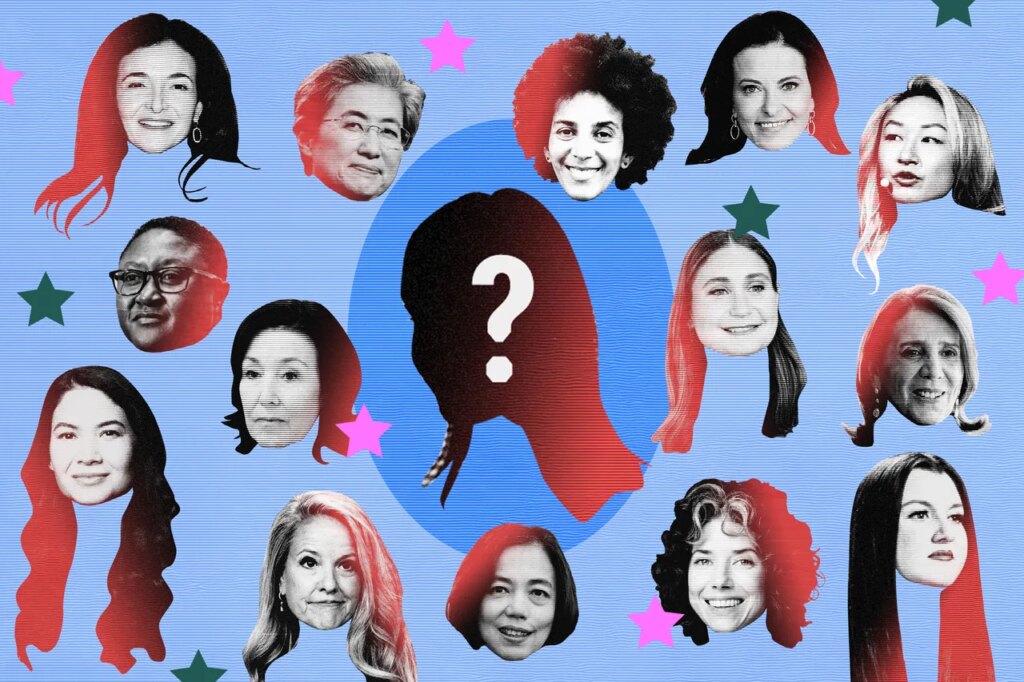
Here’s a non-exhaustive list of powerful women, sourced largely from other women in tech: Gwynne Shotwell, Lisa Su, Michelle Zatlyn, Fei-Fei Li, Safra Catz, Meredith Whittaker, Melanie Perkins, Fidji Simo, Jayshree Ullal, Reshma Saujani, Tekedra Mawakana, Aicha Evans, Ruth Porat, Dina Powell McCormick, Sarah Friar, Amy Hood, Colette Kress, Rachel Whetstone, Liz Reid, Sarah Guo, Theresia Gouw, Timnit Gebru, and Mira Murati. Laurene Powell-Jobs, MacKenzie Scott, Melinda Gates, and Cari Tuna, if you consider the origins of their immense wealth. Kara Swisher, if you count lambasting tech bros.
And one name that came up more often than most: Daniela Amodei.
Amodei is arguably the most important person at Anthropic, the nearly $1 trillion “startup” that has created some of the most powerful large language models. She’s also one half of the Amodeis. Her brother, Dario, is CEO and a cofounder. His novella-length encyclicals on AI and nutty-professor mannerisms have captivated people in the industry and the press that covers it. Either he or the savvy communications professionals behind the duo have positioned the Amodeis as cherubic foils to a Machiavellian Sam Altman.
Given tech’s long record of power imbalances, I was curious how the benefits of the AI future will be distributed across genders. Amodei was more than happy to discuss this with me over Zoom in early August. The number one thing she tells people, she said, is: “Do not let AI become a tool that’s just for the guys. It’s our job, and the job of other model providers, to not make this technology gendered, right?”
Anthropic has a remarkable number of women in its leadership ranks. Its chief product officer, chief people officer, head of public policy, head of design for Claude, head of platform engineering, head of product for coding, head of product for research labs, and head of “personality alignment” for AI models (yes, that’s a thing) are all women.
(More recently, another woman close to Anthropic has emerged as something of a power player. According to The Information and The Wall Street Journal, Dario’s longtime partner, Cami Clark—who reportedly tried to get Jeffrey Epstein to invest in her porn company—was instrumental in connecting him with some of Anthropic’s early financial backers.)
In a June interview with Bloomberg’s Emily Chang, the Amodeis revealed that Dario largely sidesteps having direct reports, while Daniela runs the day-to-day operations. All of the leadership team reports to Daniela. “That sounds like a pretty sweet job,” Chang said to Dario, her brows raised. “It’s incredibly freeing,” Dario replied, with his trademark enthusiasm. “It lets me do all the things that I do, much more easily than I would otherwise.”
“And she does all the work?” Chang replied. Dario faltered in his response.
I asked Daniela what she makes of Chang’s points and the responses they elicited. (“I saw that interview, and it just showed me how much Dario thinks he’s a special boy,” a friend in one of my group chats fumed.)
“Dario and I very much run the company together,” Amodei insisted. “I think everyone who knows the company really well or works here knows it’s a two–person ship.” She believes it would be hard for one person to run a company at the “level of consequence” of Anthropic.
Daniela has amassed considerable financial, intellectual, and cultural capital. She is not, however, the face of Anthropic’s political agenda. That’s her brother and, more recently, Anthropic cofounder Tom Brown.
“I worked on Capitol Hill before, and I know enough to be dangerous,” she told me. “I do go to Washington, and I think it’s a matter of what’s happening in the headlines versus behind the scenes.” She engages on topics like trust and safety or how AI will impact future generations—things viewed “not necessarily as the most sexy,” she explained.
And who arbitrates the “most sexy” issues in artificial intelligence? We already know the answer to that.
With her fleet of women executives and her stated ethos of non-gendered AI, Amodei may emerge as a historic figure in Silicon Valley, depending on the fate of her company. What she’s built may signal a new era of corporate culture and achievement for women. But when I asked other people if the AI boom presents ample opportunities for women, their outlook was less rosy. Bracy, who wrote World Eaters, flatly said, “No.”
THE AGITATORS
They’re not afraid to call out tech’s failings
Gebru told me that “the AI industry is worse for women than whatever the tech industry was in the 2010s.” People still don’t want to listen to women, she said, and many of the most hyped companies are still led by men.
She is correct. Outliers like Amodei and Shotwell are the industry’s high- profile heroines. They’re also complex examples of power. They are operational masterminds and the steady hands guiding the men in charge, much like Sheryl Sandberg was.
I thought about the powerful figures now schlepping to DC on a regular basis to try to bend the ear of a man and his army of acolytes who regularly minimize and degrade women. A few names on that non-exhaustive power list jumped out at me as women who aren’t afraid to say exactly what they’re thinking, consequences be damned. Significantly more women told me it’s not worth it to post their politics on X or to say the spicy truth in interviews or to try to be a podcast bro. It would compromise their focus on the work.
Women now possess all kinds of capital, which is in itself remarkable. But they are choosing not to fully enter the matrix. And really, why would they? What awaits them on the other side?
Gebru was still going, and now she flipped my question on its head. “How successful women are in AI is not my measure of power or success for women. Why do women have to join the terrible thing men are doing? They’re accelerating harm. They’re talking about littering the world with data centers. The kinds of arguments I thought were fringe, like AGI, they’ve mainstreamed.”
“What does power mean? Does it mean you have to trample on your own people in a terrible system in order to succeed in your career?” Gebru said to me over the phone.
She was sitting somewhere outside, in Boston, and kids were shrieking in the background. At one point she apologized for the noise and asked if I could hear her. I assured her I was listening.
Photo-illustrations: WIRED Staff; Getty Images; Rachel Whetstone: Shutterstock; Colette Kress: Courtesy of Nvidia
Let us know what you think about this article. Submit a letter to the editor at [email protected].
The post The Search for Silicon Valley’s Most Powerful Woman appeared first on Wired.