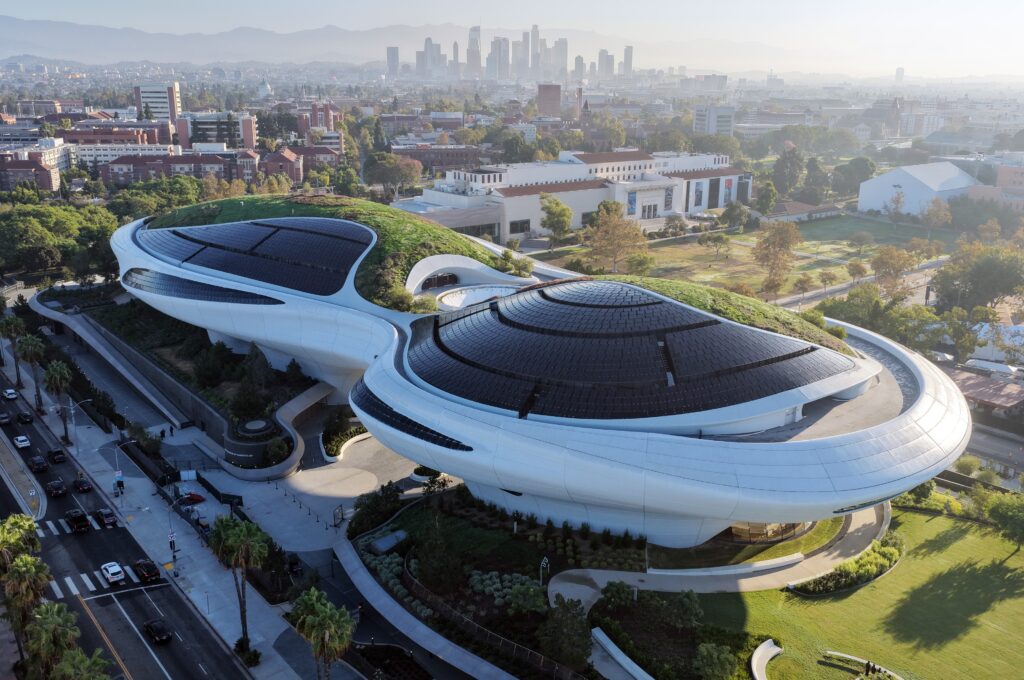
LOS ANGELES — The Lucas Museum of Narrative Art, a colossal pet project by the man who invented the Star Wars franchise, makes no apologies for looking like a spaceship arrived from outer space. Co-founded by George Lucas and his wife, Mellody Hobson, the soaring biomorphic structure designed by architect Ma Yansong’s firm MAD displays Lucas’s vast and motley personal collection of figurative art. The museum, which opens to the public Tuesday, reportedly cost somewhere around $1 billion, and given the eccentric form and size of the building (more than 300,000 square feet), and the amount of art inside (a dizzying mix of ancient relics and reproductions, a few Renaissance and baroque paintings, and great heaps of the finest dreck), it’s easy to believe that eye-popping figure.
The curvaceous structure clad in white polymer tiles grows out of the ground like two interconnected and slightly antiseptic space-age mushrooms raised above a 13-acre park. It feels both playful and ominous, as if it might disgorge aliens of unknown temperament and purpose, and it will likely inspire similar feelings in the art world — bemused condescension and unease. My conclusion after spending several hours there last week: Lucas has brought the history of the Western art museum to its inevitable conclusion. Centuries of efforts to democratize the experience have come to fruition, in a gigantic, magnificent, messy, maddening absurdity.
That, however, is not the conclusion of one of the gallery guards who was on her second day of employment. “I’ve never been to an art museum before,” she told me. “I love it.” I believe her.
Lucas has said that the museum “was created to honor humanity’s stories and the artists who illustrate them.” Senior curator Ryan Linkof refined that a little more: “I think that term ‘illustrates’ is really important for us,” he told me. Not tell stories, but illustrate stories. The story comes first, and the art serves the story.
That distinction dissolves old boundaries, between illustration and art, draftsmanship and artistry. For centuries, great artists were admired for their power of invention and their faithfulness to nature; in the 20th century, the focus was on formalism and, later, conceptual twists and aesthetic alienation. Now, Lucas posits a new standard: Good art makes clear the primal narratives of life, often preexisting or articulated by others. Which is a definition particularly serviceable to a moviemaker dependent on legions of illustrators to realize his narratives.
But “narrative art” turns out to be a capacious, amorphous and unwieldy category. There are galleries devoted to comics, manga, science fiction and fantasy. Beatrix Potter’s rabbits and Maurice Sendak’s monsters rub shoulders with works by Andy Warhol and Frida Kahlo. Portraits of women smoldering with Pre-Raphaelite beauty are chockablock with bare-breasted ladies in minimal G-strings, fighting off giant birds of prey on faraway planets.
The primacy of illustration also sidelines the moral, ethical and cultural content of the story. The issue is not the message sent, but how well the message is drafted. Galleries devoted to family life, childhood and community are dominated by the work of the phenomenally skilled magazine and storybook illustrators of the early and mid-20th century. With a few exceptions, this is a relentlessly patriarchal, heteronormative and often misogynistic world dominated by fair-haired, prosperous white people. Little boys dream over books, imagining themselves on horseback in shining armor; little girls make pie and cut out paper dolls.
Narrative art, it seems, is also entirely disconnected from history, which is both maddening and bewildering.
“We just highlight the artist, the date, the medium,” says museum CEO Tracey Bates of the minimal “tombstone” wall labels. “That’s very purposeful,” she adds, because the art is meant to be a self-contained experience, a story “in one frame” and “not a history lesson.”
No museum I’ve ever visited is so committed to the anti-intellectual proposition that art is about feeling and experiencing, not thinking. If you divorce art from history and context, devalue the artist’s power of invention and idiosyncratic insight, and privilege only draftsmanship, any effort to distinguish between good and bad art — art that elevates and art that degrades, art that provokes and art that merely affirms — is moot. I suspect Lucas would happily agree.
So, the museum wants to say good riddance to all the old hierarchies, categories and distinctions, while collecting only the best of its new category, narrative art, which seems to be anything that feels cinematic to Lucas. That demands we take a second look at a lot of art that has been unfairly overlooked or devalued. N.C. Wyeth, patriarch of the Wyeth clan, was a fine artist who produced serious, substantial paintings along with a lot of overblown, high-spirited storybook fluff. Norman Rockwell helped make America’s conscience visible to itself during the civil rights years, and he painted reams of towheaded boys and cherry-cheeked girls being adorably middle-class. The recommended daily allowance of paintings by Maxfield Parrish is probably less than one, but taken in moderation their psychedelic haze of gold and purple will make you purr like a kitten.
Representational art was beleaguered in the 20th century, by critics committed to abstraction, conceptualism and a morbid fear of the finer emotions. It’s good to see artists who resisted the straitjacket of ideology given the respect they deserve. The gallery devoted to comics could be a museum unto itself. I was thrilled to see what appeared to be a hand-annotated original of Walt Kelly’s “Pogo” classic, “We have met the enemy and he is us,” and a 1908 panel from Winsor McCay’s deliciously surreal comic “Little Nemo in Slumberland.”
Fortunately, the museum reflects more Lucas as rapacious collector than Lucas as dogmatic advocate of narrative art. There is portraiture in abundance, despite the images having no apparent connection to any obvious narrative. In the photograph galleries we see prints including Dorothea Lange’s “Migrant Mother” and Steve McCurry’s haunting portrait of Sharbat Gula, the National Geographic cover shot known as “Afghan Girl.” There are stories to be told about the people in these images, but no stories inherent in the images themselves.
But they are famous, and at some point you realize that Lucas doesn’t just want a comprehensive museum of images that illustrate stories, he wants to own as many icons of representational art, especially ones that circulate in popular culture, as he could possibly acquire. Lucas may be the billionaire demiurge of Star Wars, but as a collector he functions more like the intergalactic Mega Maid from the Mel Brooks parody “Spaceballs,” hoovering up the planet.
Perhaps it’s inevitable that someone who has been so greatly celebrated for so long would be drawn to artworks that function as celebrities within the larger world of visual culture. Lucas’s deep pockets have allowed him to collect an astonishing pantheon of disparate but recognizable images, and that almost guarantees that this museum will be successful. He has an archive of original drawings from Judy Baca’s “Great Wall of Los Angeles,” along with architectural fragments bearing original works by Banksy. Devotees of the various subcultures of art gathered here — westerns, pulp fiction covers, Star Wars paraphernalia — are likely to find some of the most important or influential material well represented.
But if you believe that art is meant to do more than tickle the eyeballs and warm the loins, you will walk away more than skeptical of Lucas’s agenda. There are some 1,300 works on view and the treacle, the clichés, the repetition and the limited ambition of too many of the artists become overwhelming.
And that impatience will prompt a question: Don’t the stories themselves actually matter? Many competent artists have devoted their career to political messaging and propaganda, and Lucas has collected samples of that, too. Some of it is conventional patriotic stuff, and much of it comes from the political left, including protest art. But given Lucas’s definition of narrative art, what would preclude Nazi imagery, the “children, kitchen, church” images that celebrated racial purity? The galleries devoted to Everyday Life and Civic Life are stuffed with American works that would be hard to distinguish from sugary genre scenes of Germany in the 1930s.
Lucas’s museum offers a second chance for some highly skilled artists whose work is more familiar than their names. Stevan Dohanos and John Philip Falter, both contributors to the Saturday Evening Post, produced a mixed bag of work, dutifully reinforcing the values of American mid-century conformity — and yet there are occasional glimmers of subversion, or détournement.
But if this giant spaceship of a building suddenly took off and visited another galaxy, aliens inspecting the cargo would be left with a very confused sense of what narrative art is, and what it is meant to do. Lucas is a fan of Joseph Campbell (whose oeuvre is on sale at the gift shop), especially Campbell’s idea of basic mythical structures that are transcultural. But the real interest in the vast majority of the work on display is its particularity, the abundant sociological, historical and political detail — all the things the museum serenely disdains to explicate in its minimal wall labels.
Beyond that, the aliens might admire the craft on display, and conclude that narrative art was a tool, for something, but what?
And finally, they would probably conclude that our planet was awash and perhaps drowning in stories, and perhaps this ship was a scow, off-loading the excess.
We don’t need more stories; we need better ones. We need less entertainment and more disruption. Perhaps anything can rise to the level of art, but art should rise yet higher. The pleasure of museum-going isn’t about recognizing what you already know, it is discovering what is new.
The vast majority of what Lucas calls narrative art is simply rearranging the familiar, the comforting, the recognizable into slightly new forms that satisfy the mind the same way the smell of turkey on Thanksgiving satisfies the nose and fireworks on the Fourth of July dazzle the eyes and ears.
Which is why this museum will be extraordinarily popular and successful, and pose an intellectual and existential challenge to museums with more substantial ambition.
The post Is George Lucas’s colossal pet project the end of the art museum as we know it? appeared first on Washington Post.