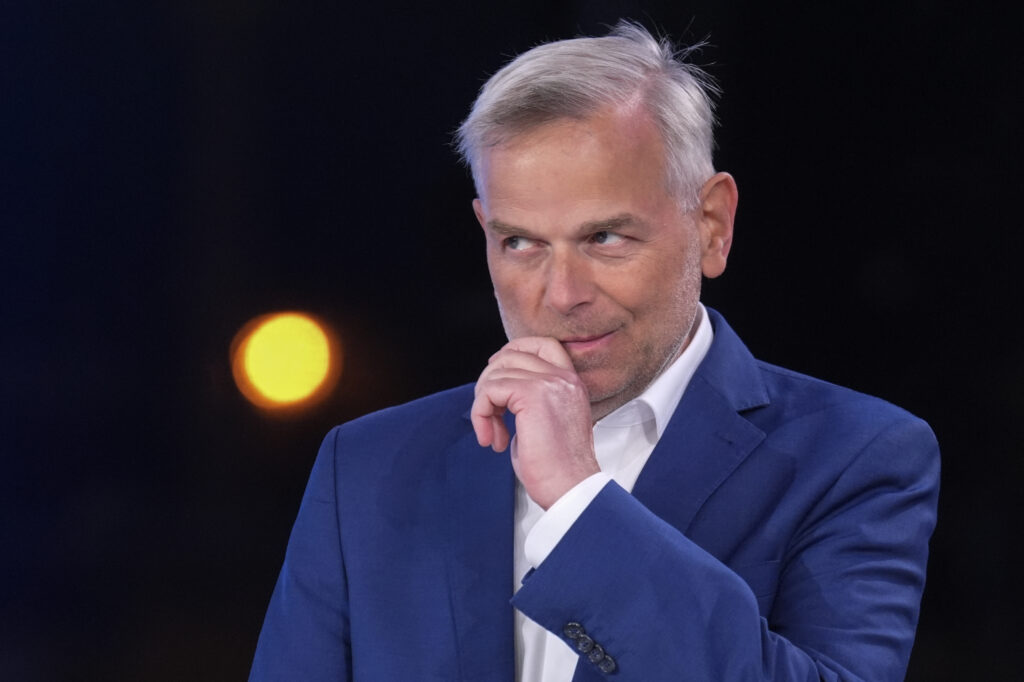
Tomasz Kurianowicz was editor in chief of Berliner Zeitung from 2022 to 2025. He is now a freelance writer living in Berlin.
In Sunday’s elections in Mecklenburg-Western Pomerania, the far-right Alternative for Germany (AfD) won around 38 percent of the vote, more than twice its share in the last election there. To the south, in Berlin, the Left, descended from East Germany’s former ruling Communist Party, emerged as the strongest party citywide, while the AfD also made significant gains. In Berlin’s eastern borough of Marzahn-Hellersdorf, for example, the AfD was running above 30 percent in the borough assembly election as results came in.
These are radically different parties. But their success points to a reality that Germany’s political establishment has struggled to understand: More than three decades after reunification, East Germany retains a political and cultural identity of its own.
It took me years to understand that.
When I applied for a job as a culture editor at the Berliner Zeitung in 2020, the fact that it was an East German newspaper meant little to me. I had just earned a doctorate in literature from Columbia University in New York. The pandemic had begun, and I needed a job. Though I am the son of Polish immigrants, I was born in Bremerhaven in 1983 and am also very much a product of West Germany. Thirty-one years after the fall of the Berlin Wall, I assumed the cultural differences between East and West Germany no longer mattered much. It seemed like yesterday’s debate.
I took seriously the idea that where people come from shapes how they see the world. I believed in a central insight of identity politics: If you have not lived someone else’s experience, be careful about telling that person what the experience means. I sought out immigrant and queer voices because I believed their experiences could offer perspectives that others could not simply reproduce. Yet I never applied that principle to East Germans.
I began to understand what I was missing after becoming editor in chief in 2022, often through arguments with my East German colleagues and the newspaper’s East German owners, Holger and Silke Friedrich. Germany’s liberal media culture, of which I considered myself a part, had become increasingly sensitive to Turkish, Polish or Arab identities. But recognizing an East German identity made us uncomfortable. Hadn’t reunification been about overcoming precisely that distinction?
During the pandemic, many of my East German colleagues reacted to government restrictions with a suspicion unfamiliar to me. They distrusted the state more readily; I was more inclined to trust medicine, science and institutions. Russia’s invasion of Ukraine made the divide even harder to ignore. Given my Polish background, I struggled to understand why some of my East German colleagues were so skeptical of sending weapons to Ukraine. We argued. They did not convince me. But our arguments started to change me.
Many saw Russia through a different history: one in which the Soviet Union had been an occupying power and political hegemon, but one in which Russians had also been neighbors, colleagues and friends. I did not have to share their conclusions to understand where they came from. That distinction — between understanding a political position and accepting it — seems obvious to me now. It did not then.
The same was true of memories of the German Democratic Republic. The GDR was a dictatorship. But for millions of people, it was also where they spent their childhoods, fell in love, raised families and went to work. A person can reject a political system without rejecting the life lived within it.
I had to learn all that. The AfD did not.
When AfD politicians embrace East German symbols — riding an old GDR Simson motorcycle through Saxony-Anhalt or singing the GDR anthem — they are making a simple offer: You do not have to apologize for where you come from. The AfD’s strength in eastern Germany has much to do with its economic populism. But people do not vote with their wallets alone. They vote with their memories, their pride and their desire to be seen.
This is what Germany’s liberal establishment missed. We had spent years learning a political vocabulary built around biography and representation. We understood that majorities should be careful about telling minorities how to interpret their own lives. Yet when it came to East Germans, we often did exactly that.
Sunday’s results underscore this story rather than complicate it. There is no single “East German vote.” In both Mecklenburg-Western Pomerania and Berlin, the post-Communist Left and the far-right AfD — parties that could hardly be further apart politically — found substantial support among voters in the former East.
These results are a reminder that eastern Germany still has a political history, identity and set of experiences that cannot simply be folded into a generic German mainstream. I am not convinced Germany’s political center has learned this lesson. During the 2025 federal election campaign, Friedrich Merz traveled through eastern Germany. Yet he didn’t sit for an interview with my paper — or any of former East Germany’s other leading newspapers. Nor did his campaign engage with a growing public debate over whether reunification had left East Germans feeling culturally marginalized and misunderstood.
For now, Merz remains chancellor. In Mecklenburg-Western Pomerania, his Christian Democrats fell below the 5 percent threshold with 4.9 percent of the vote — a historic setback for a party that has shaped the Federal Republic since its founding.
I managed to correct my misconceptions about eastern Germany. I’m afraid Germany’s political establishment is running out of time to correct its own.
The post I ran a German newspaper. Here’s what I got wrong about East Germans. appeared first on Washington Post.