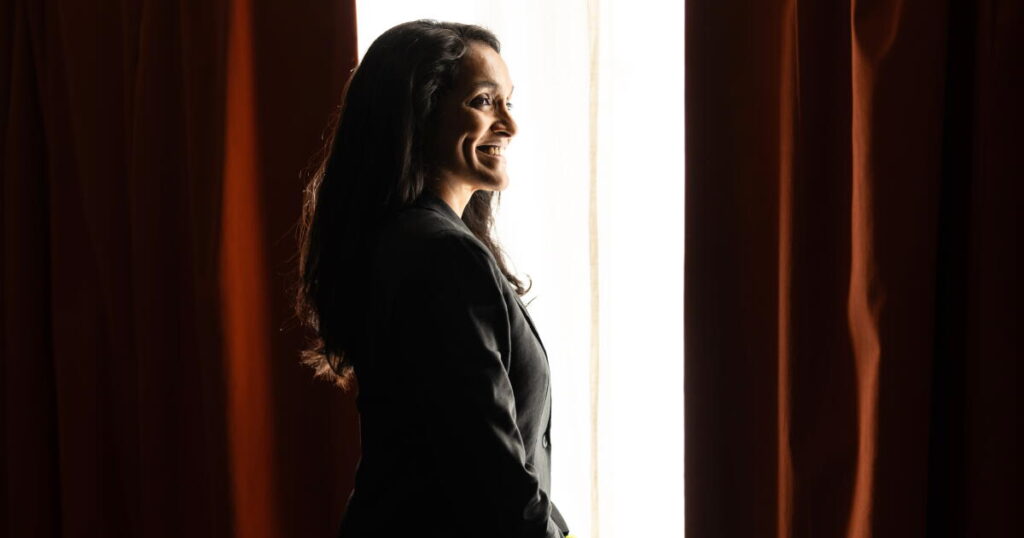
Nithya Raman, 45, has served on the Los Angeles City Council since 2020, when she defeated incumbent David Ryu to represent a district that includes Los Feliz, the Hollywood Hills and Sherman Oaks. She was reelected in 2024.
Born in India, Raman moved to the U.S. at age 6. A graduate of Harvard with a master’s degree from the Massachusetts Institute of Technology, she started a homelessness outreach nonprofit after moving to Los Angeles.
On the City Council, she passed significant legislation around tenants’ rights and rent stabilization and chaired the council’s Housing and Homelessness Committee starting in 2023, but lost that position in a council shakeup this summer.
Raman’s last-minute entry into the mayoral race alienated many of her council colleagues, who have almost unanimously endorsed Bass. This interview has been edited for length and clarity.
The Times: What do you feel, since you joined the council, has been your biggest accomplishment?
Raman: Probably leading the the tenant protections over the years has been my biggest accomplishment. Coming out of COVID, we passed Universal Just Cause eviction protections. We passed increased relocation support. We created a floor under which you could owe rent but not be evicted. And it was a big change in renter protections. We also created a database mandate where landlords had to tell the city when they were evicting someone. Council offices and the city were actually able to do for the first time, proactive outreach to someone who had received an eviction notice, ideally being able to say, “Hey, if you’re facing eviction, because you owe some rent, we have programs that might be able to help you.”
The Times: So, conversely, what is Karen Bass’ No. 1 failure as mayor?
Raman: There are a lot of issues that I could point to that have to do with the lack of management over our departments or our fiscal mismanagement that has led us to a point where we can’t fix a streetlight for a year in L.A. But I think the thing that made a lot of people lose faith in her leadership was her response to the Palisades fire: the lack of preparation in advance and the inability to meet that moment as a leader during the crisis, and then afterwards, how inexcusably slow the response has been, or the recovery has been.
The Times: What would you say your biggest mistake has been since you got to City Hall?
Raman: I think my biggest fumble was how I handled my efforts at ULA reform [Measure ULA is the so-called mansion tax].
I spent a lot of time behind the scenes working with leadership of the ULA coalition, but not enough members of that coalition. So I talked to three or four people, over many, many, many months, more than a year, about what I thought were the unintended consequences of ULA and why, as someone who believes L.A. needs to build more housing, that the mansion tax needed reform. And then hit a wall, which was the deadline for placing it on the June ballot with other things coming up in Sacramento — real threats to the power of transfer taxes, to the power of our city to have transfer taxes at all.
I just had not done the work to build the support for that reform measure in the way that I should have. I generated a lot of confusion and unnecessary friction as a result.
The Times: You mean within council and outside?
Raman: Yes. Everywhere. Within the council, outside of the council, amongst many of my allies and friends, that I didn’t need to if I had done that outreach process better.
The Times: Before you announced you were running, you endorsed Bass. Why?
Raman: As a council member, you rely on your partnership with the mayor to get things done in the district. And with this mayor, that has been particularly true because her fiscal decisions have reduced resources at the city so much, that in order to get what you need for your district, you really need to work with her office to prioritize scarce resources, so that you can get access to what you need to solve big problems.
I was in the mode of being a good council member and trying to fight for my constituents and endorsing the mayor is part of that.
The Times: Back in 2020, you tweeted during your campaign, defund the police. Did you ever believe that? And if so, what changed?
Raman: My thinking has changed on this issue. That has been visible in my votes on the council. I have voted for multiple budgets that have maintained our police staffing, sought to expand our police staffing. But I’ve also spoken up when I felt like raises being provided to police officers unbalanced our budget so much that we wouldn’t be able to provide other essential services across the city, including things that are essential for public safety like streetlights and 911 call operators.
The Times: So what caused you to change your mind?
Raman: Understanding the finances of the city and how budgeting works in the city. And understanding also that ensuring that when someone calls for help in Los Angeles someone from the city has to show up in a timely fashion and help them with the call that they made, without which, people lose faith in their government.
The ability of the city to respond to someone’s pleas for help is incredibly important in ensuring that we maintain the trust of the public. And right now, there is no alternative system besides LAPD to respond to many of the calls that are coming into 911 besides, of course, fire department calls. Ensuring that people are able to trust the city and have faith in the city is really, really important.
The Times: You said in February that LAPD should not get any smaller. But since then, it’s lost another 200 officers and is down to 8,500. As mayor, would you bring the force back to 8,700?
Raman: I think that we need to have enough people to be able to respond to calls and I don’t think it should be shrinking indefinitely. We are not building out an alternative system to respond to calls.
We need to maintain our staffing, but, you know, we’re also having new recruit classes all the time.
The Times: Do you have broadly a number [of LAPD officers]?
Raman: I had a number when I said it, which was the number that we had, 8,700. It really depends on how do we make sure that we’re responding to calls for service? How do we make sure that when you’re calling 911 and armed officers are the only option to be able to show up, that they’re showing up in a timely fashion? And that analysis is something that we absolutely need to do. How do we think about deployment so that people are showing up when people call for help, and also that they’re able to do the investigative work, to address some of the most egregious issues that our neighborhoods are facing.
The Times: Pivoting to homelessness. In your district, you’ve had locations where encampments are cleared, but then they repopulate. What do you think is the main cause of the repopulation?
Raman: We haven’t had that many.
The Times: So what do you think brings people back?
Raman: If a tent pops up here and there, it’s nowhere near those huge encampments that were there either during COVID or even afterwards.
The Times: Franklin and Cahuenga has repopulated at times. What do you think is causing it?
Raman: There are definitely places in Hollywood. Hollywood is a hot spot for homelessness. If there’s a cleanup somewhere else, they’ll move across the street. … But in most of the areas where we’ve had huge encampments, like, we had a huge encampment at Rodney and Hollywood, which is also the Los Feliz/Hollywood area. Berendo and Hollywood, no tents there. Lyman in Hollywood, no tents there.
I drive around the district a lot and sometimes stop by at different places. There’ll be, like, one or two people there, but our team is out there working with them, and they’re usually able to get in the queue and get back indoors. Homelessness exists in Los Angeles that is concentrated in places like Hollywood and Skid Row and the beaches. And I think those areas have a lot of people, they move around, and so some of the encampments in those areas may repopulate.
The Times: If a person is living on the sidewalk or just hanging out on a sidewalk and they’re in front of a business, or a home, or a school and they’re shooting up with a hypodermic needle, should the city respond? And if so, what should it do?
Raman: Something that San Francisco is trying, which could be an effective model here, is to have outreach workers and police taking them to a location where they’re not arrested, but they’re taken to another location, offered services.
I think that kind of response could be an appropriate response. I’m hopefully finding out more details about that response now, but it does feel like they’ve done a lot more coordination in San Francisco, around hot spots like that, so that they’re able to use every possible avenue to address people who have substance-use issues.
They’re responding with outreach, they’re responding with physical presence on the streets, they’re responding with security from BIDs [Business Improvement Districts], and they’re responding with fire and they’re responding with police. It has to be a whole-of-government approach to address those kinds of issues.
The Times: What if that person says, no, they don’t want to be moved.
Raman: People move. If it’s [the police] they will move or they get tickets, or they get arrested. There’s always pathways. I think when people talk about not wanting to criminalize homelessness, the policies there are really around not punishing people for not having a home, not wanting to arrest people for being on the streets.
LAPD is able to operate and enforce the laws across whatever range of laws exists here in Los Angeles for other issues. That is their role.
The Times: What was it like as a council member, participating in the Democratic Socialists for America co-governing process? And what do you think it would look like as mayor?
Raman: We have a number of groups that we work closely with in government. I see the DSA as a partner for a lot of the work that we’ve done. They’ve been a strong partner of the tenant protections that I helped pass and were a huge voice for charter reform, including some of the things that didn’t happen.
I will continue to welcome their partnership and will always work alongside organizations that are active in Los Angeles and are trying to shape the city — as I work with many, many other organizations here in L.A. and to me, that is what it means to be a good elected representative.
The Times: But does it make you uncomfortable, the way they speak about co-governance, as if they endorse and then they feel that those representatives should be answering to them?
Raman: I think it clearly makes the news media uncomfortable, because they report on it all the time. But it doesn’t make me uncomfortable, because I’m responsive to all my constituents, whether I do exactly what they want or not.
I show up. I engage. Sometimes I make them very happy; sometimes I make them very angry. That’s part of what being an elected representative means. And I’m always grateful that I get a chance to do this and represent this big, fractious city with all these different people. It is what it is. It’s what you have to do as an elected representative.
The Times: Are you still doing co-governing now? Like, is that a thing?
Raman: With everyone, with everyone. Yes. with everyone.
The Times: Who do you think the best elected official in the history of L.A. is?
Raman: There’s pieces of different people that I take a lot of lessons from.
Tom LaBonge’s love for L.A. His obvious joy and enjoyment of being a representative of the city is something I aspire to, and I want people to feel that from me. Tom Bradley was a visionary in so many ways and I look to him for leadership on bridging different parts of the city together. I thought [Richard] Riordan’s efforts at charter reform were really masterful. I think [James K.] Hahn did an incredible job in keeping the city together during secessionary movements in ways that undermined his own success in the job.
I think [Antonio] Villaraigosa was, oh my God, a champion of the city: enthusiastic, out there, just loved being the mayor, loved L.A., loved every aspect, every neighborhood of the city, and that was just infectious, and I absolutely love that. Garcetti’s vision for transportation. He came in, two years in, passed Measure M, had a vision for how to transform L.A., and we’re seeing the fruits of that today. All of these are things that I really admire.
The Times: What do you think is the No. 1 thing that not enough voters know about you that they should?
Raman: The thing that voters should know about me is that this is the last office I want to run for. I don’t want to go to Sacramento. I don’t want to go to D.C.
I just really love L.A. I’m running because it feels like it’s really, really struggling right now. And someone needs to stand up and fight for the changes that can make it better. And so that’s why I’m doing it.
The post Raman says she’s running for L.A. mayor because the city is ‘really, really struggling’ appeared first on Los Angeles Times.