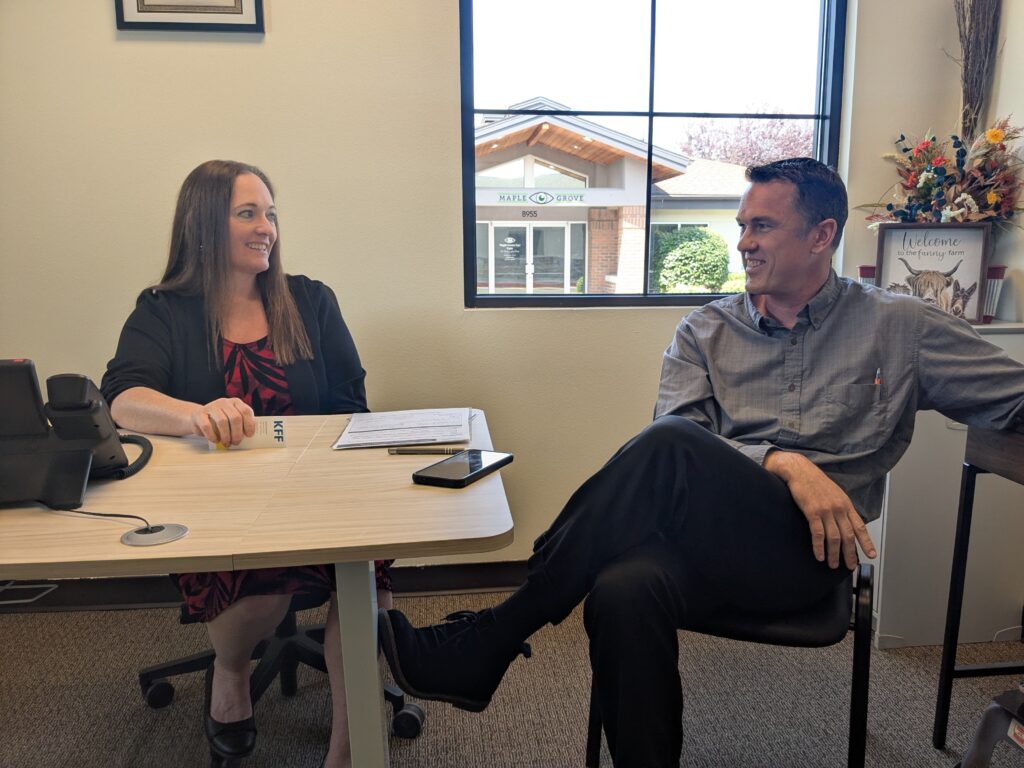
BOISE, Idaho — Joshua and Ashley Durham run a family medicine practice, and for the first time in their lives, they have no health insurance for their own family.
When the Durhams began their practice at the end of 2023 — he as a primary care physician and she as a pharmacist who handles billing — the couple bought coverage for themselves and their two children on the Affordable Care Act marketplace. But they said their monthly premiums for a similar health plan for this year rose several hundred dollars to nearly $1,600.
They decided to pay out-of-pocket for their medical expenses instead, leaning on $50,000 they had set aside in a health savings account over several years.
“It’s nerve-racking,” said Joshua Durham, 47. “It just takes, you know, one little accident, and then you got a big fat bill.”
A larger share of health care workers have health insurance than those in other fields. Nationwide, 7 percent of all health care workers were uninsured in 2024, compared with 11 percent of all adults under 65, according to a KFF analysis of the most recent American Community Survey data. And doctors were especially unlikely to forgo health insurance, with just 2 percent uninsured.
But even health care workers are feeling the pinch as health insurance costs rise each year, and employers expect that costs will jump an additional 8.2 percent for 2027.
The Republican-led Congress last year opted not to renew some Affordable Care Act marketplace credits, which were enacted during the covid pandemic. Subsidies remain in place for people with low incomes. The pandemic-era credits helped reduce many consumers’ premium payments, especially those working in small businesses such as independent medical practices. Nearly half of marketplace enrollees worked for small businesses or were self-employed in 2024; some of the most common occupations included chiropractic care and dentistry.
Jack Dillon, executive director of the Association for Independent Medicine, which represents 4,000 physician-led practices, said premium increases have become untenable for small businesses, whether employers seek coverage through the marketplace or directly from insurers.
“The cost has become so astronomical,” Dillon said. “You’re looking at it and saying, ‘What’s the value?’”
As health insurance continues to become less affordable, Dillon said, more health care employers may seek alternatives to their standard coverage, such as providing higher hourly wages or providing only minimal plans.
The number of people without insurance in the United States is expected to increase by roughly 15 million over 10 years because of the expiration of the expanded ACA subsidies and $1.1 trillion in estimated cuts resulting from President Donald Trump’s signature One Big Beautiful Bill Act, according to the Congressional Budget Office.
Healthier people are the most likely to opt out of insurance. That leaves insurance covering a smaller pool of people who tend to be sicker and need more expensive care. So insurers raise prices to cover the remaining enrollees, which fuels even higher premium costs.
‘Health care is a business’
Samantha LeGault, a nurse practitioner at a health clinic in Boise, said her employer-offered plan’s premium payment rose from $700 to $1,500 a month this year to insure herself, her husband and four of their children. LeGault has Crohn’s disease and two of their daughters also have medical conditions, so she said her family has no choice but to continue to pay for that health coverage.
But she decided to skip dental insurance to save money, and she prioritizes dental visits for her children over herself.
She had already struggled to set aside retirement savings and had switched her children from a private school they liked to public school to cut down on costs. Then the new health insurance costs tightened her budget even more. She estimated that about one-fifth of her income now goes toward her monthly premium payments.
“I know how the clinics work, that I am an expensive patient,” LeGault said. “At the end of the day, health care is a business in the United States.”
The Durhams have three other employees in their practice. Two of them receive health insurance through their spouses, Ashley Durham said. The Durhams said they pay $420 monthly toward the physician assistant’s premiums.
As a primary care physician, Joshua Durham said he doesn’t need regular doctor visits because he can diagnose and treat himself — and, if needed, the rest of his family, though he acknowledged that’s frowned upon. The American Medical Association’s code of ethics generally discourages doctors from treating themselves or relatives but makes exceptions for emergency situations or short-term, minor problems. Ashley Durham said she’s filled prescriptions for her family.
Arthur Caplan, a bioethicist and professor emeritus at New York University’s Grossman School of Medicine, said that as more people are “turning toward relatives because they can’t access or easily see a regular doctor,” it may make sense to revisit that aspect of the code of ethics.
Out-of-pocket expenses
Health care workers with less advanced medical certifications than the Durhams often don’t have the option of treating themselves or family members — or don’t have savings to fall back on for health care expenses. And many health care professionals, such as Jill Kordick, a 64-year-old retired health care executive in Norwalk, Iowa, aren’t willing to go without the safety net of insurance.
In her work, Kordick saw hospitalizations become financially devastating for patients, so she said she would never opt out of health insurance — even for the 16 months before she’d become eligible for Medicare at age 65.
Last year, she qualified for the enhanced Affordable Care Act tax credits, allowing her to pay $75 a month for health coverage. Her premiums rose to $800 a month this year when those subsidies expired.
Because she has a $10,000 deductible, she put off going to the doctor for weeks when she had a sinus infection this year, until it ultimately evolved into an ear infection. She said she regularly rethinks, and sometimes returns, nonessential groceries in her shopping cart. And she keeps her house’s thermostat at 80 degrees in the summer to cut down on air-conditioning costs.
Kordick said health care is a universal struggle in the United States, regardless of how familiar patients are with the industry. “It’s disheartening that it’s as broken and fragmented as it is,” she said.
The Durhams have seen the impact of unaffordable health care on their patients. They said they try to lend some leeway to patients when they can — a luxury they have, operating their own practice. In one case, Ashley Durham said, she wrote off $1,160 in bills for a single father whose son didn’t have health insurance rather than send their bills to a collection agency.
“It’s hard, because as a human I want to help them out,” she said. “At the same time, we need revenue for our office.”
Joshua Durham is more nervous about going uninsured than his wife. As a child, he witnessed his parents struggling to pay medical bills for their family of nine in south-central Idaho. Durham recalled that his father, who was a carpenter, helped build a surgeon’s house to pay for an operation.
Today, Durham also sometimes exchanges work for care. He said he gets free eye exams from an optometrist, who also forgoes health insurance, and offers him free primary care.
He worries about a worst-case scenario: a car crash, a sports injury, a serious diagnosis.
“Do I have pancreatic cancer today?” Durham said wryly.
So far, the couple has paid about $9,000 out of their health savings account for expenses this year including contact lenses, mental health therapy, and physical therapy for the thoracic outlet syndrome that affects Durham’s neck and shoulder. The expenses were higher than the Durhams anticipated. But they were still less than what their monthly premiums would have cost them.
Their decision has paid off, Joshua Durham said. At least for now.
KFF Health News is a national newsroom that produces in-depth journalism about health issues and is one of the core operating programs at KFF — the independent source for health policy research, polling, and journalism.
The post Even medical professionals are skipping health insurance because of high prices appeared first on Washington Post.