For all its national symbolism and historic weight, the John F. Kennedy Center for the Performing Arts was also a microcosm of life in Washington. Under its roof each night for decades, people found free concerts and black-tie galas, rap shows and operatic tetralogies. Tourists and D.C. residents — crowds who veered between over and underdressed — gathered at the arts center that was at once a grandiose memorial and a living cultural hub.
Following a 19-month effort by President Donald Trump to take control of the arts center, its board voted to close the building Tuesday as Trump, who has demanded his name be added to the institution, threatened to cancel a more than $250 million renovation. The president saidWednesday that without his intervention the building could be “ripped down.”
Earlier this week, we asked readers for their favorite memories at the Kennedy Center and received hundreds of responses. We heard stories from people who waited nine hours for “Hamilton” tickets; who worked as ushers; who stopped in several nights to visit Millennium Stage on their way home from work; whose lives were shaped by the art they witnessed and the people they met.
Here are some of their stories.
The introduction
As a 10-year-old, Vanessa Corcoran was part of a touring children’s classical choir that performed Mozart and Bach compositions at halls far from her hometown of Rochester, New York. Her trip to Washington finished with a performance at the Kennedy Center’s recently opened Millennium Stage.
She was meant to be focusing on the conductor, but her eyes kept drifting toward the grand Hall of Nations, the ornate chandeliers and the bronze bust of Kennedy that decorate the space. She recalled feeling her heart flutter.
“I just remember how stunning the building was,” she said. “It was my introduction to the city I would make my home.
Corcoran, now 40 and working at Georgetown University, had hoped to bring her 6-year-old daughter to the Kennedy Center someday. She hasn’t attended a performance there since before Trump named himself chairman in 2025, and is not certain she will again.
“I wanted to say, ‘This is where I sang.’”
The proposal
During her five years as a dancer for Suzanne Farrell Ballet Company, Ashley Harmon, 46, was used to getting paged back to the stage after a performance for directors’ notes. But one night in 2007, she returned to the Opera House stage to find, instead, her boyfriend down on one knee.
“The stage crew had stayed late to light him, which I just was so touched by because it’s a union shop so nobody has to do anything,” Harmon said. “But a lot of people were in on it to make it a wonderful surprise.”
She said yes.
The New Year’s Eve party
In his early 20s, Ben Tomchik was what he called “the lowliest of low” staff assistants in President George W. Bush’s White House. His boss knew he could not afford theater outings, so she made sure that whenever the box reserved for public officials was vacant, he could go in their place.
“I’ve told every boss I’ve ever worked for since leaving the White House: ‘No job perk will ever beat getting to go to the Kennedy Center,’” he said.
In later (and higher salaried) years, Tomchik, now 40, attended the Kennedy Center’s New Year’s Eve celebrations — first a musical, then a party with a jazz band, free-flowing champagne and a countdown to midnight. Tomchik recalled meeting prominent people there, from the lead actress in a “Wicked” production to a cabinet secretary.
“All of a sudden, the armor of D.C. fell by the wayside and we were all just theatergoers toasting in the new year,” he said. “It was so egalitarian. It was what a great arts institution does. It puts everyone on the same level.”
The field trip
Natasha Jackson, 48, can remember what she wore each time she went to the Kennedy Center: a flowing lilac gown, a pink dress with a light shawl and, when she went with her students, a simple black dress with white sneakers, which were better than heels for corralling kindergartners.
She didn’t see her first theater performance until she was in her 30s. She made sure her students in the Alexandria Public School system in Virginia saw theirs at 5 or 6 years old, through one of the center’s programs for youth.
“Hands-on learning is what’s important to them,” she said. “Being able to go to the play did so much for their social skills, but also academic skills. It was monumental. And it was free.”
The fight song
It was a Saturday in January 1988 — the day before Washington’s football team faced the Denver Broncos in the Super Bowl — and Kathleen Stine, 77, was at the symphony. She watched as Maestro Mstislav Rostropovich walked onto the stage, faced the National Symphony Orchestra and waved his baton. Then he turned to face the audience — as the NSO launched into the Washington team’s fight song.
“That had never happened before,” said Stine, a season-ticket holder. “The audience leapt to our feet in unabashed delight, practically screaming the words to the song.”
The team won the Super Bowl that year.
The wedding
Zachary Burt wanted a big wedding: nearly 200 guests, a swank 16th Street venue. But 2020 had other plans.
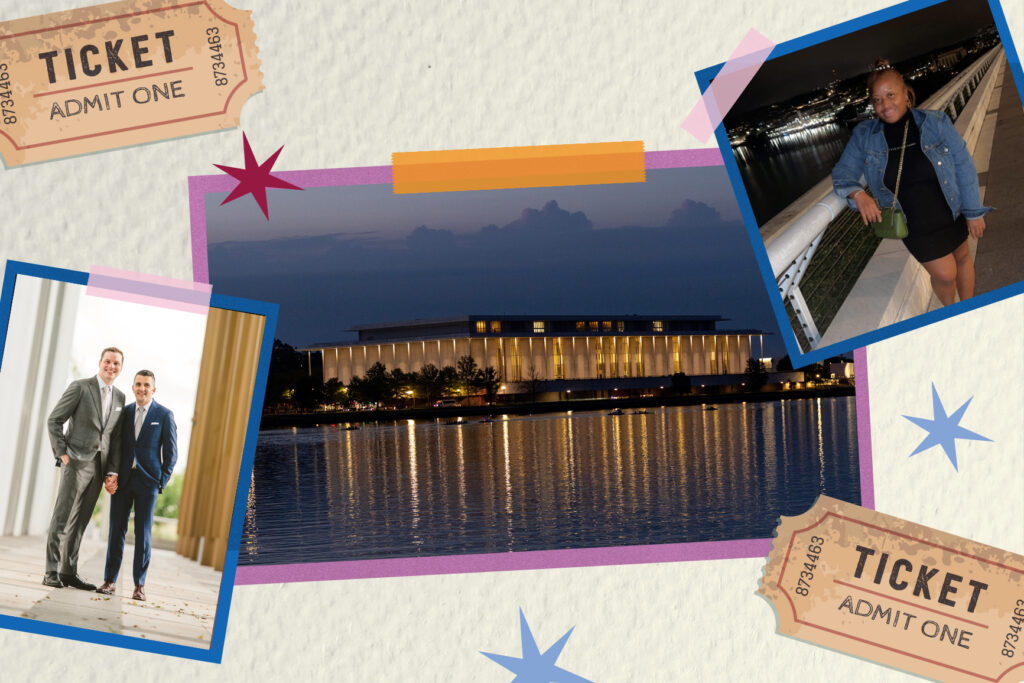
After postponing his wedding in June because of the coronavirus pandemic, he and his fiancé, Nick Hudak, didn’t want to wait any longer. They thought of venues where they could wed outside, in front of a handful of family and friends, that would be “very iconic Washington” — and chose the Kennedy Center’s terrace.
Today, the venue looks different than it did in their wedding photos. Because of changes under Trump, there are no more gold columns or wavering willows.
“When we took these pictures, I just kind of assumed these landscapes would be timeless and not change,” he said. “You know, this wasn’t some random event venue. This was such a fixture on the landscape here in Washington.”
The tears
After Bob Clark’s mother died in April 2018, he “plodded through the grief.”
“I had trouble processing the loss,” he said. He felt numb.
In the summer of that year, while attending a conference in D.C., Clark, 59, decided to go alone to a touring company performance at the Kennedy Center of “The Color Purple.” He sat in a balcony section surrounded by women in what he described as their Sunday best.
By one of the final numbers (“I’m Here”), he was crying — “a big, massive, ugly cry,” he said. “And then I realized that all the women who were around me were having the same experience for all sorts of different reasons. It was this incredibly human shared moment among strangers.”
Afterward, they went onto the balcony, hugged and laughed at themselves, he recalled, before going their separate ways. “It was really a very powerful moment that helped me personally,” he said.
The walk home
In more than 15 years of attending performances at the Kennedy Center, Krystal Ramirez, 38, has a clear favorite: Grammy-winning rapper Kendrick Lamar performing with the National Symphony Orchestra in 2015. The show was the kind of nontraditional novelty — pairing rap and classical, especially more than a decade ago — at which the center excelled, Ramirez said.
Growing up as a low-income, first-generation child, she watched “Great Performances,” the PBS arts anthology series on television and dreamed of attending shows at the Kennedy Center. She reflected on that past during her walk home to Rosslyn across the Francis Scott Key Memorial Bridge after the show in 2015, replaying the encore (“Alright”) in her head.
“It was uplifting and frankly, sort of fitting for this moment of, yeah, I hope that we’re gonna be all right,” she said.
The exit
Nathan Pugh, an Alexandria native, grew up attending Kennedy Center performances with his grandparents. But none were as impactful as a touring production of the musical “Hedwig and the Angry Inch” in 2017 — a show that pushes boundaries on gender and sexuality.
“It totally rocked my world,” he said, recalling what it meant to him as a gay teenager. “I don’t think everyone in the audience was thrilled to be watching that, but to me it was so formative and powerful. It gave me the language to talk about myself.”
It was the type of performance Pugh, now 27, hoped to support at the arts complex after he began working there in 2022 as a copywriter. But in 2025, Trump began attacking the center as “woke” and targeting its drag and LGBTQ+ programming. He resigned a month later.
“That’s when I was like, ‘I don’t feel comfortable working for you if this is the language you’re talking about my community with,’” he said. “That hastened my need to get out of there.”
The chandelier
Before the Kennedy Center opened in 1971 with the world premier of Leonard Bernstein’s “Mass: A Theatre Piece for Singers, Players and Dancers,” Patrick Ready spent hours listening to the maestro’s performers rehearse from the balcony of the opera house. He worked at the center as an electrician for over two years, and his eight-hour shifts with other specialists included tours of the facilities for repairs every two hours.
“Then we were free,” he said. “We read newspapers, watched TV or, if we had the day shift, go up and watch the rehearsals.”
Ready, now 86, also recalled a large crystal chandelier gifted by the Irish government that was delivered in hundreds of pieces, each carefully wrapped in newspaper. He and several other electricians carefully combed through the metal wiring and specialized circuitry before they were stopped by an engineering crew — the electricians would have to repackage all the pieces while the engineers reinforced the support system in the ceiling, which was deemed too delicate.
“If the building gets demolished, we picture the bulldozers going and just knocking everything down,” he said. “Here, this precious gift from a government, would be just falling down into the rubble.”
The post What Washington lost when the Kennedy Center closed appeared first on Washington Post.