State by state, gun rights groups have sought to chip away at bans on assault weapons.
This summer, New Jersey had longstanding limits, among the toughest in the country, tossed out after a federal appeals court ruled them unconstitutional.
The decision, which is paused for now, illustrated the emerging fight over the bans, months before the Supreme Court will consider whether state and local restrictions on the weapons violate the Constitution. It also demonstrated how, more than two decades after the federal assault weapons ban expired, the battle over gun control has moved solidly to states and localities.
The Supreme Court issued a landmark ruling in 2022 that effectively upended gun regulations across the country by establishing a new test for how courts should evaluate laws restricting firearms. Gun rights groups saw an opening to challenge more rules at the state and local level, including assault weapons bans.
Bans on assault weapons are only one category of gun regulation being challenged across the country. But the most immediate consequences would fall on the states that have already sought to limit access to some of the most lethal firearms.
Here’s a closer look at how states regulate assault weapons and how those rules are at stake.
Where all assault weapons are restricted
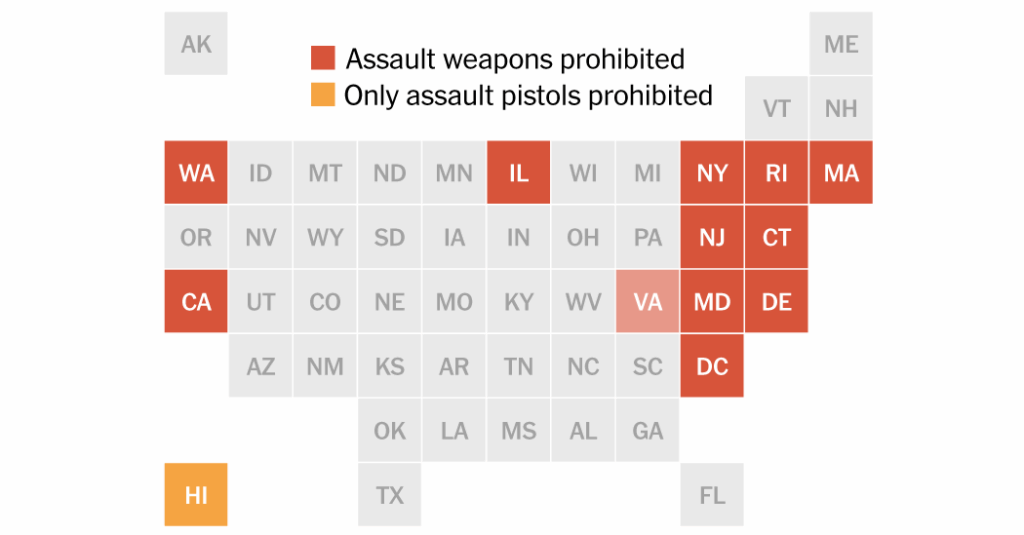
Twelve states and the District of Columbia have passed prohibitions on the sale of assault weapons. Most often, the laws are aimed at restricting semiautomatic rifles that can fire quickly, like an AR-15, but they can also ban handguns and shotguns. Depending on the law, an assault weapon is defined by its model name or a series of features borrowed from guns used in the military. The features include pistol grips, detachable magazines, flash suppressors and folding or collapsible stocks.
In some states, restrictions are already teetering. A federal appeals court ruled to invalidate New Jersey’s law, though it remains in effect until the Supreme Court rules. The decision by the appeals court would appear to threaten Delaware’s ban, if a challenge was brought in court. It was enacted in 2022 after mass shootings at an elementary school in Uvalde, Texas, and at a supermarket in Buffalo, N.Y.
Virginia’s law was enacted this year, and the Trump administration was among those challenging it at the federal or state level. A judge paused the legal challenges, and the law cannot take effect before the Supreme Court rules.
Where high-capacity magazines are restricted
Assault weapons are defined by features that make a gun easier for a person to carry and sustain fire at a rapid clip — the more quickly someone can fire off bullets, the more deadly the weapon.
That’s why states that have restricted assault weapons also limit high-capacity magazines, which store and feed ammunition to the firearm. A few states that do not prohibit assault weapons instead restrict the high-capacity magazines, which allow an assailant to fire more than 10 to 20 bullets before needing to pause to reload.
The Supreme Court has not indicated whether it will weigh in on the legality of restricting high-capacity magazines.
Where other kinds of gun ‘bans’ exist
Four states have passed laws prohibiting Glocks or Glock-style pistols, but California is the only state where the law has gone into effect.
Unlike restrictions on assault weapons, these prohibitions are new, brought on by the rise of switches, an illegal gun accessory that allows a semiautomatic handgun to fire at the rate of a machine gun.
Switches are small and often made of plastic, making them easy and cheap to manufacture. To curb their spread, some states have restricted the model of handgun that is easily modified by a switch.
The Trump administration has already sued California over its restrictions, arguing that “perfectly legal and safe firearms” should not be banned simply because they can be converted into illegal firearms.
The Supreme Court is expected to weigh the constitutionality of assault weapons bans in part by a standard that weighs how commonly they are used. Depending on how the justices rule, their ruling could affect how judges evaluate challenges to bans on the Glock, an Austrian-made pistol that has become a household name.
The post Tracking Assault Weapons Bans Across the Country appeared first on New York Times.