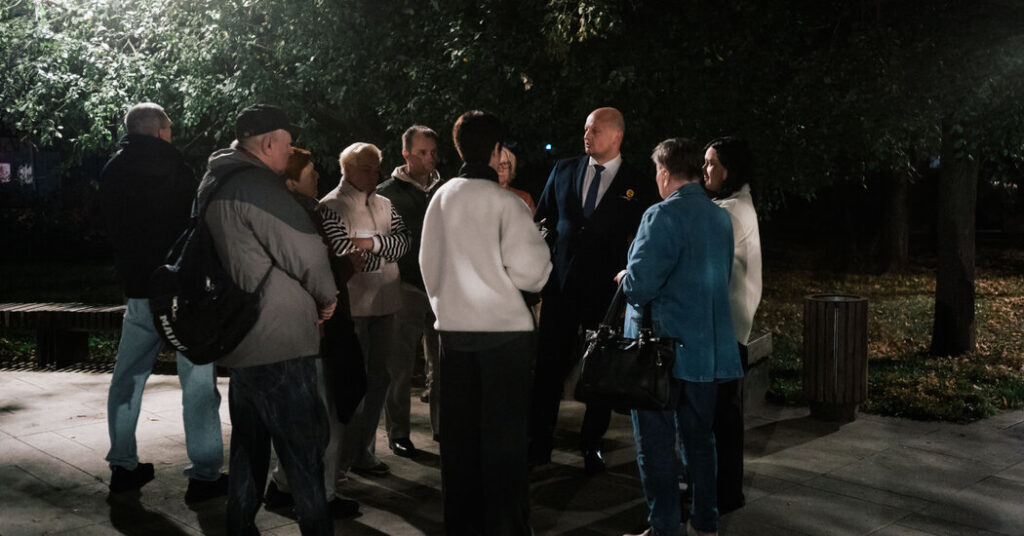
One candidate participated in Russia’s assault on Mariupol in the first months of the war in Ukraine. Another was part of the brigade accused of killing innocent civilians in the Kyiv suburb of Bucha. A third is a Kremlin-connected war correspondent who was wounded by a Ukrainian drone in 2024.
These are just a few of almost 1,600 candidates officials say are running in parliamentary, regional and local elections across Russia who are veterans of the war in Ukraine.
The elections, being held this weekend, are not going to be nail-biters. The Kremlin has carefully engineered the vote to minimize any real competition.
This year, the governing United Russia party amended its rules to make it easier for veterans, whom President Vladimir V. Putin has called the “new elite,” to get on the slate. It is an illustration of the wider militarization of Russian society, and the first high-profile test of how far the Kremlin is willing to go in empowering veterans in the country’s political life.
“Veterans bring an acute sense of justice” and responsiveness to ordinary citizens’ daily struggles, said Konstantin N. Rizhak, a candidate for the nationalist, socially conservative A Just Russia Party. He fought in Ukraine from October 2022 until July 2023.
He is one of roughly 200 veterans who are competing for spots in the State Duma, Russia’s lower house of Parliament, according to the head of the Central Elections Commission, Elena Pamfilova.
Giving a bigger platform to military elites carries certain risks: The main threat to Mr. Putin’s rule since the start of the war came from an uprising of mercenaries and military hard-liners who said he did not go far enough.
The Kremlin pared down its initial plans to put about 100 veterans in the Duma, which has 450 seats, a sign that the initial zeal for giving such a large platform to a group of former fighters may have been tempered.
Mikhail Komin, an analyst with the Center for European Policy Analysis and author of a recent paper on Russian veterans in politics, said that according to his analysis of the candidate lists put forth by the United Russia party, about 50 candidates are poised to win spots in the Duma.
The party has tried to balance battle-hardened former combatants with those who previously held managerial roles and then saw that a stint in uniform could improve their positions, Mr. Komin said.
“In mixing real combatants with ‘nominal’ combatants,” he said in a phone interview from Washington, the authorities were “deliberately trying to prevent any kind of autonomy from this potential political group in the Parliament consisting of veterans.”
But Mr. Komin said the presence of so many former fighters in the government could “put pressure on bureaucratic and business elites to demonstrate their loyalty to the military by extending tangible support for the war.”
A large, vocal group of veterans could become a powerful bloc to stymie a cease-fire or postwar reconciliation efforts, Mr. Komin argued.
Though Mr. Rizhak, the veteran candidate, is not from the governing party, he represents a group of Kremlin-preferred veterans who have high-level work experience and are not tying their candidacies solely to the war.
After being decommissioned because he has many children — Mr. Rizhak’s wife is currently expecting their eighth child, a seventh son — he returned to work at Russia’s state-owned nuclear energy corporation, Rosatom. He said his work experience was the reason people should vote for him, with his military service just one part of his background.
It is not a foregone conclusion that the wider populace will accept the veterans as the heroes the Kremlin has trumpeted them to be. Many Russians believe soldiers fought for personal gain and feel wary of the creeping militarization of politics. Others say they worry that a hard-line military bloc could pose political problems in the postwar future.
One potential voter, Marat, 31 — who asked that his surname be withheld because of fears for his personal safety — expressed deep hostility and cynicism toward veteran candidates. “Half are from prison, half are brainless,” he said during a smoke break near the liquor store where he works in central Moscow, referring to the military recruitment drives in prisons. He said he would not vote.
Mr. Putin called veterans of the Ukraine war “the true elite of Russia” in February 2024, when he announced the highly selective “Time of Heroes” program, which offers executive education and work placement to former fighters. The newly minted leaders, he said, would become the group to which “Russia might one day be entrusted,” supplanting an elite that “lined their pockets in the 1990s.”
Independent Russian journalists determined that more than a dozen participants in the program had been accused of war crimes.
A number of the candidates running participated in the Time of Heroes program. Among them is Vladislav Golovin, 29, who lost part of his leg in fighting in Mariupol, Ukraine, and now runs the Yunarmia, a Kremlin-conceived military-patriotic youth movement, for which he is under Western sanctions.
Larisa, 66, a retired medic from the Siberian city of Krasnoyarsk — who also asked that her surname be withheld because of her fear of talking to an American media outlet — said she was open to having veterans at all levels of government.
They had “experienced real hardship,” she said, and could contribute positively to society, though she said her primary criterion was “managerial skills.” She said she would be voting for United Russia.
Aleksei A. Venediktov, the former editor in chief of the liberal Echo of Moscow radio station, which was shut down in the early days of the war, downplayed the role the handpicked veterans could have in the Duma.
“Everyone knows,” he said, that members of the Duma “will vote as they are told.”
The presence of veterans in the election is indicative of the wider militarization of Russian society. If, in the early days of the invasion of Ukraine, leaders called it a “Special Military Operation” that would minimally affect people’s lives, rather than a full-scale war, now the state has sought to promote veterans and fallen soldiers everywhere: on television, in movies, in schools — and even in a new metro station in Moscow.
The station, on the Rublyovo-Arkhangelskaya line, features bas-reliefs of soldiers alongside drones and military equipment.
Mr. Rizhak, the veteran candidate, said he was in favor of political pluralism, and even went so far as to say that it was wrong for the Central Elections Commission to remove the antiwar Yabloko party from the ballot, even though he disagreed with their platform of an immediate cease-fire.
“No normal person advocates for war,” he said. “All normal people want peace.”
But Mr. Rizhak said ending the war right now would mean his fallen comrades had died in vain.
“Sometimes,” he said, “the path to peace lies through war.”
The post The Kremlin Has Put Lots of Veterans on the Ballot. Could It Backfire? appeared first on New York Times.