Over nearly two decades as a photographer for The Times, I’ve spent innumerable hours in the subway system. It’s not always the most pleasant place to work. Sometimes, as a diversion from the relentless onslaught of train clatter and the endless flood of humanity — hustling, jostling, trying to make it through the commute inside traveling bubbles of indifference — I stop to look for art. I don’t mean the excellent sculptures and mosaics commissioned by the Metropolitan Transportation Authority to brighten up the commute. I mean the accidental kind.
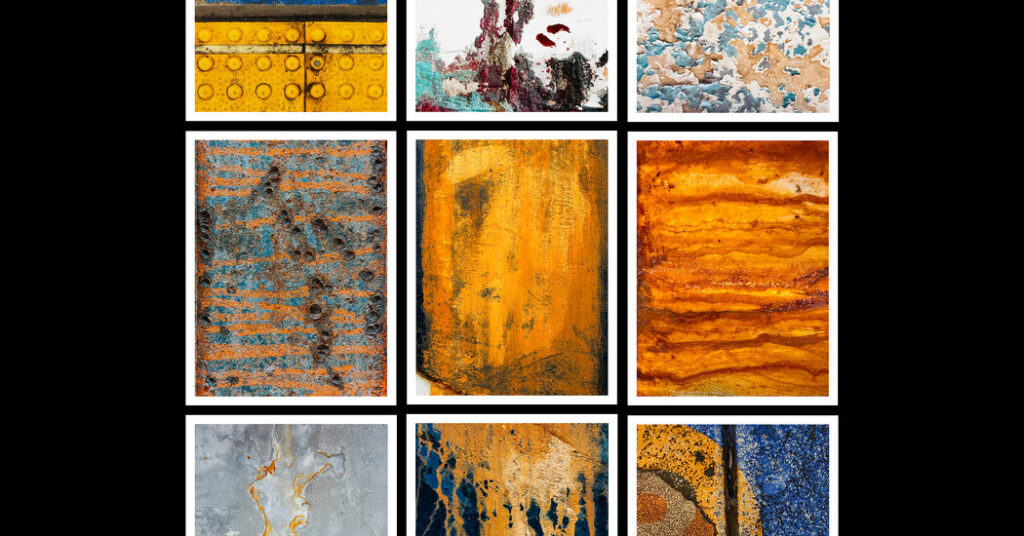
I look for the colorful scenes of decay on the tunnel walls, the rusted iron beams, patterns formed in crumbling tiles and peeling paint. I’m drawn to the strange forms found in discarded bubble gum and to the delicate sketches etched in HVAC soot. They appear to me as secret works of art just waiting to be noticed and appreciated. I like to imagine them under glass, on pristine white mats inside deep black wood frames on the walls of the Museum of Modern Art. I’ve come to think of it as the “M.T.A. Modern,” a public museum open to all New Yorkers for a mere $3 — if only they knew where to look.
Water is the key medium for much of the naturally occurring art within the subway. It acts as both builder and destroyer. As water permeates the surrounding bedrock, it picks up mineral passengers and slowly deposits them where it seeps through, streaks and evaporates. Shallow beds of milky white and amber crystals emerge, glistening, from the primordial solution. As water oxidizes steel, the chemical transformation creates streams of leathery ocher hues.
The M.T.A. estimates that its workers — and 753 pumps — drain the equivalent of 15 Olympic-size swimming pools of groundwater every day. When there’s a storm or a water main break, the volume becomes almost unfathomable. It courses through an aging system, much of which still relies on its original infrastructure, sometimes more than 120 years old. It forces that water to surface in strange and surprisingly beautiful ways.
It pushes its way under thick layers of “M.T.A. Green” paint slathered on structural supports and emerges in bright orange streaks that seem perfectly picked from the opposite side of a color wheel. Several I-beams in Times Square Station display this kaleidoscope of texture and color. On a tunnel wall at 47th-50th Streets-Rockefeller Center, storm clouds stream down showers of acid rain against a foreboding night sky, while farther down the platform a form reminiscent of a Georgia O’Keeffe painting blossoms from an ivory canvas.
But water isn’t the only creative force at work. Over 4 million people ride the subway on an average day. Thousands of hands run down railings, thousands of feet shuffle over platforms, leaving their mark. Countless footsteps over a pandemic-era social distancing mat at Marcy Avenue unearthed years of layered texture and color. On a platform bench at 110th Street-Malcolm X Plaza, the repetition of daily seatings and the resulting abrasion of cloth on wood revealed a sinister portrait.
Sometimes, the slow, grinding creative rhythm is broken: A sharp, even violent action by a single person can spark a riveting new piece. A blow to an M.T.A. digital display at Times Square creates a spider web of faceted cracks, reflecting and refracting pinks, greens and blues from the LEDs beneath. At the Bowery station, an extravagant splash of matte gray paint — hurled onto glazed ceramic tiles — creates a striking monochromatic abstract. And at Brooklyn Bridge-City Hall, a long-since-removed object has left mounting anchors, broken tiles and rust stains, bringing to mind a primitive ceremonial mask.
The forces of nature and humanity collaborate. It’s reminiscent of the slow procession of time and water that hews away at, say, Bryce Canyon, leaving divine peaks in its wake. Or how the steady dripping of calcium carbonate-rich water formed the stalactites of Carlsbad Caverns. They remind me of places where water has carved deep, winding gashes through miles of stone over the millenniums or constructed intricate crystalline structures with mathematical precision.
The M.T.A. Modern’s accidental art reminds me of the fine pigments suspended in liquid polymers that are splattered, carved and swirled, over days and weeks and months, layer by layer, onto canvases hung in museums and galleries around the world. Here, underground, are the swirls of van Gogh’s “Starry Night,” Mark Rothko’s minimalist blocks, Richard Serra’s seemingly weightless steel sculptures.
During a visit to the Guggenheim decades ago, I stood beneath a towering canvas that was entirely black. It was a monumental, leaden void on a powdery white sweep of museum wall. Time and close inspection revealed the slow, painstaking process the artist must have undertaken to create it, stroke after stroke. It would have been easy to ignore, but its barren austerity taunted me, and the sheer audacity of its size and prominence dared me to pass it by. I didn’t. It was perplexing, even infuriating, but I was fascinated. It changed the way I thought about art.
I felt that same way again years later, marveling at some of the subway’s creations. The system is almost a living, breathing — and quite prolific — abstract artist. The tunnels, beams and platforms are the studio, where works of startling, unintended beauty are created — sometimes by human interaction, more often by the forces of nature and time.
You only have to pause your subterranean scurrying and look.
There is a pleasure to be had in finding beauty in unexpected places and taking time to contemplate it. Next time you see a rusted pipe or a slow trickle of water down an I-beam, stop. Let this train go. Take a minute to explore what water, time and your fellow riders have created. You’ll have the museum to yourself until the next train arrives.
Damon Winter is a staff photographer for Opinion.
The Times is committed to publishing a diversity of letters to the editor. We’d like to hear what you think about this or any of our articles. Here are some tips. And here’s our email: [email protected].
Follow the New York Times Opinion section on Facebook, Instagram, TikTok, Bluesky, WhatsApp and Threads.
The post Please Stand Clear of the Accidental Art Museum appeared first on New York Times.