LANSING, Mich. — Iqrama Zhar, 19, remembers her middle school classmates turning their heads and staring at her when their history teacher mentioned 9/11. She felt hot shame and rising tears for being implicated in an atrocity simply by virtue of her religion.
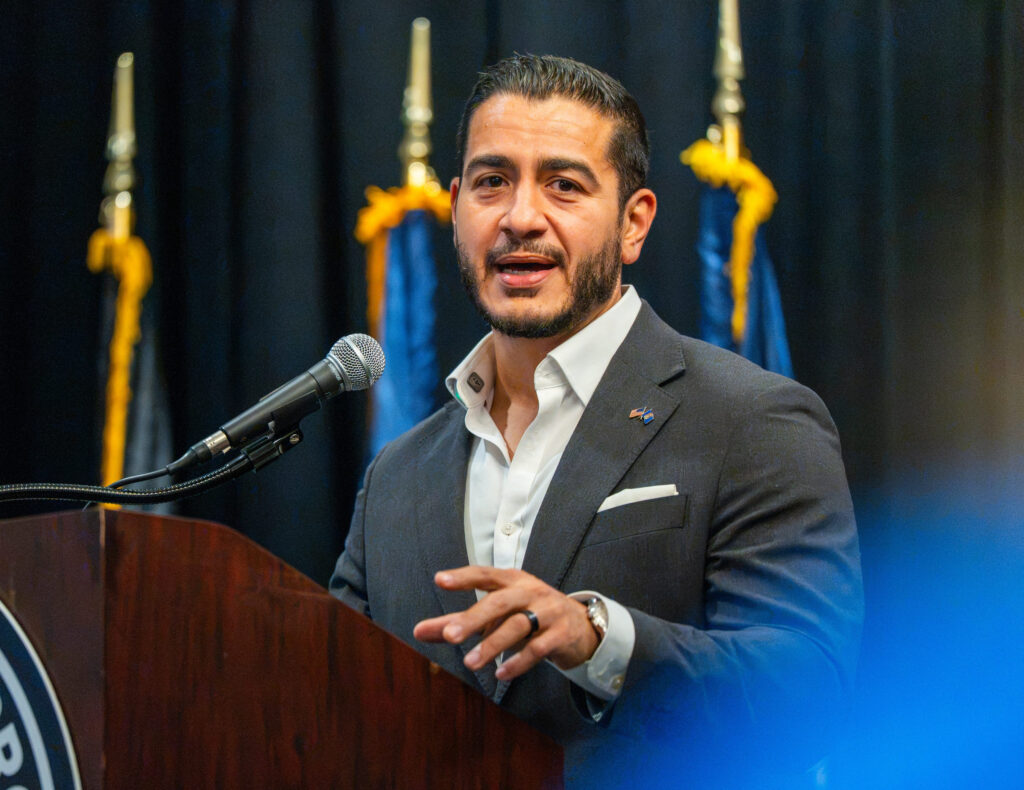
The Michigan State University student of Pakistani heritage said she thinks of that moment when she hears Abdul El-Sayed, the man who could become the nation’s first Muslim senator, portrayed as close to terrorist sympathizers by his Republican opponent, Mike Rogers, in the race for Michigan’s open U.S. Senate seat.
In the swing state, which is home to one of the highest concentrations of Muslim voters in the country, elections are decided by narrow margins. In 2024, Rogers lost a Senate race by fewer than 20,000 votes to Democrat Elissa Slotkin.
To some of the roughly 240,000 Muslims in Michigan, the campaign against El-Sayed has landed in ways that feel familiar but nonetheless upsetting. It has also contributed to a heated race in an election cycle that has seen Republicans across the country evoke stereotypes about Muslims or openly embrace Islamophobia.
El-Sayed, the son of Egyptian immigrants who was born and raised in Michigan, faces the challenge of an electoral environment where anti-Muslim rhetoric may resonate.
The Democrat holds a narrow three percentage point edge over Rogers among likely voters, according to a Washington Post-Schar School poll released earlier this week. The same poll found that 45 percent of likely voters would not consider voting for a Muslim presidential candidate. Those voters were slightly less likely to support El-Sayed than the Democratic nominee for governor, Jocelyn Benson.
The findings demonstrate that the prejudice against Muslim political candidates stretches beyond El-Sayed — and crosses partisan lines — with 78 percent of Republicans and 22 percent of Democrats unwilling to vote for a Muslim president.
GOP campaign groups generally do not explicitly criticize El-Sayed’s faith, but they often juxtapose him with references to the Sept. 11, 2001, attacks, terrorism and Islamist extremism, and Rogers has repeatedly called him anti-American. Three-quarters of Republicans’ $29 million worth of ad spending in the Michigan general election has gone toward attacking El-Sayed, with 1 in 3 of those dollars spent on ads that link him to terrorism, according to The Post’s analysis of data from AdImpact, a nonpartisan political advertising tracking firm.
A separate Post analysis found that anti-Muslim language has surged about El-Sayed in social media posts, newsletters and podcasts by right-wing influencers in the weeks since his primary win.
Rogers and other Republicans say their critiques of El-Sayed are grounded in fact, not Islamophobia, and accurately cite his past comments and associations. “Mike condemns hatred in all forms — including Islamophobia,” Alyssa Brouillet, a spokesperson for Rogers, said in a statement.
But some Muslim voters call the attacks on El-Sayed dog whistles that play into fears of them.
Zhar is trying not to let associations of her religion with terrorism — a portrayal she calls “blasphemous” — frustrate her.
She joined about 450 people for El-Sayed’s town hall in Lansing on the 25th anniversary of 9/11, which he began with a moment of silence. She was relieved at the turnout despite all of the opposition to the Democrat online. Still, she understands why El-Sayed’s candidacy has generated so much conversation.
“It’s not every day you hear of a Muslim running for senator,” Zhar said.
Rise of anti-Muslim sentiment
Since the Sept. 11 terrorist attacks orchestrated by al-Qaeda, Islamophobia has become “as American as apple pie,” said Dawud Walid, executive director of the Michigan chapter of the Council on American-Islamic Relations (CAIR), a Muslim American civil rights organization.
In some respects, he said, prejudice is worse today than during the early 2000s. CAIR Michigan has seen a steady rise in self-reported incidents of Islamophobia in the state — surpassing the number in the immediate aftermath of 9/11. At the same time, Republican politicians have become more pointed in their language, sometimes describing CAIR as a terrorist organization.
Sen. Ted Cruz (R-Texas) has claimed that “communists and Islamists” are “sweeping over” the Democratic Party and that Islamism “produces murder and oppression.” President Donald Trump told reporters in the Oval Office that the country is seeing “jihadists being elected all over the place.”
“After 9/11, George Bush went to an Islamic center and said we are not at war with Islam. Today, it’s different,” Walid said.
El-Sayed has accused Republicans of trying to make the election “about the color of my skin or how I pray.”
“To try and raise the temperature in a way that inadvertently or advertently puts a target on people’s back, that’s a dangerous thing,” El-Sayed told The Post, when asked about rising anti-Muslim rhetoric from the GOP. “My family have had to bring on security — and that shouldn’t have to come with running for office.”
Focus on Hasan Piker
Republicans have particularly focused on El-Sayed’s relationship with Hasan Piker, a left-wing political commentator and Twitch streamer who has made inflammatory comments about Israel and 9/11. Piker was an early booster of El-Sayed’s candidacy and campaigned with him during his primary against Rep. Haley Stevens.
More than $7 million worth of ads featured Piker’s 2019 comment that “America deserved 9/11.” Piker has since apologized for the remark, calling it a poorly worded attempt to discuss the concept of foreign policy blowback.
One recent ad, aired in Michigan from the Front Line Action, a super PAC founded by Cruz allies, uses artificial intelligence to depict El-Sayed; his half sister, a pro-Palestinian activist; and Piker, wearing a kaffiyeh on his head, holding cards that read “Death to America” and “Celebrate 9/11.″ The voice-over narrates: “The destruction of Israel and the West isn’t just a game for them, it’s a mission.”
That ad “goes beyond dog whistle politics,” said Nazita Lajevardi, an associate professor of political science at the University of Michigan, who studies political discrimination against minority communities.
“When ads tap into the word ‘terrorist’, they are psychologically tapping into concerns about El-Sayed as an existential threat and a narrative that all Muslims are to blame for making Americans unsafe,” Lajevardi said.
Rogers has previously misattributed Piker’s 9/11 quote to El-Sayed, who called the comment dumb and has repeatedly condemned the attacks as a tragedy. In his 2020 book, “Healing Politics,” El-Sayed wrote: “I watched terrorists with names like mine attack my country in the name of my faith. … The attack devastated me.”
Following criticism from Democrats and others, El-Sayed has distanced himself from Piker, whom he now refers to dismissively as a streamer from California, and has said he has “no plans” to campaign with him again. But El-Sayed has repeatedly rebuffed calls to condemn him completely.
The Piker controversy doesn’t appear to be registering with the electorate. Most of Michigan’s likely voters — 55 percent — had no opinion of Piker, according to the Post-Schar poll. Those who had an opinion of the streamer overwhelmingly had a negative one, but perceptions of Piker were not predictive of voter preferences in the Senate race.
Muslim voter reactions
Bilal Hammoud, a Dearborn-based progressive activist, described voting for El-Sayed in the Democratic primary as “bittersweet” because he anticipated that it would release a “torrent of Islamophobia” against the candidate and Michigan Muslims. He saw it as no coincidence when, weeks after El-Sayed’s primary win, a far-right influencer held an anti-Islam rally in the majority-Arab city of Dearborn.
Hammoud, 38, said he feels most let down by El-Sayed’s own party, whose members not only “tacitly accept” the anti-Muslim rhetoric of senior Republican politicians, but engage in it themselves.
During the Democratic primary, El-Sayed condemned attack ads funded by the American Israel Public Affairs Committee (AIPAC), which suggested he was sexist, building on tropes about Middle Eastern men. Several high-profile Democratic women made similar arguments against him.
El-Sayed, who has described Israeli military action in Gaza as a genocide, has split Michigan’s Jewish community.
Rogers has criticized El-Sayed for saying “hurt people hurt people” after a March attack on a Michigan synagogue, referring to the fact that authorities had said the attacker lost family in an Israeli airstrike.
El-Sayed has since apologized and said that he did not mean to justify the attack.
Hammoud said he thinks many Democrats in recent years have come to view Muslims as a “political liability” over diverging stances on the Palestinian people and feels they are unfairly blamed by some in the party for Kamala Harris’s defeat in the 2024 presidential election.
“I wish we were part of the coalition of people who were deemed human and worthy of protection,” said Hammoud.
Ali Aldhalimi, 38, sees a funny side to the anti-Muslim rhetoric aimed at El-Sayed, describing it as evoking old and ridiculous tropes.
The Detroit-based comedian came to the United States as a 5-year-old refugee fleeing domestic turmoil in Iraq after the 1991 Persian Gulf War. He remembers his younger brother telling him that his teacher had blamed Iraqis for 9/11.
“For an Arab American Muslim, it’s always been a struggle. Even if you’re just Arab American and not Muslim,” Aldhalimi said. “You have to deal with that animosity based on that identity.”
However, Aldhalimi has empathy for voters apprehensive about Muslims who may have only seen them portrayed on-screen as villains. Having tried his own hand at acting, he said “terrorist” was often the only role available to Iraqi Americans like himself.
Aldhalimi doesn’t vote and doesn’t plan to make an exception for El-Sayed, saying, “Blue or red, they’re going to bomb my cousins and they are Brown.”
He still hopes the election of a Muslim senator could be a watershed moment for Arab Americans.
“Maybe the xenophobic rhetoric that comes towards him is something that he has to go through to turn a page, so we can move past this,” Aldhalimi said.
Scott Clement and Luke Connors contributed to this report.
The post How anti-Muslim rhetoric is influencing the pivotal Michigan Senate race appeared first on Washington Post.