MIAMI — The president of Florida International University was onstage when a few dozen students in the audience abruptly stood up.
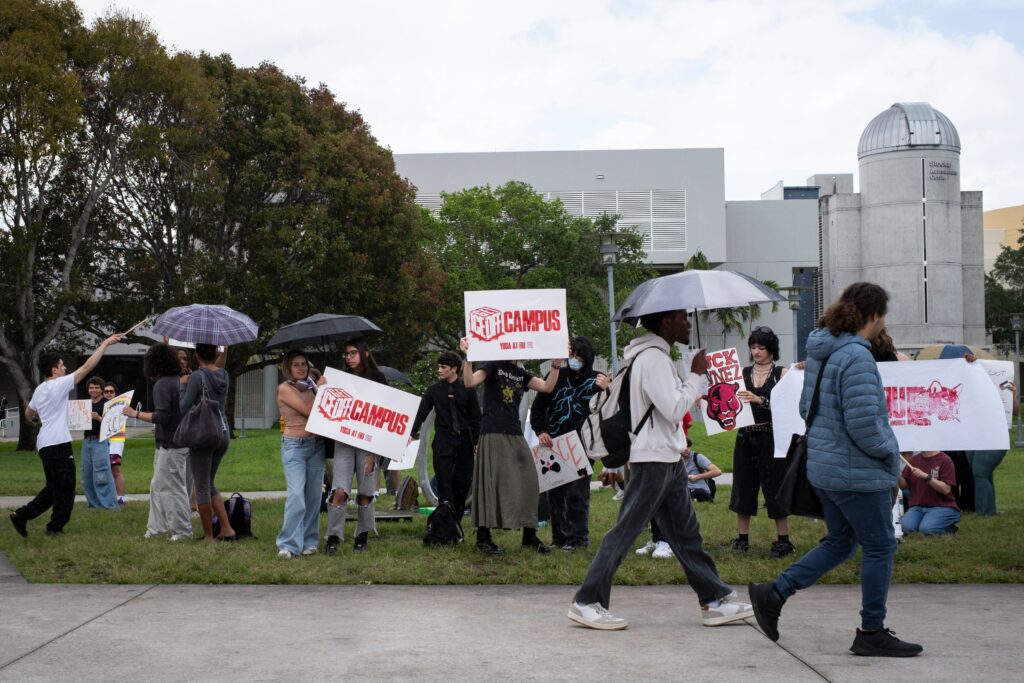
They unzipped their sweatshirts, revealing matching T-shirts that displayed a message in big red letters: “ICE off FIU.”
“We had been desperately trying to talk to her about her damaging decisions, but she kept ignoring us,” said Andrew Caro, then a junior. “So we brought it directly to her.”
Almost a year had passed since the university’s leader, Florida Gov. Ron DeSantis’s (R) former lieutenant governor, had okayed a deal with U.S. Immigration and Customs Enforcement to deputize four campus police officers as ICE agents.
This type of agreement, known as a 287(g) partnership after that section of the Immigration and Nationality Act, has exploded in use across the country under the mass deportation agenda of President Donald Trump’s administration.
In Florida alone, pressure from DeSantis helped bring the most expansive type of agreements to 15 public colleges. Deputized officers could stop and question people they suspect of being in the country illegally and detain those who are.
FIU, like institutions around the country in the Trump era, was being asked to bend to the administration’s priorities. In this case, the choice centered on an issue — its relationship with immigrants — that many here saw as core to its identity and history.
But FIU, which graduates more Hispanic students than any other school in the country, never put up much of a fight.
The deal — like so much else on campus these days — seemed to chip away at the very spirit of a university bedecked in banners declaring that “international is in our middle name.”
“It was a betrayal to the future of our young people,” said Mike Fernandez, a Cuban American billionaire philanthropist and former Republican donor who had sent his son to FIU and pledged money to the school.
Once founded to educate the children of Cuban exiles, this massive state school was now declaring open season on the next generation.
FIU President Jeanette Nuñez and FIU Police Chief Alexander Casas, both children of Cuban immigrants, have defended the 287(g) agreement as a way to give the university more control over immigration enforcement on campus, rather than leaving the matter entirely to federal agents.
If ICE “has the name of an FIU student who resides on campus, I want them to call us first,” Casas told faculty at one meeting. “I want to be, as much as possible, in the driver’s seat. Without the agreement, I’m not even in the car.”
None of FIU’s 55,000 students have been detained on immigration charges by campus police since the agreement was finalized in July 2025. Only two officers on the 50-person force underwent training last year to carry out immigration enforcement, the department said, and officers do not actively stop people and ask them for proof of citizenship.
But the deal’s impacts have reverberated around campus. Fernandez pulled a $1 million donation. A nonprofit that helped pay tuition for more than 180 undocumented students withdrew its support. Most of those students, all of whom arrived in the United States as children, transferred out.
Even the dozens of world flags that adorned the hallways of the student center, long seen as a symbol of the school’s multicultural identity, suddenly came down.
“It’s just hypocrisy,” said Maria, a 20-year-old undocumented student who was born in Honduras and was brought to the United States at age 6. She transferred out of FIU after the deal and spoke on the condition her last name not be used for fear of being targeted.
“Immigrant students are a part of making the school what it is,” she added, “and then all of a sudden, we’re walking around afraid they’re going to ask us for IDs.”
Caro, who had been protesting Nuñez at her event this past March, said he felt a similar feeling of betrayal as he got up to demonstrate — as if the school he once knew was no more.
After he and the others exited silently, university police approached them outside the auditorium. They kept walking — a decision for which they would later be threatened with suspension.
Their violation? Not showing identification to campus police.
The politician-turned-president
FIU, like the city around it, is impossible to separate from its deep connection to Latin America.
The school’s main campus, west of the chaotic Miami International Airport and near a clutch of shopping malls, boasts a Pollo Tropical and a Café Bustelo in the student center alongside a Starbucks and a Chili’s.
The school has fraternities, sororities and “Pitbull Stadium,” named after the Miami rapper born to Cuban immigrants. But many of the mostly working- and middle-class students spend more time on jobs or long commutes than campus life as they seek to lift up their families and forge a path toward professional careers.
Nuñez was a product of that route.
After her father left Havana in 1961 under the threat of house arrest, he resettled in Miami and started a family just five miles from campus.
Nuñez, who worked a high school summer job in the registrar’s office, returned the following year to study international relations and political science. After graduating, she climbed the political ranks as a legislative aide, health care lobbyist and then a GOP state lawmaker.
In 2014, she broke from her party to sponsor a measure that would let undocumented students who had grown up in Florida pay in-state tuition at its public universities.
“Let’s not hold these children responsible for actions that their parents took,” Nuñez said on the state House floor at the time. “Let’s not allow the American Dream to fade for this group of students.”
DeSantis later picked her to become his lieutenant governor. And when he tried to repeal that tuition measure two terms in, she reversed herself.
The law had “run its course,” Nuñez said in January 2025. Florida, she added, should no longer subsidize the tuitions of undocumented students at state schools, including the more than 500 who were enrolled at FIU.
Less than a month later, Nuñez was appointed FIU’s interim president, at DeSantis’s request. She declined repeated interview requests through FIU.
The same month that Nuñez arrived on campus, DeSantis pushed a different law targeting immigrants through the state legislature. This one threatened to suspend any elected or appointed government official who refused to partner with ICE.
Although university police were technically exempt, a lobby group for Florida police chiefs told campus department leaders that the DeSantis administration wanted them to sign on immediately.
That same week, Casas, the police chief, emailed other top FIU officials. “Local law enforcement is being asked to sign,” he wrote, according to an email obtained through a public-records request. “We are trying to expedite this.”
Nuñez, he would later note, had approved the deal.
‘Whatever assistance we could provide them’
Inside an FIU biology classroom a few months later, in spring 2025, Tania Lopez looked up from the front row as Nuñez and Casas addressed members of the school’s faculty senate on the details of the agreement.
Outside, a line of FIU instructors in matching T-shirts chanted, “No ICE on campus!”
The issue was personal for her. Lopez, who fled Cuba as a college student and was once held in a detention center, specializes in teaching writing to immigrant students who didn’t grow up speaking English.
As she scribbled notes, she worried about how those students might fare. Some had told her they were nervous their student visas would be suspended. Others fretted that even a parking ticket might lead to deportation.
Something needed to change, she thought.
From the center of the room, Nuñez told the crowd that the school’s police department was simply complying with an order from DeSantis. There was “much misinformation” about the deal, she said.
Casas, the police chief, added that conversations with his peers at other schools convinced him it “really is with our best interest at heart.”
But Lopez struggled to understand how that could be true.
FIU police officers — unlike ICE agents — could get into campus dorms and classrooms. Professors like her did not know what to do if an officer entered their classrooms. Florida’s “halo law” barred bystanders from filming officers up close, meaning that other students might end up at risk.
That the partnership with ICE could end with some of them in the same detention center she had been in decades ago made it feel worse.
At a later event in May, Casas acknowledged that if ICE instructed FIU police to help in off-campus operations, his officers would offer “whatever assistance we could provide them.”
Someone in the crowd filmed that line and posted it online. Anxious and angry emails — from students, upset alumni, outside groups — poured in.
The officer and the student
Driving around FIU’s main campus with campus police officer Quentin Powell on a sunny South Florida day in March, it would have been hard to notice the controversy that had engulfed his department.
Powell is not one of the officers deputized for immigration enforcement — FIU declined to identify them or make them available for an interview — but said their afternoons might look a lot like his on this day.
Passing the Ronald Reagan statue outside the university president’s residence, he got a call about a woman who was feeling faint and needed medical attention. Later, he spoke with a student who suspected someone might have broken into his car.
The only time he asked someone for ID was after reports came in complaining of students smoking marijuana inside the school’s nature preserve.
“Nothing has changed about the way we do police work,” Powell said.
More than 50 miles away, Maria, the undocumented student who once attended FIU, was still trying to get adjusted to her new life on a different university campus.
The cancellation of in-state tuition quadrupled her tuition, making it impossible for her to keep studying international business. Then the nonprofit that funded her scholarship, TheDream.US, cut ties with FIU entirely, saying it didn’t want to put her at risk.
She started feeling scared, too, asking friends to walk her from her car to class and avoiding the small talk she once made with campus police officers in the student center. Her deepest fear was imagining she might get assaulted and not being able to go to the police for help.
“I felt like I was always on the verge of a panic attack,” she said.
Now, she was walking the grounds of a smaller university in South Florida, where the nonprofit had helped her transfer. The private school did not have to sign an agreement with ICE.
But it was Whiter and wealthier, and it didn’t have the same sense of Latino community. People didn’t speak Spanish in the halls between classes.
It wasn’t, she said, the dream school that she had gotten to attend for only a year.
Sabrina Rodriguez and Yasmeen Abutaleb in Washington contributed to this report.
The post Hispanics flock to this university. It let campus police double as ICE agents. appeared first on Washington Post.