President Xi Jinping of China is throwing his weight around as he prepares to arrive in Washington.
When Chinese and American leaders gathered for summits in the past, it was the American president who held the cards. Not so this time. What’s sobering about Xi’s visit to the United States in the coming days — and a reflection of the way President Trump has diminished America — is that this may be the first China-U.S. summit in which China appears in the lead role.
“In the past, American leaders generally drove the relationship, but now Xi is in the driver’s seat,” Julian Gewirtz, a China scholar at Columbia University who served in the Biden White House, told me. “Trump sees Xi as a peer and China as a superpower and is generally quite deferential to him.”
For his part, Xi has demonstrated his strength by almost thumbing his nose at the United States.
Trump said he asked Xi in May, at their last meeting, to free Jimmy Lai, a media mogul who is among the most courageous advocates for democracy. Xi spurned the request. Instead, a Hong Kong court this month sentenced three other dissidents to harsh prison sentences, and one of the most famous of Hong Kong’s democracy campaigners, Joshua Wong, 29, is facing up to a life sentence for supposed crimes.
China, whose per capita income of more than $14,000 came within a whisker in July of achieving “high-income” status at the World Bank, also appears to be brazenly violating sanctions on North Korea this year. It buys Iranian oil and reportedly supports Iran’s war effort. And despite having officially suspended strict export controls on rare-earth elements, it has continued to exert control over them in ways that create problems for Western companies.
Asked about reports that Chinese organizations supplied intelligence that Iran used in an attack in July that killed three American soldiers, Trump was strikingly reticent. He seemed to downplay any suggestion that China had done something wrong.
Xi has leverage in the relationship partly because the suspension of those export controls expires in November. If no deal is reached with Trump, then Beijing could further tighten access to rare earths that are vital for manufacturing everything from cars to submarines.
The United States is weakened in part because Trump started a trade war with China last year, which he then effectively lost when China weaponized its control over rare earths. In addition, America’s war with Iran has depleted weapons stockpiles, reducing our ability to defend Taiwan or project power in the Pacific or the Middle East. We have antagonized allies and backtracked on democracy and freedom, and according to U.N. investigators, we may have committed war crimes in Iran — and all of this has tarnished our global image and reduced our influence and soft power worldwide.
Trump is seen in much of the world as reckless and unpredictable, while Xi has tried to project an image of stability and maturity, soothing global oil markets that had been inflamed by Trump’s war on Iran. A new poll from the Rockefeller Foundation finds that Canadians, Indonesians, Brazilians, Turks, Mexicans and others all see the United States as more of a “major threat” than either Russia or China.
“The U.S. is in retreat,” Phillips P. O’Brien, an American historian, wrote this month. “It is watching bases of great strategic importance get destroyed and cannot protect them, it is abandoning allies that heretofore it considered of the highest priority, and it is making it clear that it cannot look after its own interests in some of the most important places of the world.”
O’Brien adds that “this is clearly the end of the American age” — but I’m not so sure about that. The United States still has strengths, not least its tech sector, while China, Europe and Japan all have significant weaknesses of their own, including demographic and economic challenges. Despite its propaganda, China remains an oppressive regime with no clear successor after Xi, while there is some prospect that American democracy will show its resilience in November’s elections.
If it is humbling to have Xi arrive in a position of strength, at least there may be an opportunity ahead. Both Xi and Trump seem to want to lower the temperature and stabilize the relationship, which would be a good thing.
I hope that might also leave an opening for a sliver of progress on artificial intelligence, one of the most important topics the two leaders will discuss. It’s difficult to see how the world can make much progress on improving A.I. governance if America and China resist cooperation on safety.
A major deal on safety is very unlikely, for Trump has called A.I. concerns “a hoax,” while Xi apparently thinks the problem is potential American abuse of the technology to target the Chinese regime, rather than A.I. itself. In China, A.I. is portrayed as a threat not to human existence but to Communist Party rule.
Still, perhaps there is space for a modest cooperative step forward. Rajiv Shah, the president of the Rockefeller Foundation, which is working on A.I. issues, told me that there may be an opportunity for progress on A.I. safety as it relates to specific, narrow domains such as reducing the risk of terrorist attacks using bioweapons.
That’s a real concern as synthetic biology and A.I. together create new perils: Imagine terrorists assembling a deadly virus, or engineering an animal ailment like cowpox or horse pox to be deadly and virulent like smallpox. It should be possible for China and America, working through both governments and unofficial channels, to collaborate on protocols to reduce risks like that.
That would at least be a major sign that A.I. safety cooperation is possible. “Doing one thing, even if it feels like it’s not solving the whole problem, at least creates a repeatable playbook,” Shah said.
China and the United States should also create some kind of hotline to discuss and defuse A.I.-related incidents that threaten to create military or diplomatic crises. After all, what if Open A.I. agents had hacked not Hugging Face but rather units of the Chinese People’s Liberation Army? Or generated deepfake video of Xi renouncing claims over Taiwan?
Right now, at a time when America has blown up the geopolitical order that we ourselves created after World War II, modest steps may be the best we can hope for.
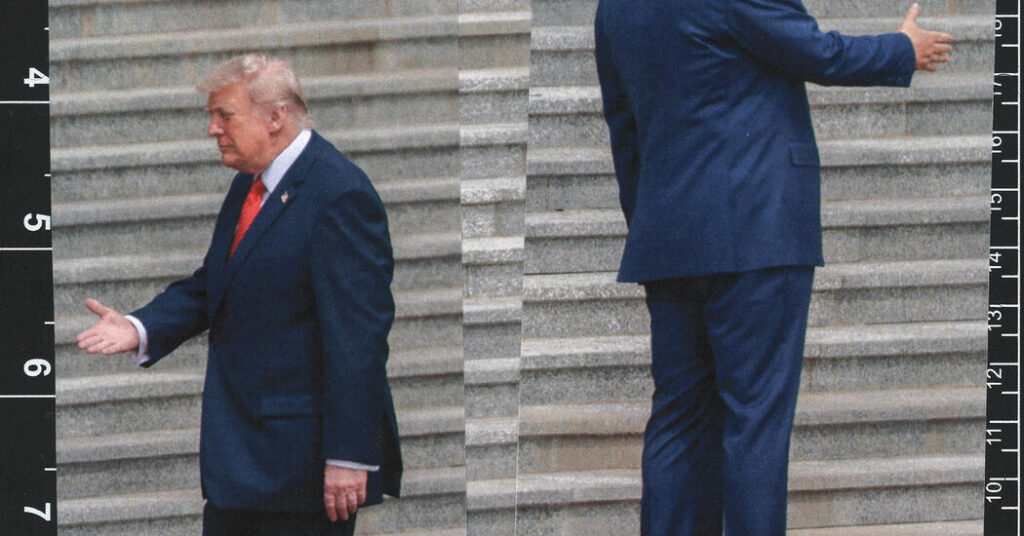
Source photograph by Evan Vucci/Reuters.
The Times is committed to publishing a diversity of letters to the editor. We’d like to hear what you think about this or any of our articles. Here are some tips. And here’s our email: [email protected].
Follow the New York Times Opinion section on Facebook, Instagram, TikTok, Bluesky, WhatsApp and Threads.
The post Here’s How Trump and Xi Can Make Progress on A.I. appeared first on New York Times.