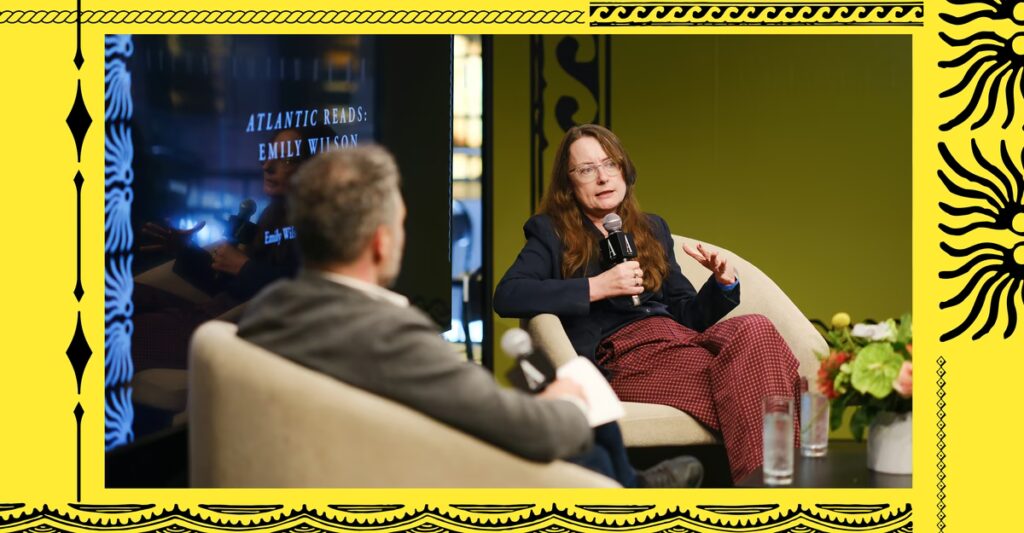
Emily Wilson has become the most famous living translator of the Homeric epics. Her 2017 The Odyssey, the first major translation of the poem into English by a woman, has sold more than 1 million copies. (Her Iliad translation came in 2023.) And this summer, she found herself right at the center of cultural discourse after she drew her sword and published a scathing review of Christopher Nolan’s blockbuster adaptation of the ancient work. She didn’t anticipate that she would become part of a pop-culture controversy, and she was reluctant to revisit the episode when we sat down for an interview at this year’s Atlantic Festival. “I really wanted to like the film,” she said, but “it seems to me that criticism has a responsibility to tell the truth.” Her strong convictions animate a new book of essays, Crossing the Wine-Dark Sea, which dissects translations of ancient work with unsparing rigor.
Wilson, who is now working on a second translation of The Odyssey, entertained the idea that there might be something “compulsive” in her art and her approach. Her new essays reveal a translator’s difficult balancing act—between fidelity and originality, and between accessibility and strangeness. In the course of our wide-ranging conversation about the pleasures and blind spots of translation—and, yes, the backlash to her now-notorious movie review—she spoke about the imperative she feels to get that balance exactly right.
The following conversation was condensed and edited for clarity.
Gal Beckerman: You take a pretty hard line in this book about when a text should be retranslated, but you’re translating The Odyssey again. It’s interesting that you should want to go back in again. Have you learned something new about the text or come to see it in a new way that makes it exciting for you to tear it all up and start it from scratch?
Emily Wilson: It’s not tearing it up to do a new one, right? Partly it’s that I’m kind of addicted; I can’t stop doing this. I have several other projects I’m supposed to be doing. I did The Odyssey really prioritizing pacing, because my students would very often show up to class saying, Oh, it was so boring. And I would be like, How can The Odyssey be boring? And then I would realize it’s because the translation was twice as long as the original. Then, with my Iliad translation, I was a little bit looser about not confining myself to the exact same number of lines as the original. I thought there were advantages to doing that. So as soon as I’d finished The Iliad, I wanted to go back to The Odyssey and start all over again to produce one that matches my Iliad. So it’s not that I think there’s anything wrong with my current translation, and I think that there will be readers who will like that one better. It will be snappier and all that.
Beckerman: Do you think that translators have a kind of a compulsion to continue to play with the words, to work this Rubik’s Cube?
Wilson: Yeah, I think it is compulsive, maybe that’s right, but I don’t think that’s just me. I think that is very common, especially for a very long project like this. You’re constantly thinking about, How might I be able to get closer to whatever the vision is?
[Read: A Trojan horse is supposed to have humans inside it.]
Beckerman: One of the things I love that you do in the book is demystify translation, and make us understand that these are human beings and that they have biases, that they’re in a specific cultural moment—a certain gender, a certain kind of life experience—and that it shows up in the word choices. When your translation of The Odyssey came out, a lot of the excitement about it was that you were the first woman who was translating The Odyssey in English. And I wonder if you feel like being a woman has affected your translation?
Wilson: I think some of those headlines were kind of bogus, right? I mean, they were suggesting this really simplistic set of ideas about gender: And of course gender will be the only factor that will contribute to how someone writes. And of course all women write in iambic pentameter, just naturally, and all men don’t. Some of it was really silly, I thought.
Beckerman: But do you feel like you understand the particular worldview that you’re bringing to it? None of us fully know the water we’re swimming in, of course, but when you’re translating, are you like, Oh, I think that I’m reading this way or I’m making these choices because I’m a woman of a certain age living in the 21st century in America?
Wilson: You know, I honestly never think that. I mean, I think that when I’m talking to people like you. Well, I don’t mean “people like you”—
Beckerman: Nosey journalist.
Wilson: Exactly. It’s only very belatedly that I feel that I have to prepare an answer for things like this. When I’m actually wrestling with it, I do quite often think, Okay, I’m putting the stress on that, and that syllable and that name; is that because I’m British? To what extent is my approach to the passage informed by that critical study or this critical study? That kind of thing comes into my thinking all the time. But the question is about my lived experience, and do I have this particular relationship to this banquet scene because I don’t eat meat? No.
Beckerman: Right. I mean, meter is important to you, that the sound of the poem or the text in another language have some relationship to the original. For translators 200 years ago, they wouldn’t necessarily care in the same way.
Wilson: Yeah, this is a very old-fashioned choice on my part. I see myself as super retro. I see myself very much as taking a sort of mid-19th-century approach to translation.
[Read: The secret of Rome’s success]
Beckerman: How do you think film adaptation is different or similar to literary translation? When you think about a director approaching a text like The Odyssey—wanting to adapt it and making very definite choices about the value system that is underlying the plot that he’s created—is that the same type of thinking through interpretation that a translator does when they approach a text?
Wilson: I would say no. I think it’s a very different kind of thinking. What I’m trying to do as a translator is to get to something equivalent to the experience of the original. I think a good adaptation tries to do the opposite of that. Virgil was certainly doing that in rewriting The Odyssey as The Aeneid. It’s on some level the same story; it’s also the opposite story. So I think the more the adaptation pushes against it, in many cases the more successful it is artistically.
Beckerman: There is this interesting sort of tension through a lot of these essays in your new book, where you want these ancient texts to be popular, to get out there, to have people engage with them and to make new things with them. But on the other hand, that often leads to a kind of a reductive quality. And I feel like it’s a tension that came out around Nolan’s movie. You wrote a very critical review of the film, and I had a moment as I read that when I wondered, Is she trying to distance herself from it as something that has reductive qualities, and is it popular in a way that doesn’t engage with the full texture of the text?
Wilson: I wish I would have liked the film more. I went in hoping to like it and thinking I was going to like it. And it turns out I didn’t. It seems to me that criticism has a responsibility to tell the truth. There’s another kind of responsibility: that you shouldn’t actually lie about your actual feelings and thoughts. And there’s also a question about: what does it mean to spread the word that everyone should read ancient literature? Everyone should take some kind of interest in history. Everyone should engage with long, difficult books. I really believe in those things, and I don’t believe that the best way to engage with history and to grapple with the essential questions of art and cinema and plays and music and literature is to sort of say, Yay, we love it all.
Beckerman: But what lenses did you put on to critique the film? As a translation or as an adaptation?
Wilson: No. I mean, I say at the start of the review that very often the best adaptations are the ones that are most resistant to the original. The ways that I was critiquing the film were in terms of pacing and characterization and narrative. A satisfying cinematic experience needs to follow through on its own premises. And so if you set us up to think this is going to be the kind of film where we’re supposed to care about the characters, then you need to follow through on that promise.
[Read: An Odyssey deserving of the biggest screen possible]
Beckerman: What did you make of the response to your response—the backlash of sorts? I’m just curious what it told you about people’s relationship to these stories, because there was this real defensiveness about the film, about this effort to make a popular piece of art around The Odyssey. Were you surprised?
Wilson: Yeah, I thought it was really weird. Many people reviewed this film, including other Odyssey translators, and there was no discourse about anyone except for me, which is really weird, I thought. So I’m not sure that I can really comment on what weird people thought. But I feel like this is taking us a bit far from the book? Because I don’t discuss the film in the book. I discuss theater and ancient literature.
Beckerman: I know, I understand. It’s just that it was an interesting cultural moment. It is not every day that my Twitter feed is full of people wanting to debate the finer points of The Odyssey. So I can imagine, for somebody who’s as immersed in it as you are, that it must be unsettling but also exciting.
Wilson: I think it’s wonderful insofar as it is actually substantially about either the film or about the poem, or some combination of the two. I felt that some of the discourse wasn’t about either of those things. I’m, on some level, interested in it because it’s a symptom of some kind of bad stuff in our culture, but I’m not that interested in it, and I’m not going to celebrate it.
Beckerman: Right. So my last question: I’ve thought a lot about the limits to how much we can understand people’s lived experience so far in the past, and as a translator of these texts, you come the closest—you walk right up to that edge—and I’m curious for your thoughts about that. Is it never going to be possible for us to get at what it meant to be living in the time when The Iliad or The Odyssey were written? Or do you see a kind of universality that connects us to the people who wrote those texts?
Wilson: That’s a great question and such a difficult one. I mean, part of my reason for focusing so much on literary form and poetic form is that even if we can’t get the lived, embodied experience of what it means to be going around in your chitons and eating your ancient Greek olives—I’m not sure that we can get to that through texts—I do think we can get quite close to something like the experience of being a fluent listener or reader. I don’t think that means universals, but I think it means we can get to a kind of multicultural imagination that includes going back in time as well as going to different places in space. And if we can do that, there’s a kind of magic in that in itself.
The post Emily Wilson Wanted to Like Nolan’s Odyssey appeared first on The Atlantic.