The Federal Aviation Administration said Friday that President Donald Trump’s proposed 250-foot triumphal arch would not pose a hazard to aircraft.
The FAA’s aeronautical study said the proposed structure should feature “a non-standard eternal flame” to make it noticeable to pilots. It also said the arch should be continuously floodlighted by searchlight projectors around its base.
An FAA spokesperson said safety experts reviewed airspace, air traffic patterns and procedures around Reagan National Airport and other nearby airports.
Friday’s report was the FAA’s final determination on the project. A preliminary study also found the arch would have no adverse impacts on National but said it should be marked with red, blinking obstruction lights.
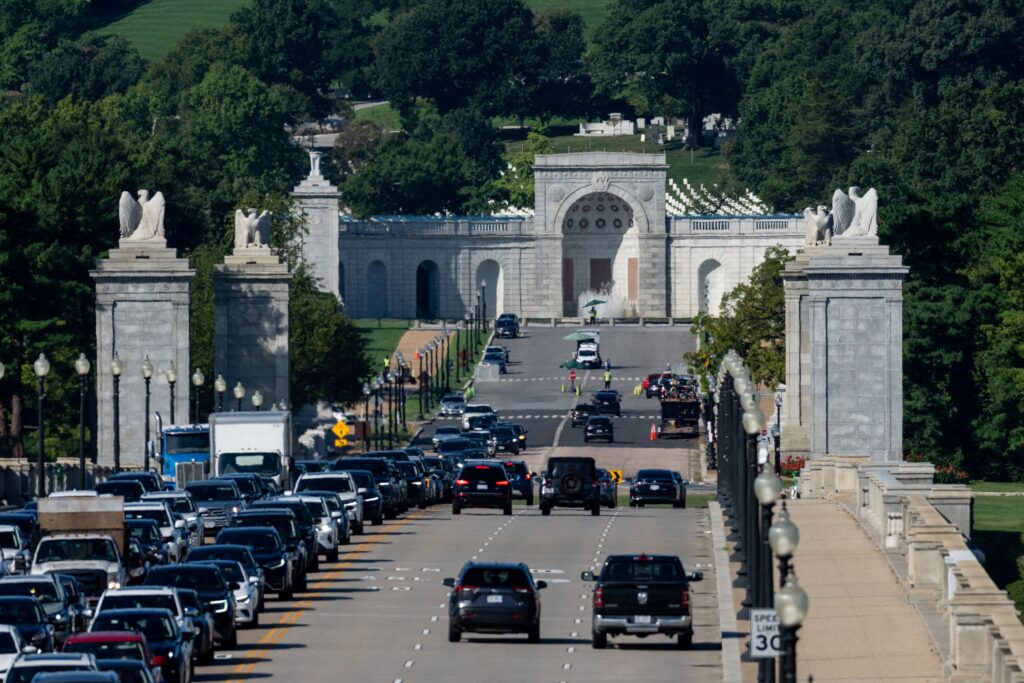
The arch would sit directly in the paths of flights in and out of National. Aviation safety there has garnered significant attention since a 2025 collision near the airport that killed 67 people.
Jeff Guzzetti, a former accident investigator at the FAA and the National Transportation Safety Board, said his biggest aviation safety concern in Washington is the high volume of flights at National.
“The building of this arch, while aesthetically might be objectionable to people, poses a very, very small additional risk to the congested airspace around Washington,” Guzzetti said.
Tom Lintner, who worked for decades at the FAA, said he doesn’t think the height of the arch would pose a problem to pilots but raised concern about whether the lighting could cause a distracting glare.
“The glare and light, depending on how extravagant they are around the monument, could be an issue,” he said.
The report said the proposed lights are compatible with night-vision goggles but that glint and glare evaluation falls outside the study’s scope.
Catch up quickly every weekday morning with a rundown of the 7 most important and interesting stories. Sign up for The 7 newsletter.
The post Arch needs ‘eternal flame’ to alert pilots, but would pose no hazard, FAA says appeared first on Washington Post.