AI may be restoring the importance of the liberal arts degree, at least according to the cofounder of one of the industry’s biggest players.
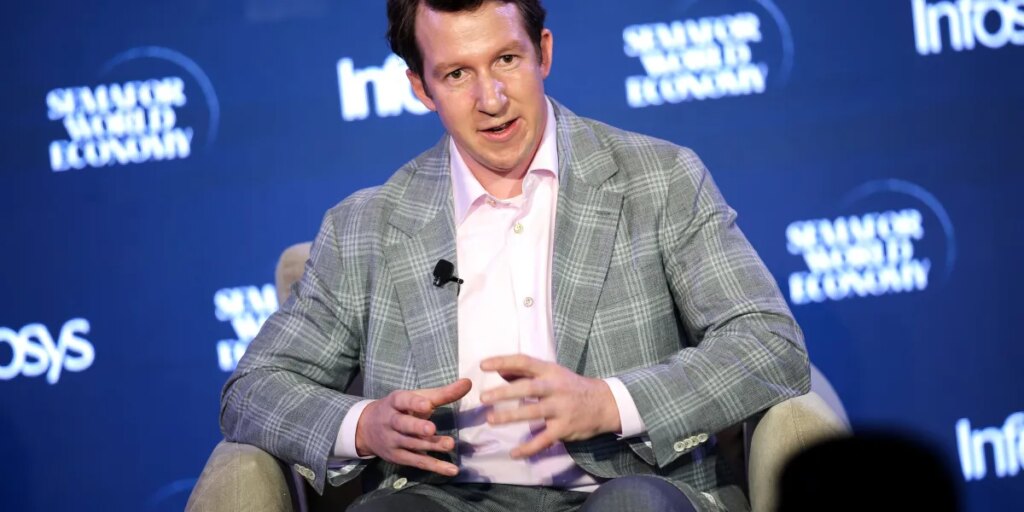
Jack Clark, a billionaire cofounder of Anthropic and former journalist who majored in English literature and creative writing, says his literary education is what helped him become an influential figure in the world of AI.
“I’m a literature graduate, and I don’t think you’d put that as a cofounder of a frontier AI company, but what turned out to be useful is that I got to learn a lot about history and a lot about the kind of stories that we tell ourselves about the future,” he said during a conference earlier this year.
“That’s turned out to be, like, extremely relevant for AI in a way that I think people wouldn’t have predicted,” he added.
For young people trying to figure out where they fit in an increasingly AI-fueled economy, their best bet may be learning to ask the right questions, he added.
“The really important thing is knowing the right questions to ask and having intuitions about what would be interesting if you collided different insights from many different disciplines,” he said.
Clark claimed young people should avoid pursuing basic or “rote programming” and added the degrees that are going to become even more relevant in the future are the ones that involve “synthesis across a whole variety of subjects and analytical thinking about that,” he said.
Cracks in STEM
Clark’s insight comes as more young people are grappling with what an AI-dominated future looks like for them. For decades, enrollment in STEM education exploded—partly owing to a spike in computer science interest that helped increase science and engineering graduate enrollment by more than one-third between 2000 and 2015, according to the National Center for Science and Engineering Statistics (NCSES).
Between 2013 and 2023 STEM job growth also outpaced non-STEM job growth with a 26% increase, compared with a 9% increase, respectively, according to the NCSES, which is part of the National Science Foundation.
While STEM jobs are projected to grow, some cracks have started to appear thanks to AI. A report by Anthropic researchers Maxim Massenkoff and Peter McCrory earlier this year found AI can theoretically take over 94% of computer and math tasks. Computer programming jobs are among those that are most exposed to AI, the report found.
Leaders at companies like Anthropic that are building the worker-replacing tech are increasingly sounding the alarm about job displacement. Anthropic CEO Dario Amodei notably claimed AI would eliminate half of all entry-level white-collar jobs, before later softening his opinion. Meanwhile, the creator of Anthropic’s Claude Code, Boris Cherny, said this year “coding is practically solved” and “we’re going to start to see the title ‘software engineer’ go away.”
For young people, the influx of AI across industries poses a significant risk as they are still trying to establish themselves in the workforce. During the same interview, Clark admitted, “I see potential weakness in early graduate employment in some industries,” without specifying which industries. He hedged his comments by saying, “I haven’t seen anything beyond that,” regarding AI-linked layoffs, although he emphasized AI will upend businesses and how business is conducted.
The unemployment rate for recent college graduates stood at 5.7% as of June, according to the Federal Reserve Bank of New York. That’s up from a 3.6% unemployment rate for the same group prior to the pandemic in 2019. It’s also higher than the unemployment rate of 4.1% for all workers as of June.
Frustrated by a laggard job market, some young people have started to consider entering the trades. Vocation-focused community college enrollment increased 16% last year, according to data from the National Student Clearinghouse. Others have eschewed full-time positions in favor of multiple part-time jobs that allow more freedom or have started their own ventures.
Liberal arts comeback
At the same time, there is some evidence a liberal arts degree is becoming more relevant, at least in tech. Jaime Teevan, Microsoft’s chief scientist, said earlier this year a liberal arts education will be important for developing the soft skills that are still needed when other work is delegated to AI.
“Metacognitive skills will be very important—flexibility, adaptability, experimentation, thinking critically, being able to challenge things. Developing critical-thinking skills requires friction, doing things that are hard, doing deep thinking,” Teevan told The Wall Street Journal.
Michael Oakes, the executive vice president for research and economic development at Case Western Reserve University, told Fortune a classical liberal arts degree will be important because it develops workers who can navigate deep nuance and culture—qualities he said AI cannot replicate.
“As AI lowers the barrier to technical execution, the labor market premium is shifting toward a human layer of rigorous critical reasoning,” Oakes said.
Nontraditional positions in tech where a liberal arts education is important may be growing. Alphabet’s DeepMind AI lab has hired several philosophers to deal with the thorny ethical questions surrounding AI.
Clark for his part said Monday that Anthropic also employs several philosophers.
“When was the last time you heard that a philosophy degree was like a great job prospect?” Clark said. “But it turns out that now it is.”
A version of this story was originally published on Fortune.com on April 14, 2026.
The post Anthropic billionaire cofounder Jack Clark studied literature, not code—and says liberal arts degrees will win in the AI age appeared first on Fortune.