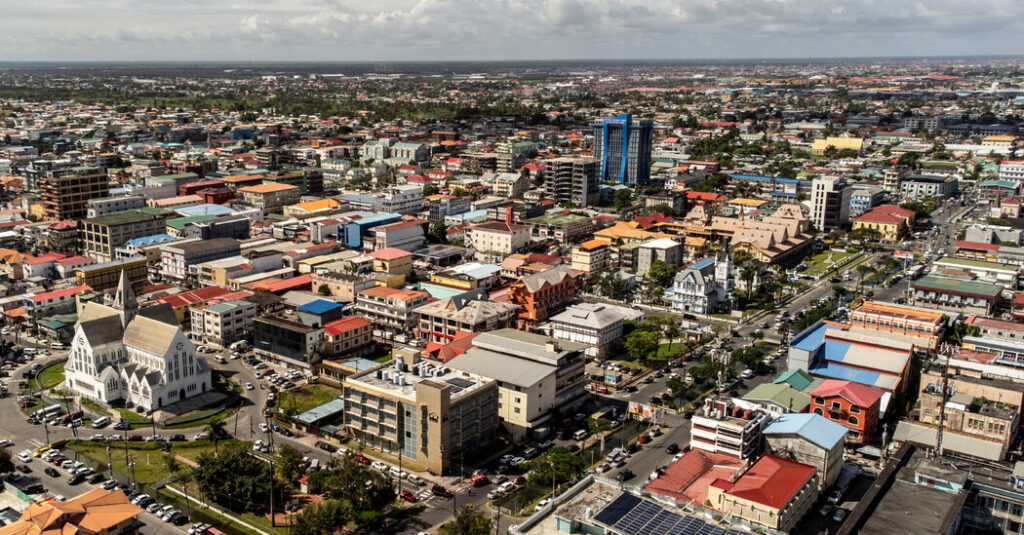
Ferraris and Lamborghinis creep through traffic-choked streets. New steakhouses serve imported cuts of Wagyu beef. Music festivals fly D.J.s in from Miami and Jamaica. Opulent weddings are the talk of the town.
Such luxury trappings are popping up in Georgetown, Guyana’s capital. The city is far removed from the widening war in the Middle East, which has severely restricted energy flows, casting a pall over economies around the world.
But Guyana, a small South American country bordering Venezuela that began producing oil just a few years ago, is reaping a windfall from the turmoil.
The English-speaking nation with just a million people is positioned to take in an estimated $6.5 billion in oil revenue this year, more than double the amount forecast at the start of the year, as the Iran war drives oil prices higher, and countries race to secure supplies far from drone-infested choke points.
This torrent of oil money underscores Guyana’s new standing as a linchpin in a sweeping realignment of global energy markets.
Blunting the loss of Middle Eastern oil, production is surging up and down the Americas, strikingly in Guyana but also in Canada, Brazil, Argentina and, perhaps soon in Venezuela. The Americas now produce around 37 percent of the world’s oil, up from 27 percent a decade ago, according to S&P Global Energy, a research firm.
“Guyana is suddenly punching well above its weight,” said Richard Rambarran, an economist in Georgetown. “But this is only the beginning.” Oil output now stands at about 900,000 barrels a day. Guyana’s production capacity is projected to surge to 1.7 million barrels a day by 2030, Mr. Rambarran noted.
Economic growth reached a staggering 33 percent in the first half of the year, according to government data, making Guyana the world’s fastest-growing economy. But the boom also carries the risk of inciting or magnifying tensions and grievances across the former British colony.
Far from creating a shared prosperity, many in Guyana complain that a small elite is amassing fortunes while ordinary people face rising inflation, rampant corruption, a housing shortage and substandard public services.
The rifts have stark implications for the United States. Guyana is becoming one of the main growth engines for Exxon Mobil, the largest U.S. oil company, as the Trump administration seeks to assert greater control over the Western Hemisphere’s energy resources.
Guyana’s chronically strained ties with neighboring Venezuela are also worsening as Venezuela’s leaders press ahead with a claim to more than half of Guyana’s territory, and Venezuelan migrants pour into Guyana in search of jobs.
Government officials and economists argue that oil revenues are fundamentally improving living standards in what was one of Latin America’s poorest countries, citing tax cuts, new infrastructure like bridges and highways, the elimination of college tuition and one-off cash payments of about $500 to citizens.
Guyana’s population is so small, and its oil so plentiful, that such initiatives are quickly becoming the new normal. The per capita value of Guyana’s oil reserves was recently estimated to be second highest in the world, after Kuwait.
After a state-run ferry capsized in July, killing about 100 people in Guyana’s deadliest event since the 1978 Jonestown mass murder and suicide, some people at vigils and protests asked how this could happen in the world’s fastest-growing economy.
The disaster’s casualties, demonstrators emphasized, were among those still struggling to eke out a living even as Guyana’s government is increasingly flush with oil money.
“We’re sick of hearing about a boom that means nothing to most Guyanese,” said Romola Lucas, a lawyer arrested with other protesters and accused of unlawful assembly after demanding that government officials be held accountable for the tragedy.
As Ms. Lucas emphasized, there can be a jarring disconnect between Guyana’s stunning economic growth and conditions on the ground.
The World Bank has noted Guyana’s rise to high-income status. Annual per capita income in Guyana stands at about $32,000, ahead of every other country in Latin America, including relatively prosperous Uruguay and Chile.
But at street level in the capital, Guyana does not feel like it is suddenly turning into an advanced economy.
Raw sewage flows through Georgetown’s canals. Families cram into squalid housing vulnerable to flooding or fires. Pedestrians take their lives into their hands just to cross anarchic intersections. Robberies at gunpoint are a common hazard.
Georgetown’s rapidly changing cityscape is another point of friction as developers raze the city’s famed, often-decaying Victorian wooden architecture designed for its tropical climate, replacing it with high-rises made of concrete and steel.
“The sheer ugliness of it all is what gets to me,” said Thomas Singh, a professor of economics at the University of Georgetown.
The Iran war’s energy shock has also revealed a paradox: Guyana produces lots of oil but lacks the infrastructure to turn it into fuels like gasoline or diesel. Reliant on imports, Guyana faces high electricity costs and briefly ran short of fuel this spring.
As resentment festers over the uneven gains from the boom, concerns are growing over Guyana’s ability to avoid the all-too-common phenomenon where rapid oil wealth enriches insiders, stokes corruption, unleashes inflation and degrades non-oil sectors of the economy.
Gerry Gouveia Jr., a business leader involved in aviation and lodging ventures, said such fears were overblown. He listed legislation requiring foreign energy companies to utilize local businesses and workers, and Guyana’s creation of a sovereign wealth fund, with limits on what leaders can immediately withdraw, as factors enabling Guyana to avoid those problems.
“Guyana’s leadership knows where other countries got it wrong,” Mr. Gouveia said. Citing infrastructure investments and a robust farming sector, he added, “We’re showing that we have a chance to get this right.”
Guyana’s government did not respond to requests for comment. But in public remarks in recent days, President Irfaan Ali said the economic boom would benefit “every household” in Guyana; he also said authorities were adopting measures to shield citizens from rising inflation.
In the meantime, Guyana’s fractious political system is showing signs of strain.
President Ali, who rose to power in 2020 after one of the most protracted electoral standoffs in modern South American history, has been assailed over whether corruption was involved in his acquisition of a ranch near Georgetown.
He has repeatedly denied any wrongdoing. But by homing in on Mr. Ali’s ranch, Azruddin Mohamed, the opposition leader, seized on public grievances over how some in power, or those aligned with them, are reaping fortunes.
Mr. Mohamed operates under his own cloud of corruption allegations. The Biden administration placed him under sanctions in 2024 in connection to gold smuggling and bribery schemes.
Guyana is also affected by the political and economic turmoil in Venezuela, which lays claim to over half of Guyana’s territory. After Exxon found oil more than a decade ago in the waters off Essequibo, the region in dispute, the feud escalated drastically.
Under its previous leader, Nicolás Maduro, Venezuela intercepted a seismic research vessel hired by Exxon, constructed a military base directly facing the Essequibo border and sprayed a Guyanese military vessel with gunfire.
Less than a year ago, a Venezuelan man was arrested in connection with the detonation of explosives at a Mobil gas station in Georgetown that killed a 6-year-old girl. Authorities called the blast an act of terrorism, raising the possibility that it could be part of a campaign aimed at destabilizing Guyana.
Venezuela’s government rejected any involvement in the attack. When U.S. forces toppled Mr. Maduro in January, many in Guyana thought the dispute would ebb.
But the opposite happened.
Venezuela’s new leader, Delcy Rodríguez, elevated the feud to one of her top foreign policy objectives, even traveling to the International Court of Justice in the Netherlands, part of the United Nations, to present Venezuela’s case.
Her moves have perplexed Guyanese officials, especially after the United States previously showed support for Guyana with defense partnerships and warnings of retaliation if Venezuela attacks Guyana or Exxon.
With the I.C.J.’s ruling in the dispute expected by early 2027, some in Guyana have questioned whether the Trump administration is effectively playing both sides, potentially as a way to exert greater dominance of the energy resources in Essequibo.
“The U.S. does not have friends, only interests,” said Mr. Singh, the economist.
A State Department spokesperson said that President Trump was prioritizing security and prosperity in the Americas, without going into any detail regarding the territorial dispute.
For Guyana, another challenge involves demographics as thousands of migrants, largely from Cuba but also from Venezuela, stream into the country in search of work. Guyana’s government has mostly welcomed this influx as a way to ease labor shortages.
Their arrival is a vivid illustration of the shifting fortunes of Guyana and Venezuela: one country on the rise while the other is trying to exit years of stagnation and decline.
“This place holds opportunity,” said Mirelis Ramos, 39, a Venezuelan migrant who recently arrived in Guyana. She says she even feels at home some days in Bourda Market, a teeming area of open-air stalls where Venezuelan Spanish is heard at every turn. “I see no reason to go back.”
The post A Small Country’s Huge Windfall From the War in Iran appeared first on New York Times.