Russians began voting on Friday in the first parliamentary elections since the full-scale invasion of Ukraine, an exercise carefully engineered by the Kremlin to project popular support for continuing a war now in its fifth year.
Since 2021, when the previous State Duma election was held, the country has changed significantly. The political system has shed its last vestiges of tolerance for dissent. Hundreds of thousands of people have fled the country, including most of its vocal opposition leaders and activists. Almost all antigovernment media outlets have been forced to shut down or operate from abroad.
In recent months, anxiety has been building in society over intensifying economic and political fallout from the war. But the stage-managed election offers little outlet for discontent. According to polls and analysts, the vote is likely to leave the Duma’s composition largely unchanged. The pro-Kremlin United Russia party is expected to retain its legislative supermajority, with four nominal opposition parties splitting the remaining seats.
Here’s what to know about why an authoritarian Russia continues to hold elections and what it does to achieve its desired outcome.
Importance
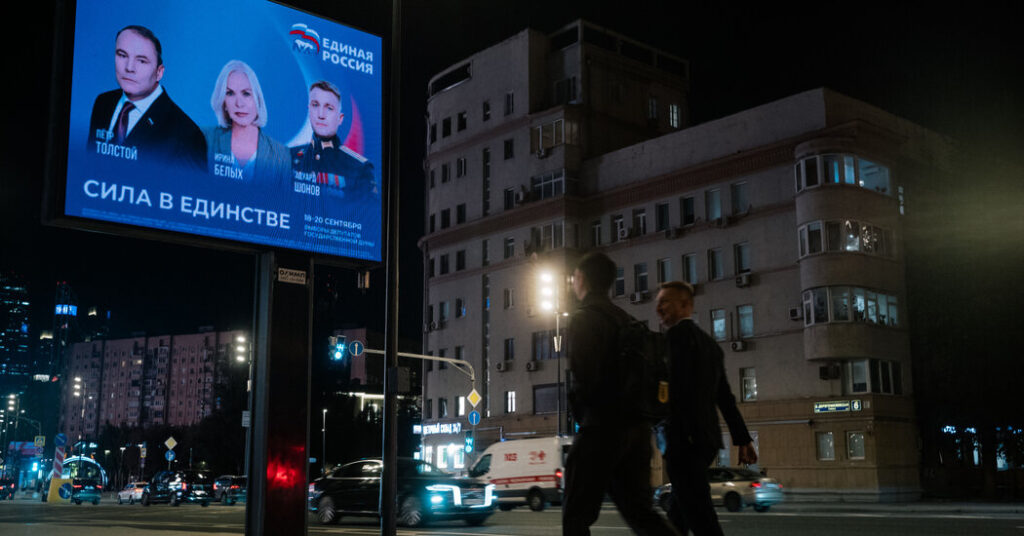
In Moscow, it has been hard to tell that a major election is even taking place. Campaign posters have been scarce, and only a handful of activists have handed out leaflets on streets. There were no large-scale outdoor rallies, and televised debates drew attention only for how uninspired and inarticulate the candidates appeared. On many occasions, candidates skipped the debates altogether.
Still, the voting is critical for those in power, said Ilya Grashchenkov, a political analyst in Moscow who advises Russian politicians and parties.
Mr. Grashchenkov said that stage-managed elections provided the Kremlin with its “sole source of legitimacy.” The government can hold up the results as proof that it is delivering for the Russian people, even with the obvious caveats that come with an unfree vote.
The election also bolsters an official narrative. President Vladimir V. Putin has repeatedly pointed out that Russia continues to hold elections despite the war in Ukraine, contrasting this with Ukraine’s postponement of elections under martial law. (The questionable value of Russian elections, of course, goes unmentioned.)
“We have to stand for election, not be afraid to run for office,” Mr. Putin said in June. “And I would advise everyone to do the same. Especially in Ukraine.”
Mechanics
Elections in Russia are orchestrated through an elaborate, multilayered system managed by the Kremlin’s political apparatus.
First, unwanted candidates are filtered out early. This year, the primary example was the removal from the ballot of the liberal Yabloko party, which has explicitly called for an immediate cease-fire in Ukraine. The party was barred after it rapidly galvanized pro-peace sentiment in Russia, which appeared to be stronger than the Kremlin had expected.
Second, the central government’s political managers set targets for the final composition of the Duma, Mr. Grashchenkov, the political analyst, said. These goals are handed down to regional authorities, who are tasked with delivering specific margins based on their region’s demographic and cultural profiles.
The governors and their political advisers then apply pressure intended to get public sector workers to go to the polls in support of the government. Local companies and businesses that back the government also push workers to cast ballots by entering voters into lotteries or offering other incentives. Because of sparse campaigning in Russia, people who might support opposition candidates feel discouraged from participating in the election.
Finally, the Kremlin uses online voting, which is available in more than a third of Russia’s regions, to fine-tune the result, Mr. Grashchenkov said. While the government is not believed to engage in wholesale rigging of voting results, opposition activists have accused it of altering numbers from online voting, which is easier to do than with paper balloting.
Evolution
After emerging from the collapse of the Soviet Union in 1991, Russia initially tried to conduct open parliamentary elections modeled on Western systems.
That period was short-lived. In 1993, during the first post-Soviet parliamentary vote, a nationalist party finished first over pro-Kremlin forces. “At that point, the idea emerged that everything needed to be moderated and managed,” Mr. Grashchenkov said.
The intensity of the management has grown steadily over time. In the beginning, the Kremlin leaned on Russian oligarchs to fund pro-government parties. In the 2000s, political strategists were dispatched to the regions to engineer the desired outcomes. In the decade preceding the war in Ukraine, the authorities relied on more heavy-handed tactics, coercing state employees to vote.
After the 2022 invasion, pressure to back the government intensified. The message, Mr. Grashchenkov said, was, “If you’re not with us, you’re against us.”
On Wednesday, in an address before the election, Mr. Putin made it clear that voters should have no second thoughts about whether the war should continue until complete victory.
“Your choice and resolve will show once again that millions of people stand behind our fighters,” Mr. Putin said. “Participating in the elections is our shared contribution to Russia’s victory.”
The post Why Russia Holds Elections, and How the Kremlin Gets the Results It Wants appeared first on New York Times.