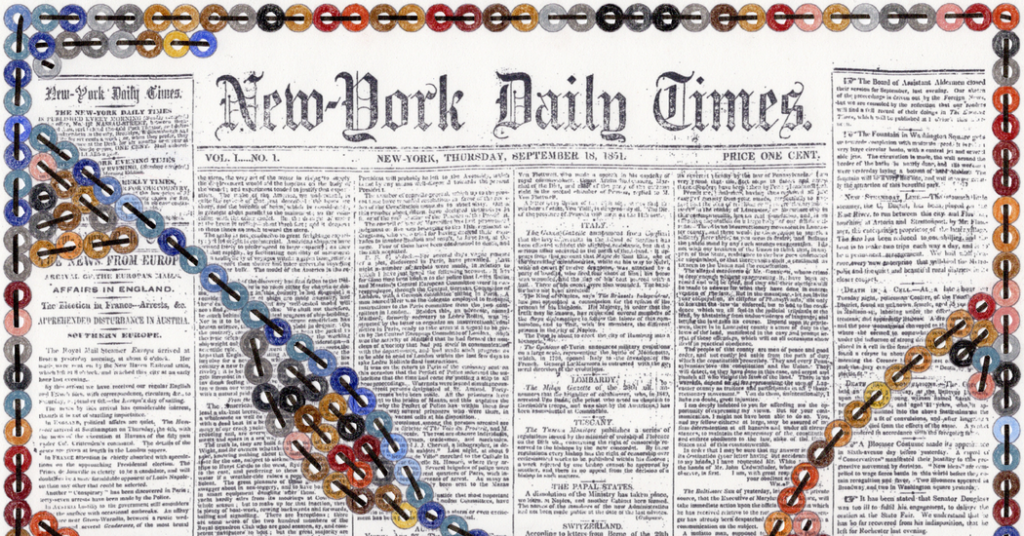
The world of journalism that Henry Raymond and George Jones were venturing into when they gave birth to The New-York Daily Times on Sept. 18, 1851, was, um, open for improvement. Look at competitors like The Sun or The Courier, and you will notice, first, that all but a few of the many columns on a typical front page were completely filled with ads.
Not particularly riveting ads, to the modern eye. But back then, of course, a lot of people were looking for help in a pre-mass-media world, where it was no easy task to find a room “suitable for a gentleman” or get the chance to purchase scrap iron or 300 bags of black-eyed peas.
The peas were probably a bit more interesting than the actual news stories in those newspapers on Sept. 17, the day before Raymond’s first issue. (One of The Courier’s top articles began, “This has been an unusually dull day for business generally.”) It’s a tribute to the readers of the era that they were interested enough in the world around them to buy the papers anyhow.
More serious dailies offered meatier stories. Horace Greeley’s New-York Daily Tribune, where Raymond had previously worked, announced the publication of more than a dozen new books on its front page, including “The Insects of Autumn” and “Professor Dodd’s Arithmetic.” But readers had to turn to the inside pages to learn, for instance, about a riot in Key West, Fla., during which Spanish shops were ransacked and one ship nearly burned. The paper, known for its judgmental reporting, described this as “another gross outrage against Spanish citizens.”
The New York Herald boldly offered hard news on Page 1 about the arrest of conspirators against the government of France, tension and unease across the Italian peninsula after the revolutions of 1848 and the emperor of Austria’s effective abolition of the Constitution — news all sent by telegraph and often sourced from European newspapers. The Herald also reported about President Millard Fillmore’s visit to Rhode Island and the opening of a railroad in New York State that could carry passengers from New York City to Canandaigua in less than 14 hours.
Raymond was also entering into competition with a large variety of special-interest and advocacy papers, many of them weeklies, promoting or supporting abolition, temperance, women’s rights, workers’ rights and various religions, occupations and immigrant communities. Prominent among these was the four-page Frederick Douglass’ Paper, published in Rochester, N.Y., a leading voice for abolition nationwide.
Readers of all dailies wanted to know what was going on in Europe, even if the stories they were rewarded with included stuff like one of the lead pieces in The Sun, titled “Leaves from My Note Book.” In it, an unnamed correspondent used his prime front-page turf to report on a trip he’d just taken to a “vineyard on the Rhine” in Switzerland and shared with the readers his conclusion that the territory could use “a little more variety in the colors of the landscape.”
Truly, it was like the worst letter you ever got from a distant relative abroad.
He — let’s face it, the writers were just called “our correspondent,” but they were mainly guys. (We stop here to give a quick bow to Margaret Fuller, the great author who became the first American female war correspondent, covering battles in Europe for The Tribune in the late 1840s.)
But about that lack of bylines — do you think the publishers wanted to keep all the credit for themselves? Or maybe the role of newspaper writer was so unimpressive back then that people who were doing it told their friends they were designing furniture or selling real estate for a living.
Once the Civil War began, the anonymous-correspondent issue would actually become … an issue. Military leaders complained that reporters were disclosing secret information and demanded the writers publicly stand behind their stories. Or maybe, as one Union general suggested, if all else failed, the government could just try “holding the editors responsible.”
Guess that got their attention. The byline came into common use. But The Times wasn’t all that enthusiastic about the sudden elevation of employees, many of them undoubtedly sort of scruffy guys, to the named representatives of the paper. It didn’t totally go along with the trend until well into the 20th century.
The Times’s biggest early success story was probably sheer survival. Papers came and went without fanfare in the city of roughly half a million residents. Seven dailies, named The New York Times, had already arrived, published and failed.
The one that would last was produced by a crew that worked long hours (sometimes by candlelight) out of a modest building at 113 Nassau Street. City journalism itself was evolving. One-cent papers, supported mainly by advertising, were springing up to compete with the six-cent dailies. These newcomers were aimed not at political and business leaders, as their competitors generally had been, but at readers with general interests. Thus, reporters were dispatched to actually gather real news. Even their plentiful ads were meant to serve, in the words of the journalism scholar Michael Schudson, “the newspaper reader as a human being with mortal needs.”
The human being, Raymond imagined, valued independence. In his prospectus for the paper, he declared, “columns will be free from bigoted devotion to narrow interests, and will be open, within necessary limitations, to communications upon every subject of public importance.” One necessary limitation: Raymond was a Whig and later, when the Whigs came unraveled, a Republican — and so was his newspaper. But this was no scandal. Back then, newspapers were partisan as a matter of course.
When The Times first arrived on the scene, people could buy scandal-mongering papers to give them something to talk about over the 19th-century version of an office water cooler. One thing folks weren’t counting on back then was up-to-the-minute reporting. The telegraph was just coming into its own, and some customers were getting papers like The Courier by mail. That version came out only twice a week, so it’s unlikely many readers were expecting breaking news. The challenge for the more high-minded publications was to provide stories that were respectable but still engaging.
It wasn’t easy. The lead story in the Sept. 17 issue of The Courier was a report on “affairs in England” from a correspondent who shared the news that the Crystal Palace from the Great Exhibition of 1851 was about to be closed. Well, about to be closed in October, when it was scheduled to shut down all along.
The story pushed the American angle. That actually did seem a little … sad, given the fact that the lead had to be about a shortage of U.S. exhibitions. “Although the space allotted to us was not filled, we shall not occupy a position altogether insignificant,” reported the optimistic, though unnamed, writer.
That report on the dismal American showing at the Crystal Palace tried to push the positive: “Among the various articles contributed by our countrymen, none is attracting such general attention, or eliciting such unanimous approval from distinguished Mechanicians, as Gwynn’s Balanced Centrifugal Pump” the writer reported. The article continued: “It is amusing to witness the astonished incredulity with which both the learned and un-learned contrast the enormous body of water ejected by this pump, with the small orifice through which it is discharged.”
Perhaps this is the kind of thing that readers talked about with their families over dinner. But it’s also pretty easy to imagine that the pump conversation had its limits. After all, young America in 1851 was preoccupied with a few other topics — slavery, a wave of immigration, westward expansion, a hotel boom in New York City, a railroad boom beyond and the budding idea that Black people and women should be able to vote (and to have bylines). It could be that readers were looking for front pages that reflected the energy of that world, which is maybe why, in less than two weeks after its September birthday, Raymond’s paper claimed a circulation of 10,000.
The post The Day Before The Times Began appeared first on New York Times.