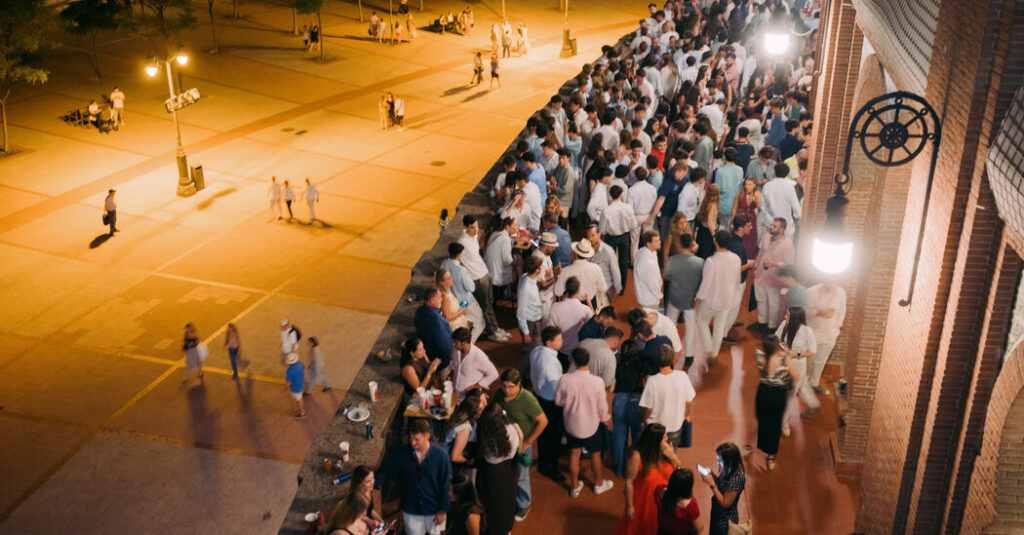
Hundreds of Spanish teenage boys — many wearing loafers, fitted cropped white pants, quilted vests or Barbour hunting jackets — erupted in cheers when a boy band in similar outfits introduced their hit song from the stage.
“This song is self-explanatory, it explains our origins,” one of the singers said to the packed courtyard of an exclusive Catholic prep school on a rainy night in Madrid. “This is who we are and we’re not going to change!”
With that, the group, Avenida, struck the driving opening chords of their hit song “Cayetano,” a term often used to describe young Spanish conservatives with a fondness for preppy clothes. When they reached the chorus, the audience sang “All my friends are named Cayetano” in gleeful unison.
No one seemed to mind that the song was actually a nearly decade-old cover of a hit by another Spanish band that had used it to mock the very kind of people now singing their hearts out. That Avenida had re-appropriated the insult “Cayetano,” an aristocratic-sounding first name often associated with wealthy families, exemplified the newfound confidence of young Spanish conservatives.
The retro, and at times revanchist, Cayetano movement has claimed the counterculture mantle in Spain, opposing a left-wing government that has led the country for nearly a decade.
Self-described Cayetanos — whose style has infused Madrid’s streets, national political rallies and pop concerts — bristle in their ironed shirts and flowing floral dresses against the left-wing government’s support for immigration or its opposition to Spanish traditions like bullfighting.
Their views are less uniform than their outfits. Some are fixtures of well-to-do Spanish society and members of Spain’s mainstream conservative party, but the Cayetano aesthetic can also be seen at the rallies of Vox, Spain’s main far-right and anti-immigrant party. During the pandemic, it was also a feature of protests in Madrid’s toniest neighborhood against coronavirus lockdowns, a wave of demonstrations that the Spanish news media dubbed “The Cayetano Revolt.”
In conversations with dozens of exponents of the Cayetano style, they often chafe at the notion that they hold racist, sexist or homophobic positions, or that they don’t ascribe to the civil liberties of modern Spanish democracy. But they also portrayed the overreaches of feminism, multiculturalism and woke politics as a threat to Spain’s traditional identity.
They say that they are on the front lines of a battle for Europe’s cultural and political reversion, with a renewed adherence to religious institutions, traditional gender roles and, for many, the politics of nationalism.
“It’s a response to the wave of anti-nationalism, and we wanted to be proud of our country’s roots, the bullfighting, the church, the way we dress,” said Gonzalo Fernández de Heredia, 22, an engineering student and self-identifying Cayetano.
He wore the Cayetano’s preppy uniform as he spiked orange soda with rum in the stands of Madrid’s bullfighting arena on a June evening.
“We want to go to the past,” he said.
It is a vision that some young Spanish women feel equally at home in. “Being a Cayetano is a style,” Pilar Izquierdo, a 24-year-old consultant, said approvingly of the look, adding that it was also “a way of being in the world.”
Liberals, including officials in the government led by Prime Minister Pedro Sánchez, whose very name is a curse in Cayetano circles, are worried that young conservatives are potentially a threat to Spanish democracy — an accusation that strikes the conservatives as overblown and itself undemocratic.
Leftists often cite a poll last year that showed growing approval among young Spaniards for the right-wing dictatorship of Francisco Franco, which ended in 1975. For leftist leaders, Cayetanos are Francoist wolves in Ralph-Lauren-like clothing, the loafer-wearing jackboots of Spain’s far-right party Vox.
Despite — or perhaps because of — that scorn, Cayetanos are increasingly present across the Spanish cultural landscape, spreading beyond the elite political and business circles of Madrid and southern Spain. In 2022, Burger King released an ad in Spain, set to an operatic version of the song, “Cayetano,” that depicted a family of posh Spaniards, many named Cayetano, evaluating what made the chain’s burgers so classy. That year, a podcast by the liberal newspaper El País asked: “Why do Cayetanos fascinate us?” In 2024, María del Carmen Méndez Santos, at the University of Vigo, published a paper on “The Lexicalization of the Proper Name Cayetano,” exploring how the term had become so widespread.
The emergence of the band Avenida underscored the Cayetanos’ arrival as a cultural force.
In late 2025, Javier Navarro, a talent scout at Universal Music Group, saw one of Avenida’s music videos going viral. Commentators had roasted the clean-cut group as “Vox Street Boys,” a reference to the right-wing political party. But Mr. Navarro and his label saw promise.
“‘Man, you have gold,’” he said his colleagues told him after he signed the group.
I met the band’s five members, all well mannered and affable, in one of their apartments, in a living room decorated with a Catholic triptych and a magazine article declaring them “Good Boys.” A shoe rack behind the door held lots of loafers.
The cultural energy, and even countercultural edge, is now on the right, said Nacho Gómez, one of the band’s lead singers, “mostly because people want a change, right? If the change now is to return to what was before, hey, then we change.”
He said that the cool thing to do now was go to Mass and get a beer on Sundays, to return to the way things were before, because “the old stuff is cool. Politically, too.”
‘We Want to Go to the Past’
Experts say that the Cayetano look is newfound rather than new, traceable back to the landed gentry who lived or summered in the Spanish south in the 19th century.
“This is a tradition that comes from Andalusian high society,” said Carlos Sánchez de Medina, a prominent fashion historian.
The men in that class often looked to England, the standard-bearer of landed gentries, and borrowed the English pastimes of hunting and horseback riding, Mr. Sánchez de Medina said.
Gradually, the landowners adopted the English hunting aesthetic and clothing brands, including Barbour, and dress shirts that they unbuttoned in a southern Spanish flourish. “What we now call the Cayetano,” Mr. Sánchez de Medina said, had its model in the “Andalusian landowner aristocrat.”
In time, he said, the dress code took on a political meaning. There were clearly exceptions, he said, but it was generally a conservative look for conservative people.In 2017, the indie rock band Carolina Durante categorized the adherents of the look as “Cayetano” in their hit song of the same name. “Always three buttons unbuttoned,” the band sang, referring to the Cayetanos’ open-chested shirts. “What great hair.”
In Madrid, aficionados of the aesthetic often suit up at Castellanos, a popular shoe store in the tony Salamanca neighborhood that has lent its name to the style of loafers preferred by Cayetanos.
On a recent afternoon, Luis Eugui, a 23-year-old who works in finance, wore a button-down shirt opened in a deep V that exposed a tangle of gold crosses and medallion necklaces. He wore Castellano tassel shoes and proudly showed off the new pair that his father, the C.E.O. of a construction company, had bought him.
Mr. Eugui rejected the term Cayetano as a slur and said it was reductive to think that “how you dress should indicate your political ideology.” He could vote for anyone, he said.
Still, he acknowledged his cleaner style of dress was more associated with the right, and his father nearly choked at the suggestion that his son could support the liberal prime minister.
“Sánchez,” Mr. Eugui confirmed, “is not my style.”
‘Long Live the Cayetanos!’
This summer, groups of identically dressed young men filled Las Ventas, Madrid’s most famous bullfighting ring. Many of them weren’t watching — they stood chatting in the rafters with their backs to the action as the bull fighter struggled to put the evening’s last bull out of its misery.
Finally the bull fell, and a cry of “To the bars!” erupted from the stands. Packs of young spectators raced to the concourse, showing their I.D. cards to the bouncers working the ropes to the balconies. The bullfight had morphed into a giant Cayetano after-party.
Dressing up in one’s best shirts and loafers for the bullfights has turned into a political act for young Spanish conservatives, even if many of them do not actually watch the fighting. Spurred by the left-wing government’s opposition to bullfighting, they have helped revive interest in the Spanish tradition after years of declining attendance at bullrings.
Managers at Las Ventas have seized the moment. To the chagrin of bullfighting purists, they set up a post-event bars to lure young people to what became a conservative dating scene, in the hopes some would fall for bullfighting, too.
In October 2025, the star bullfighter Morante de la Puebla gave a superlative performance, after dedicating his fight to Santiago Abascal, the leader of Vox who was seated in the front row. That prompted hundreds of young bullfighting fans, dressed in the Cayetano style, to storm the arena. Such exuberance hadn’t been allowed in the past, Carlos Ruiz Villasuso, an official at Las Ventas, said, in part because the spectators were generally too old “to jump the barrier.”
Now, he said, bullrings around the country were copying his after-hours model. He estimated about 30 percent of Las Ventas’ ticket holders were now under the age of 30. And many of them, he acknowledged, wore the Cayetano uniform.
“I don’t think it’s a rule, it’s a way of dressing,” he said, adding, “Long live the Cayetanos!
Well past midnight, two friends, both dressed like Cayetanos, stood by the ledge of the terrace, talking politics and comparing their loafers. Nicolás Paredes, 20, wore polished penny loafers, while Lucas Fernández, 19, wore tasseled ones.
“These are the two kinds of shoes,” said Mr. Paredes, a proud supporter of Spain’s far-right.
Mr. Fernández said that Vox had become “the party of Cayetanos,” even if the party itself has broadened its appeal to working-class voters, with many new members sporting boots instead of loafers.
But Mr. Fernández said the clothes didn’t always make the man, or his politics.
“I like the Socialists,” he said, almost in a whisper. “I’m the stranger here.”
Carlos Barragán contributed reporting.
The post Spain’s Preppy Conservatives Are Having a Moment appeared first on New York Times.