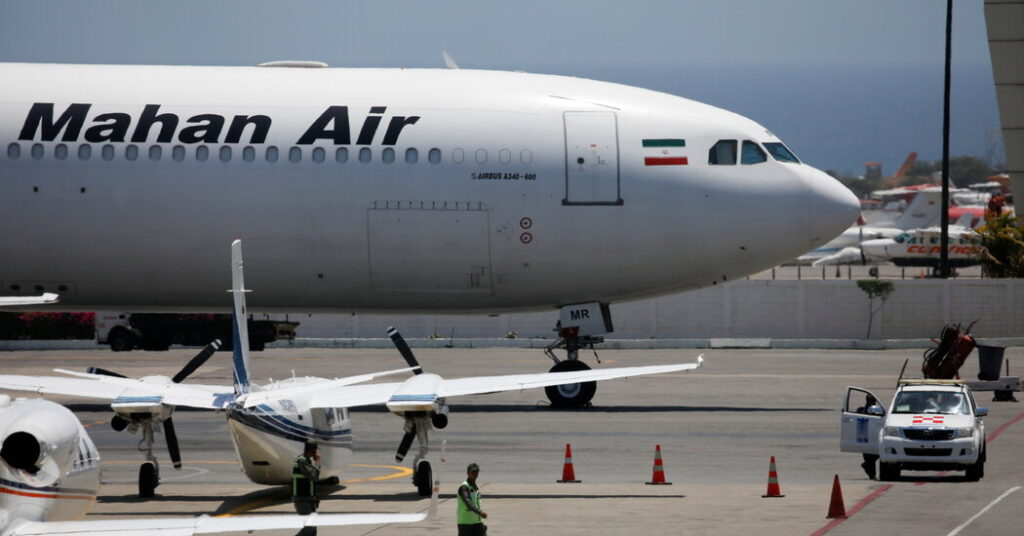
A major Iranian airline suspended flights to neighboring countries, adding to the country’s isolation caused by sweeping U.S. sanctions and a naval blockade that have sought to cut off Iran from the global economy.
Mahan Air, Iran’s most prominent commercial carrier, announced the measures on Wednesday, just over a week after the U.S. Treasury Department put restrictions on Iran’s aviation industry intended to severely limit its ability to operate abroad. The new U.S. measures also make it difficult for other countries and non-Iranian companies to work with the Iranian aviation industry, as doing so could be put them at risk of being punished by the U.S. government.
The flight suspensions are likely to further strain many Iranians’ already fraying links with the outside world and add to their hardship, with much of the population feeling squeezed by an American economic pressure campaign.
Mahan Air will stop flying to Oman starting on Thursday and to Turkey starting on Monday, it said in a notification sent to Iranian travel agencies on Wednesday. It did not explain why in detail, saying only that it would stop flights after unspecified decisions by the Turkish and Omani aviation authorities. It did not cite the sanctions.
The suspension of flights comes as a longstanding economic crisis in Iran has been made worse by the war. The U.S. Navy has instituted a blockade of Iran’s southern ports that has curtailed its ability to export oil or import key goods. The Iranian government raised some fuel prices this month because of the financial pressure, increasing the price at the pump for Iranians who were already enduring spiraling inflation and high unemployment.
Last month, the U.S. Treasury announced an “Economic D-Day” that threatened to punish countries and entities that did business with Iran. It said it would target Iran’s trade in gold and cryptocurrency, among other sectors, helping to send the price of Iran’s currency, the rial, to new lows and making imports more expensive.
Mahan Air issued its announcement after the U.S. Treasury Department imposed sweeping sanctions on 27 Iranian airlines and wider restrictions on the sector this month.
The restrictions are part of a broad U.S. campaign to sever Iran’s ability to skirt restrictions on its financial and military sectors, and cut off what it sees as the government’s use of civilian aviation for military ends.
For Iranians who can afford to travel, the airline restrictions add to the list of problems caused by the economic pressure.
“We, the Iranian people, are the ones who are miserable,” said Marzieh, 62, a housewife living in the southwest of the country. Like others who were interviewed for this article, she spoke on condition that her last name not be published, for fear of retribution by the government. “Day by day, we are being pushed further and further toward ruin.”
Speaking before the airline announced that it was suspending flights, she listed what she saw as the likely result of the new measures: fewer international flights, higher prices and more obstacles to those who want to migrate, seek medical treatment or visit family abroad.
The aviation sanctions could also make it harder to maintain American-made planes used by Iranian airlines.
The Treasury suspended licenses that allowed payments to the Iranian government for American aircraft flying over Iran or forced to make emergency landings there; that allowed planes flying to or from Iran to receive some goods or services in the United States; and that allowed the export of goods or services to Iran to ensure the safety of American-made planes. The Treasury said that it would “consider aviation safety-related requests on a case-by-case basis.”
The Treasury also paused a broad license that had allowed American-made civilian aircraft, or civilian aircraft made up of 10 percent or more U.S. parts, to be flown to Iran.
Because the vast majority of the world’s civilian airliner fleet falls into those categories, sanctions experts said, foreign airlines will now have to apply for a license from the U.S. government if they want to maintain their routes into Iran.
The Treasury also sanctioned Emirati and Turkish companies that it said helped Mahan Air purchase three aircraft this summer.
Iran’s aviation sector has been targeted by the United States for years, because of accusations that it has been used to help fund and equip the country’s militant allies in the Middle East.
The U.S. Treasury imposed sanctions on Mahan Air as early as 2011, saying it helped to ferry militants and members of the Islamic Revolutionary Guard Corps, the most powerful branch of Iran’s military, which the United States has designated as a terrorist organization. Nonetheless, Mahan had been able to procure planes and continue to fly abroad before the new restrictions took effect.
“I’d frame the whole package this way: Treasury is shutting down a general, no-questions-asked permission system that the regime has exploited for years and replacing it with case-by-case licensing,” said Miad Maleki, a former U.S. Treasury official who worked on Iran issues and has urged the Trump administration to more strictly enforce sanctions on Iranian aviation.
Treasury’s actions, he said, come “in the middle of a war in which the regime is firing missiles and drones at the very Gulf cities its planes fly into.”
Iranians inside the country had a variety of reactions to the new sanctions. Some were concerned that the costs would fall mostly on ordinary people, while others observed that many of them cannot afford air travel anyway because of Iran’s deteriorating economy.
Ensieh, 74, a retired teacher who visits her children occasionally in Europe, said that “while these sanctions do have a significant impact on the government, sanctions targeting Iran’s aviation sector cause the greatest harm to Iranian families and society.”
Others, like Masoud, a 39-year-old accountant in Mashhad, in the northeast of the country, blamed Iran’s government for pursuing military and regional policies that spurred U.S. sanctions.
“People are dealing with so many problems that sanctions on airlines — which perhaps are ultimately used by no more than 5 percent of the population — don’t matter that much to people who have long been struggling to make ends meet,” he said.
The post Iran’s Isolation Grows After U.S. Imposes Sweeping Sanctions on Airlines appeared first on New York Times.