The Trump administration plans to roll out a new A.I. air traffic control tool designed to predict and prevent flight delays in the Washington region starting Monday, as the opening step of an eventual nationwide deployment.
The tool, called Strategic Management of Airspace, Routing and Trajectories, or SMART, is designed to analyze airline schedules, weather patterns and other potential air traffic interruptions to “predict traffic flows and identify potential conflicts before they occur” and recommend alternate flight routes to avoid compound delays.
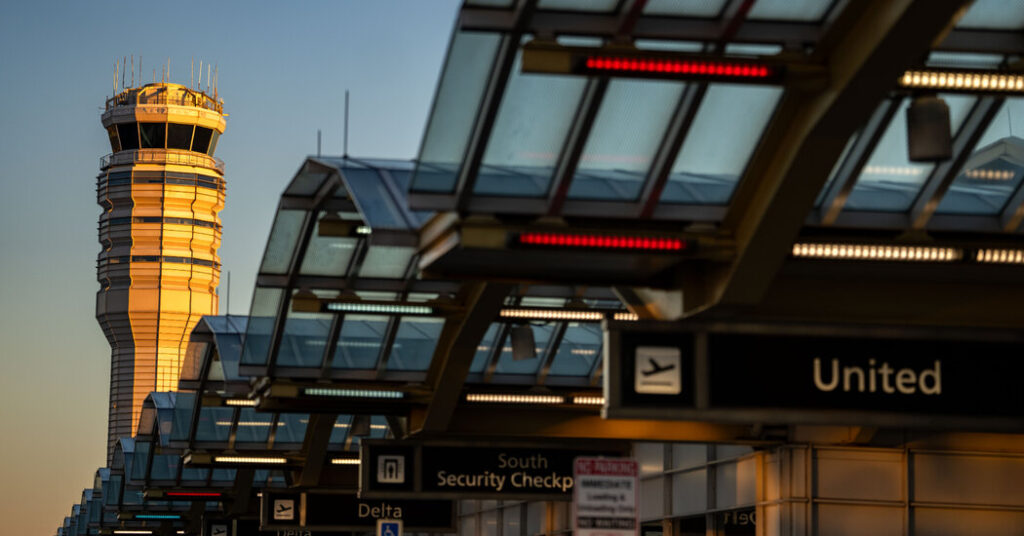
While the $875 million system is expected to be deployed nationwide by 2028, Monday’s rollout will be limited to the Washington region, affecting three airports: Ronald Reagan Washington National Airport, Dulles International Airport and Baltimore/Washington International Thurgood Marshall Airport.
Washington’s congested airspace, one of the busiest in the nation, has drawn particular scrutiny following the January 2025 midair collision between a commercial jet and an Army Black Hawk helicopter that killed 67. The National Transportation Safety Board placed the blame for certain failures leading up to the crash on the Federal Aviation Administration.
The phased rollout is a chance for the administration to assess how well the new technology helps airlines and air traffic controllers avoid flight delays, and whether artificial intelligence can help those responsible for managing airline traffic circumvent potential interruptions more efficiently than they can on their own. The rollout comes amid a national uproar over the rapid development of A.I. models and bipartisan calls to rein in the industry, which President Trump and several of his deputies have flatly rejected.
Against that background, Transportation Department officials stress that the SMART system will not replace human operators or direct any changes to flight routes, but merely offer recommendations that controllers can choose to heed or ignore. The system will be located at the F.A.A.’s Air Traffic Control System Command Center in Warrenton, Va., which manages airspace traffic; officials will disseminate the A.I. recommendations to controllers at the regional towers and other air traffic facilities.
Transportation officials also pointed out that SMART is designed to analyze scheduling and congestion data over a month in advance to help predict when airports and airlines might be vulnerable to delays. But the rollout will begin modestly at first, with the A.I. system offering alternatives to avoid only same-day delays, such as those caused by weather, before being scaled up to its full potential.
“We’re excited to launch SMART and take another major step toward improving air travel for the American people,” the F.A.A. spokeswoman Hannah Walden said in a statement, calling SMART “a new tool that will fundamentally change the way we manage our skies.”
Yet the progress to this point has not been wholly smooth.
Federal transportation officials announced in June that they had awarded the contract to develop SMART to Air Space Intelligence, a Boston-based software company. At a congressional hearing this week, Bryan Bedford, the F.A.A. administrator, asked Congress for billions more dollars to fully modernize air traffic control systems, arguing that new technologies are needed to “supercharge our ability to safely grow traffic and reduce the workload and strain on our controllers.”
Transportation Secretary Sean Duffy and other administration officials have criticized current air traffic control systems as outdated and touted new programs, including the new A.I. tool, as “a huge, massive build and upgrade.”
For a rollout to begin only a few months after the contract was awarded is uncommonly fast, according to officials and experts, some of whom stressed that the F.A.A. had to engage in extensive conversations to allay concerns among airlines and controllers that the A.I. system might prove more problematic than helpful.
Robert Mann, a former airline executive who is now an aviation industry consultant, said that SMART may suggest better flight plans, but it is unlikely to address the major problems associated with delays, which happen after a flight plan is filed.
“Whether it’s on the ground or in flight or in the terminal area,” Mr. Mann said, “you’re up against a whole bunch of other traffic which arrives roughly the same time, and that’s because they’ve experienced the same sort of random delays on the ground, en route, and in the arrivals area that you are.”
While airlines might cooperate with the program initially, he added that they might come to view it as an intrusion from the F.A.A., because they carefully plan and manage their flight schedules well in advance and changes are costly.
“We’ll see how long that acquiescence lasts,” Mr. Mann added.
The rollout also comes as the F.A.A. has struggled to solve a chronic shortage of air traffic controllers. While the agency has insisted that the new A.I. system will not displace or replace human employees, the Trump administration and the union representing air traffic controllers are currently locked in a dispute about how many controllers the F.A.A. needs to hire to make up staffing shortfalls.
A year ago, the F.A.A. published a report suggesting that it would need 14,633 controllers to be fully staffed; this spring, it revised that estimate down by more than 2,000 positions, stressing that more efficient scheduling could offset the need for more hires. As of this April, the F.A.A. reported having more than 11,000 fully certified controllers.
A spokesman for the National Air Traffic Controllers Association said in a statement that the union “believes any new technology should complement and not replace the experience, training and professional judgment of air traffic controllers who are responsible for the safety of the National Airspace System.” It added that the group had not been part of the design or testing process of the system.
The post F.A.A. to Roll Out New A.I. Tool for Washington Airports appeared first on New York Times.