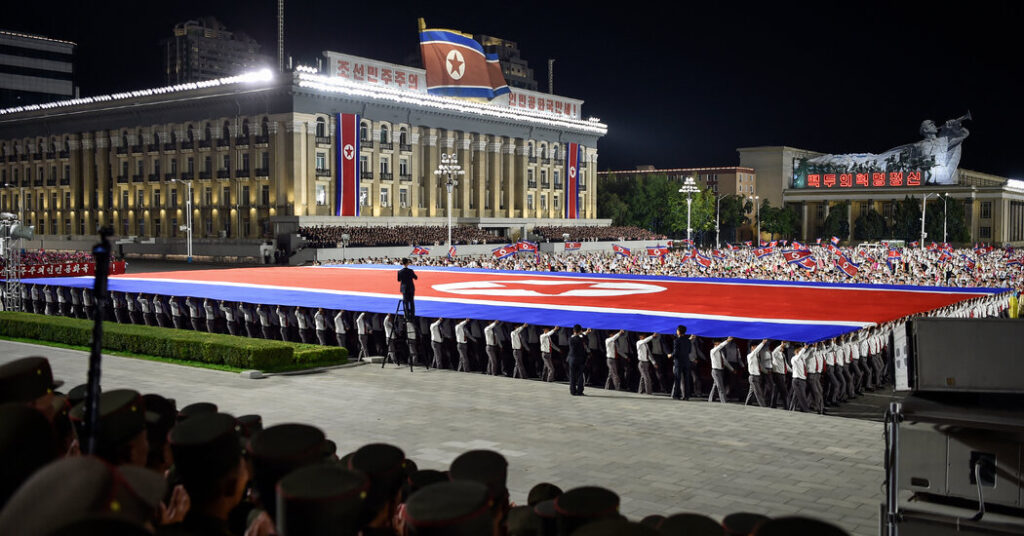
His nation is now a de facto nuclear power. Its economy is growing at the fastest pace in years. He has been courted by the leaders of China, Russia and the United States.
Kim Jong-un, the North Korean dictator, has emerged as an unlikely winner of the post-pandemic era. And his newfound strength rests on the systematic exploitation of his own people, which is actively facilitated by Moscow and Beijing.
By supplying troops and ammunition for Russia’s war in Ukraine, Mr. Kim is estimated to be reaping billions of dollars. Russia is repaying Pyongyang in advanced military technology and critical commodities like flour, pork and oil — goods his regime can then resell at home for profit.
But the human cost is staggering, for North Koreans at home and abroad.
Thousands of North Korean soldiers have been killed or wounded on faraway battlefields.
“I tremble as I await the daily reports, wondering how many soldiers were lost, whether they suffered reckless losses in the pursuit of bravery, whether they succumbed to fear or fell captive to the enemy,” one young North Korean platoon leader wrote in his diary before he, too, died in combat.
Thousands more North Koreans toil behind the front lines, working in military drone factories, repairing war-damaged cities and building apartments across Russia to meet revenue quotas set by Mr. Kim’s government. With Moscow looking the other way to evade sanctions, many enter Russia on student visas but never see a classroom — instead sleeping in shipping containers and enduring 14-hour shifts with hardly any days off.
Closer to home, China is openly importing North Korean coal in violation of United Nations sanctions, satellite imagery indicates. Defectors say the commodity is mined by workers trapped in forced labor in central and northern North Korea.
Even North Korea’s biggest official export — hair products like wigs and false eyelashes, which are not subject to U.N. penalties — has brutal origins. Much of that merchandise is produced in labor camps, where inmates are forced to meet daily quotas and, survivors say, risk starvation if they fail. The payoff for Pyongyang was $188 million in sales to China in 2024 alone, according to Chinese customs data.
On paper, North Korea is a socialist state, with free provisions for citizens. In reality, it is a regime of quotas, in which everyone must contribute to a shadow economy that sustains Mr. Kim’s extravagant lifestyle and military ambitions — lavish dinners, armored cars, luxury yachts, seaside resorts and nuclear missiles.
“North Korea claims to be a tax-free country where everything is free,” said Ryu Hyeon-woo, who was its acting ambassador to Kuwait when he defected. “In reality, its system survives by milking its people.”
North Korea’s economy has grown more than 3 percent in each of the past three years, according to South Korea’s central bank, a drastic reversal from its pandemic-era contraction. To uncover the methods driving this turnaround, The New York Times spoke with dozens of North Korean defectors, human rights investigators and geopolitical analysts.
The Wig Makers
The first thing that Baek Hye-ok said she noticed at the Chongori labor camp in northeast North Korea was the smell.
A cell no larger than a two-car garage held more than 100 women. Wardens, unable to bear the stench of unwashed bodies, ordered inmates to kneel 10 feet away when summoned. Bedbugs dropped into bowls of gruel.
“You didn’t spit it out because your life depended on it,” Ms. Baek recalled years later in Seoul. “You never forget the stomach-churning smell when a bedbug bursts between your teeth.”
Work began at dawn. Young women with sharp eyesight stitched wigs and false eyelashes. Trucks delivered raw materials labeled in Chinese and departed with finished goods. Prison officials told inmates that the shipments went to China through the nearby city of Rason, Ms. Baek said.
“Your life depended on meeting your quota,” she said. “Fail, and you were beaten and your ration cut.”
During separate interviews, Ms. Baek and Lee Young-ju, another former inmate who defected and now lives in Seoul, said that roughly one in every 10 inmates died each year. They were quickly replaced by new arrivals — many of whom had been caught foraging for food across the border in China because they did not have enough to eat at home. Others were being punished for watching smuggled South Korean dramas. Some inmates were so desperate that they ate maggots from corpses. Ms. Lee spent three years at the labor camp while Ms. Baek put in two years over two stints.
“The place was a living hell,” Ms. Lee said.
The Elites
Few can escape quotas, defectors say.
Villagers scour hills for berries bound for China. Schoolchildren supply rabbit hides for soldiers’ gloves. Tractor plants run dual lines: farm machinery on one, tanks on the other. Elites fund gold-plated statues of Mr. Kim’s father and grandfather, and maintain the Pyongyang mausoleum where their embalmed bodies lie. The 1.3-million-strong army — the world’s fourth largest — doubles as a free work force, dispatched to construction sites.
The scramble for revenue extends abroad.
Diplomats smuggle Cuban cigars and African rhino horns inside diplomatic pouches to raise “loyalty funds” for Mr. Kim, or to feed his family’s taste for Russian king crab, Arabian sweets and gold-tipped Montblanc pens, said Mr. Ryu, a son-in-law of the former head of the ruling Workers’ Party’s Bureau 39, which manages Mr. Kim’s secret funds.
Even the General Bureau of Reconnaissance — North Korea’s main intelligence agency — moonlights as a business. At one point, it ran restaurants and a squad of 19 hackers and IT workers out of the United Arab Emirates, Mr. Ryu said. They stole cryptocurrency or used stolen identities to take freelance coding jobs.
Pyongyang selects young students gifted in math and science, training them from an early age to become software engineers or hackers. It later deploys them to China, Russia and the Middle East, where they help fill the regime’s coffers while living in dormitories and being monitored by secret police. In the first four months of this year alone, they accounted for 76 percent of all cryptocurrency stolen worldwide, according to TRM Labs, an analytics company.
Mr. Ryu said a North Korean banking operative named Sim Hyon Sop had been central to laundering the earnings of these workers in the Middle East. The U.A.E.-based money-laundering network run by Mr. Sim and his Chinese partners has also been cited in U.S. court documents and a Treasury Department sanctions report.
The Miners
Son Myong-hwa’s father labored underground in iron ore mines until lung disease claimed his life at 59. He spent days on end in the suffocating darkness of the pit, especially when the authorities raised production quotas. When Ms. Son arrived with lunchboxes, he and his co-workers were so caked in dust that “only their eyes and teeth flashed white when they smiled,” she said.
Mines serve as a dumping ground for those deemed lowest-class, including South Korean prisoners of war from the 1950s and their descendants — among them Ms. Son’s father and siblings.
Jeong Sun-nam, whose father and siblings worked mostly in iron ore mines, said her father survived three underground explosion accidents. When blasts shattered the shafts, she recalled, the miners’ wives clawed at the rubble with bare hands until their fingers bled.
“Minerals from North Korea are stained with blood,” said Ms. Jeong, who, like Ms. Son, managed to defect to South Korea.
Coal and iron-ore exports have long been an economic lifeline, though U.N. sanctions began squeezing the trade about a decade ago. Yet, smuggling has thrived, with ships cutting their tracking transponders and swapping illicit cargo in the open ocean. Satellite imagery analyzed last year by the London-based Open Source Center identified six repeat offenders ferrying North Korean coal and iron ore to Chinese ports.
Now even the pretense of secrecy is vanishing, especially after Russia and China dismantled in 2024 the U.N. panel monitoring sanctions enforcement.
A July report by the Citizens’ Alliance for North Korean Human Rights, a nonprofit based in Seoul, found that visits by large cargo ships to Nampo, North Korea’s primary coal and oil terminal, had surged fivefold since 2019. Blacklisted vessels no longer hide in the shadows — instead, the report said, they dock “openly” at Chinese terminals.
The ‘Students’
Lee Eun-pyong was a sergeant in North Korea’s 131st Guidance Bureau — the agency responsible for construction, security and uranium mining for North Korea’s nuclear program. In 2017 he was ordered to go to Russia and earn money for the regime. He said he and 33 of his comrades were heralded as “forefront warriors of the country’s nuclear power buildup.”
Their days in Moscow began at 7 a.m. and stretched past midnight, he said. The men slept on the dusty floors of unfinished buildings or crammed into shipping containers, chasing a mandatory monthly income quota of $600. On paper, he was enrolled at the European Institute Justo, a university in Moscow, but he was put to work laying bricks, making concrete slabs and plastering walls.
“We didn’t even know where the school was,” he recalled, after defecting to South Korea.
Under Mr. Kim, exporting laborers has become nearly every state agency’s side hustle. An estimated 100,000 North Korean workers remain in China, defying a 2019 U.N. repatriation deadline. Russia issued more than 36,000 entry visas to North Koreans last year — a fourfold jump from 2024 — nearly all for education, according to Russian government data. The Citizens’ Alliance and the Database Center for North Korean Human Rights, another nonprofit in Seoul, say that Pyongyang conspired with Russian schools like Sodeistvie College in Moscow to disguise workers’ labor in construction sites and sewing and meat-processing factories as “internships” and their wages as “scholarships.”
The Migrant Workers
Today, Russian staffing agencies openly advertise North Korean workers for long shifts at textile mills, restaurants and farms. Job postings actively seek Korean interpreters. One Russian mayor said that demand for North Korean laborers — who “work like robots”— was so high that his city couldn’t afford them as street sweepers.
“We guarantee discipline: Employees work strictly according to the schedule, without smoke breaks or absences,” one staffing agency’s pitch reads. Another Moscow-area listing offered 40 North Korean women for hire, insisting that any future employer house them together — a condition their North Korean supervisors demand to prevent defections.
An investigation by the Dutch nonprofit Global Rights Compliance found that North Korean workers in Russia average 14-hour days, with some receiving only two days off a year. They live under the suffocating watch of security officers sent from Pyongyang. Three former workers, interviewed separately by The Times, recalled that the deepest sting was watching co-workers from Uzbekistan, Kyrgyzstan and Armenia call their families freely while they could not.
To survive, the North Koreans dug through dumpsters for discarded clothes, they said. When one worker was sent home, others pressed letters into his hands for their families, with whatever money they had saved — usually a $20 bill — tucked inside. (The U.S. dollar is the most coveted currency in North Korea.)
During the pandemic, Pyongyang raised quotas and ordered laborers in Russia to keep working, citing the state’s own economic strain, according to a North Korean worker who fled Russia for South Korea in 2022. One man, he said, was escorted outside his work sites exactly once in five years — to buy gifts for his family the day before he finally went home.
“We were nothing but draft animals,” said the worker, who asked to be identified only by his last name, Han.
The Battlefield Soldiers
Last year, Ukrainian troops found a dead North Korean officer in Russia’s Kursk region. Documents recovered from his body exposed the predicament facing the estimated 16,000 North Korean troops Mr. Kim has dispatched to Russia — they were, essentially, cannon fodder. South Korean intelligence estimates that as many as 2,000 have been killed.
The documents — obtained by the Human Rights Foundation, a New York-based nonprofit — listed deployment plans, instructions and battlefield experiences of North Korean troops. A two-page document noted that some North Korean troops faced “a barrage of enemy artillery fire and suicide drones swarming in like a cloud of hornets.” When soldiers fell, their comrades often rushed to rescue them, disregarding enemy fire and suffering further casualties. Russian evacuation vehicles routinely took more than 10 hours to reach the wounded.
“Because of the failure to evacuate the wounded in time,” one document stated, “combatants were sacrificed during the evacuation.”
The account stands in stark contrast to the official narrative in North Korea, which glorifies the fallen as martyrs and claims that many had chosen to detonate hand grenades rather than risk capture while wounded.
The diary of the fallen platoon leader revealed the human cost of that pressure. Ukrainian special forces recovered the diary from the dead soldier and shared it with the Human Rights Foundation, where it was reviewed by a staff member who was a North Korean defector. In its pages, the officer alluded to his struggle between the duty to demonstrate “unparalleled bravery in battles” for “the greatest joy and satisfaction to the homeland and the party,” and a private fear that his ambition would ultimately cost his men their lives.
In December 2024, he wrote a final prayer for his fallen comrades. That same month, he wrote to his “princess” back home, leaving behind a promise in case he did not return.
If he died, he wrote, “I will become a butterfly and find you.”
The post The Hidden Human Cost of Kim Jong-un’s Newfound Power appeared first on New York Times.