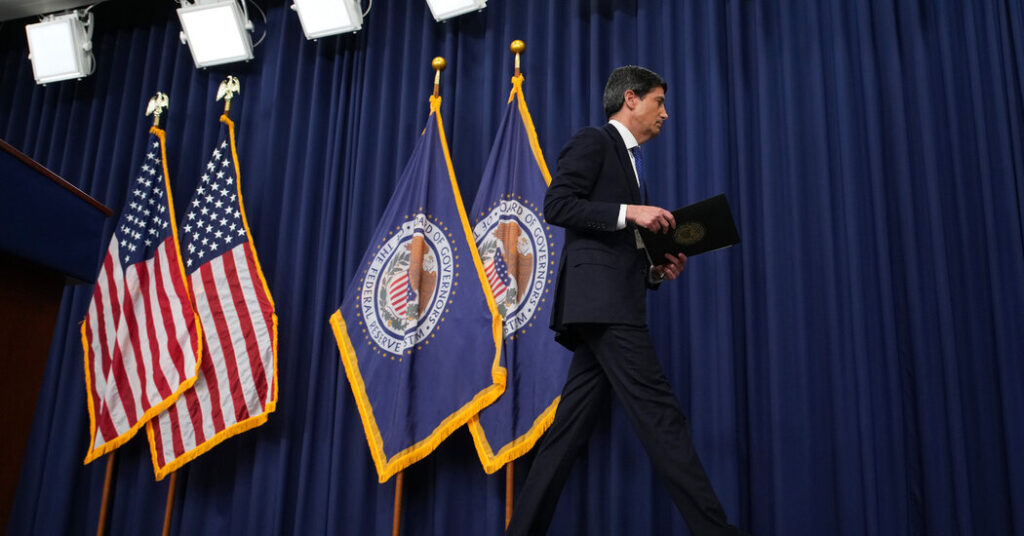
After four months of talking tough about inflation, Kevin M. Warsh finally followed through.
On Wednesday, the chairman of the Federal Reserve announced with his colleagues that the central bank had raised interest rates by a quarter of a percentage point to a new range of 3.75 percent to 4 percent.
The move was widely expected, with financial markets ascribing over 90 percent odds to an increase ahead of the gathering. The question now is what comes next.
Mr. Warsh, in an abridged news conference, sought to keep the Fed’s options open. He underscored his aversion to providing guidance about what the future path of policy might be and said plainly that he did not want to “prejudge any future decisions we make.”
But in parsing through Mr. Warsh’s comments on Wednesday, and a new set of economic projections from officials that accompanied the rate decision, it was clear that the Fed was not done raising rates.
The most direct signal came from the updated “dot plot,” which aggregates on a quarterly basis what officials think will happen to borrowing costs over the coming years.
It showed that 16 of the 18 policymakers who submitted projections expected at least one more quarter-point move by the end of the year. That would push rates to a range of 4 percent to 4.25 percent. Most wanted rates to stay at or above that level throughout 2027. They also raised their estimates for rates for 2028 and beyond compared to three months ago.
Mr. Warsh, as in June, did not submit projections, in keeping with his opposition to the dot plot as a communications tool. But he appeared aligned with the message that the Fed’s work was not complete.
Mr. Warsh struck an upbeat tone about economic growth and the labor market, emphasizing that the Fed’s focus had to be on inflation at this juncture. He emphasized the unanimity around the rate decision, which he said showed “we’re serious about this.” And he made clear that he was unsatisfied with the recent trend in the data that showed lackluster progress toward the 2 percent inflation goal.
The comment that garnered the most attention, however, was his description of Wednesday’s move as the Fed having “removed a dose of accommodation so that financial and credit conditions would be more consistent with our ultimate objectives.”
That gave the impression that Mr. Warsh did not believe the Fed’s policy settings were weighing meaningfully on the economy and instead were bolstering it, conveying a more hawkish message than expected.
He was later asked how this related to his views of the “neutral” policy setting that neither spurs growth nor subdues it — a concept that is often used by Fed officials when describing their rate outlooks. Mr. Warsh suggested that this “academic” framing had no bearing on Wednesday’s decision.
Without a sense of how Mr. Warsh saw the policy rate relative to an estimate of the neutral rate, economists and investors were left guessing how many more increases the chairman believed were necessary to quell inflation.
In the absence of a specific steer, the consensus view is that the Fed will raise rates a couple of more times through the early part of 2027. Patrick Harker, who served as president of the Federal Reserve Bank of Philadelphia for a decade-long tenure that ended in 2025, said he expected the Fed to reverse cuts that it delivered late last year to guard against a weakening labor market. That would suggest two additional moves, for a total 0.75 percentage point increase in rates.
He expects the Fed to skip raising rates at the central bank’s next meeting in late October, just days before the midterms, not only because of the “optics” of taking action just before an important election, but also because there is “no rush,” having just moved this month.
“I don’t think they’re looking at a long cycle of increasing rates,” said Mr. Harker. “I don’t think they were mildly restrictive and this is moving them there.”
Raising rates just before the midterms would further anger President Trump, who criticized the Fed for taking action on Wednesday. Speaking to reporters, he reiterated his belief that the United States should pay the “lowest interest rate anywhere in the world because we have the strongest credit.”
Mr. Trump, who picked Mr. Warsh for the top job, did not directly blame the new chairman, in a break from his past practice of admonishing Jerome H. Powell, the former head of the central bank. Instead, he directed his anger at the six other members of the Board of Governors, two of whom were appointed by Mr. Trump.
The president, late on Wednesday, said he told Mr. Warsh that he “might as well vote with the board because it’s just not going to matter.” He added: “The board is very hostile. They’re very political. They’re doing the wrong thing. They’re a bunch of politicians.”
The timing of future adjustments depends in large part on the incoming data. Signs that inflation was continuing to stall out, or worse, deteriorate further, would keep pressure on the Fed to deliver successive increases regardless of the electoral calendar.
The problem, said Seth Carpenter, a former Fed economist who is now at Morgan Stanley, is that “there is very clear tension within the committee in terms of how to think about a single data point.”
Mr. Warsh on Wednesday emphasized that he was most focused on trends in inflation rather than specific data points, which he described as “noisy.”
“Data point dependence is a dangerous preoccupation,” he said. “It’s not something that concerns me. Markets over time will come to understand how this Fed makes its decisions, what’s relevant and not.”
But other officials at the Fed, and financial markets more broadly, appeared to be ascribing a great deal of importance to incoming data, suggesting there were different thresholds for additional action for different people.
“It’s going to be very tricky,” said Mr. Carpenter, regarding what would and would not constitute a catalyst for another increase.
The risk is a breakdown in the unanimity seen on Wednesday, a fissure that could grow more pronounced if there started to be a trade-off between taming inflation and maintaining a healthy labor market, said Derek Tang, an economist at the research group LHMeyer.
“Warsh is willing to hike right now and do this for inflation because there’s a low cost to doing so,” Mr. Tang said. “What’s not answered is: What if the cost of doing so is higher?”
Right now, that tension does not exist. The unemployment rate is low, consumers are still spending and growth has stayed solid. But Daleep Singh, who formerly worked at the New York Fed and the Treasury Department, warned that achieving Mr. Warsh’s inflation pledge might require much more substantive tightening that could imperil that.
As of now, Mr. Singh forecasts the Fed delivering a total of three quarter-point increases before pausing, delivered in October and December. It is far from clear if that will be enough for a Fed that is confronting “overlapping and compounding supply side shocks,” he said, and an environment in which the drivers of growth, such as artificial intelligence, are not as sensitive to higher rates as other sectors.
“If we’re wrong, it’s not that they’re going to hike less than 75 basis points; it’s that they may have to hike more,” said Mr. Singh. “The market is going to have to assign at least some probability to the scenario in which this is an open-ended rate hiking campaign that involves more significant pain in terms of economic growth.”
The post The Fed, After Raising Rates, Grapples With What Comes Next appeared first on New York Times.