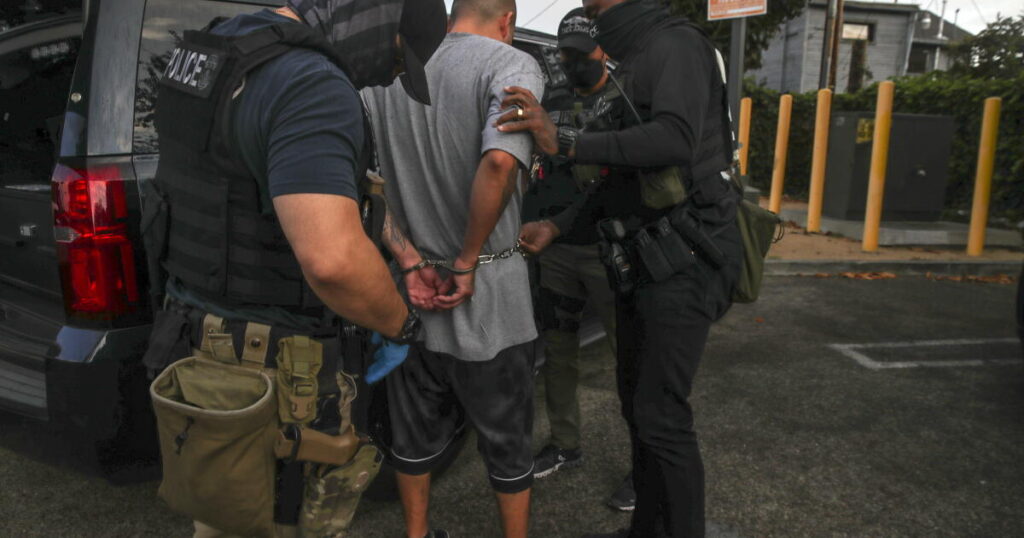
A Los Angeles federal judge has ordered immigration agents to stop making civil arrests without a warrant unless they first determine that a person is likely to escape before one can be obtained.
U.S. District Judge Maame Ewusi-Mensah Frimpong said in an order granting a preliminary injunction that the government “is regularly abstaining from conducting a likelihood of escape analysis at all” when making arrests without a warrant.
Frimpong’s order applies in the Central District of California, which includes Los Angeles and the surrounding areas, including Orange, Riverside, San Bernardino, Ventura, Santa Barbara and San Luis Obispo counties. It landed on the public docket Wednesday, after it originally was filed under seal on Sept. 2.
The ruling requires federal immigration agents to consider the totality of the circumstances known to them before arresting someone without a warrant.
“Mere presence within the United States in violation of United States immigration law is not, by itself, sufficient to conclude that a person is likely to escape before a warrant for arrest can be obtained,” Frimpong, an appointee of President Biden, wrote in her order.
When agents make a civil immigration arrest in the district, Frimpong ordered them to document the circumstances, including the “specific, particularized facts” that show probable cause, pre-arrest, that the person was likely to escape before a warrant could be obtained.
Frimpong denied the government’s request to stay the order for 14 days while it considered whether to appeal.
The Department of Homeland Security, which oversees Immigration and Customs Enforcement as well as and Customs and Border Protection, did not immediately respond to a request for comment.
Frimpong’s ruling stems from a lawsuit filed last year by the American Civil Liberties Union of Southern California, Public Counsel and other groups and private attorneys calling to end unlawful stops and arrests. The suit also called for the protection of due process and access to counsel rights for people in immigration detention.
In a June motion for the preliminary injunction, lawyers for the plaintiffs argued that agents continue to make arrests without taking necessary steps required by federal law. The lawyers asked that Frimpong bar immigration agents from arresting people in the district unless they’ve conducted an escape risk analysis.
“This ruling is one of the most important decisions to date in the community’s effort to end the federal government’s cruel and illegal practice of abducting people and separating them from their families,” Mayra Joachín, an attorney at the ACLU of Southern California, said in a statement. “This court order should put an end to hundreds — if not more — of unlawful arrests that continue throughout Southern California.”
Federal judges in Portland, Colorado, Washington, D.C. and the Eastern District of California have blocked similar warrantless arrest practices.
Last month, Daniel Mummolo, an attorney with the Department of Justice, pushed back during a hearing on the motion, telling Frimpong that a warrantless arrest policy “does not exist either in written or unwritten form.” Mummolo urged Frimpong to deny the preliminary injunction.
Lawyers for the plaintiffs noted when seeking the injunction that a review of arrest narratives produced by the government showed that at least 89 of 113 cases — nearly 80% — contained “either no escape risk assessment whatsoever … or generally follow an escape risk template narrative.”
“For the narratives that contain some discussion of ‘flight risk,’ it is largely boilerplate,” the motion states.
Mummolo maintained that the “overwhelming majority” of the arrest records included a discussion of flight risk but added that agents were “not required to document that.”
In her order, Frimpong cited video footage of arrests, including one in which “agents appear to follow a car, pursue an individual who exits the car, and arrest that individual, seemingly without asking the arrestee any questions.”
Frimpong said two of the plaintiff organizations are likely to be able to show “that the Government is following an illegal policy.”
“It is not the final decision on whether the Government is following an illegal policy,” Frimpong wrote. “That will be decided later in this case.”
The post Federal judge limits immigration arrests without a warrant in Southern California appeared first on Los Angeles Times.