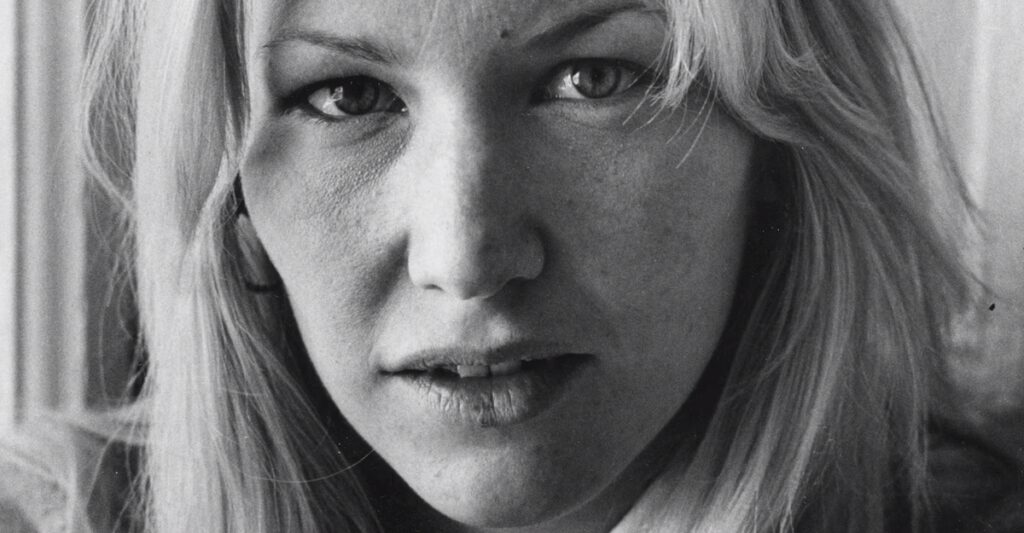
“Nature’s silence is its one remark,” Annie Dillard wrote in a 1981 Atlantic essay. Dillard, who died yesterday at age 81, spent her life listening.
She opens that essay, “Teaching a Stone to Talk”—which was later adapted into a collection by the same title—with the story of a man named Larry who is trying to get a rock to speak to him. “He keeps it on a shelf,” she writes, protected “by a square of untanned leather, like a canary asleep under its cloth. Larry removes the cover for the stone’s lessons.” Dillard is not sure what exactly happens at these lessons, but she respects the process: “It is a noble work, and beats, from any angle, selling shoes.”
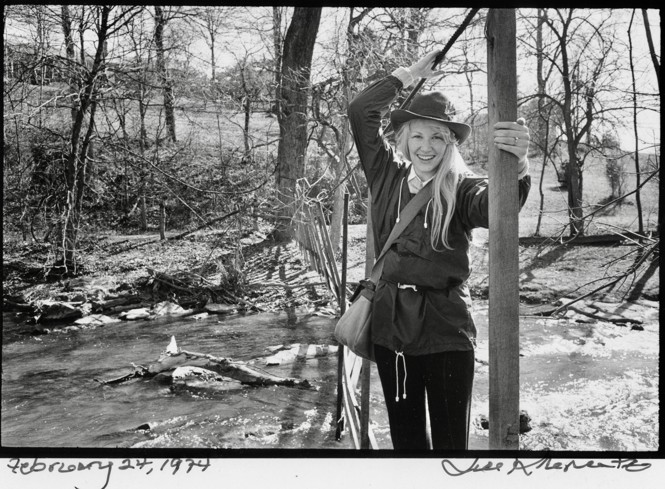
To Dillard, striving to hear the natural world was holy work too. “What have we been doing all these centuries but trying to call God back to the mountain, or, failing that, raise a peep out of anything that isn’t us?” she asks. Born in 1945 in Pittsburgh, she found inspiration in some of the places she lived. At age 28, she published Pilgrim at Tinker Creek, a Pulitzer Prize–winning nonfiction book that draws from her walks in the Blue Ridge Mountains in Virginia in the ’70s. Her musings on these solitary experiences in nature drew comparisons to Henry David Thoreau, who strongly influenced her work. She was also one of the first women to find a place in the male-dominated genre of wilderness writing. The writer Diana Saverin, who spent time going through an archive of Dillard’s personal writings and correspondence at Yale, once describedin The Atlantic Dillard’s trepidation about how she would be received: “Before she published her book, she scribbled in her journal, wondering who would take her book seriously if its author was a ‘Virginia housewife named Annie.’”
She dealt with this problem by leaving her day-to-day suburban life out of her work, so much so that some critics felt that she was exaggerating just how often she was in the wildness of nature. As Saverin noted, Dillard acknowledged that “she sometimes distorted the literal truth to achieve an artistic one.” But to Dillard, the ultimate truths revealed themselves in the time she did spend outside. In her journals, she acknowledged the “theological” sensibility in her books, and it is there on every page. “What is the difference between a cathedral and a physics lab?” she wrote in The Atlantic. “Are they not both saying Hello” to the world beyond?
Throughout her life, Dillard identified, in turn, with Protestantism, Catholicism, and nothing at all. I first encountered her work in a religious-studies class at Wesleyan University, where she taught from 1979 to 2001, before my time there. Dillard was a shock to my system: Growing up as an observant but theologically confused Jew, I spent my teenage years in synagogue itchy with guilt, poring over the same words in the prayer book every Saturday and willing myself to believe. Only later did I come to understand that faith—and, perhaps more important, the very act of living—can also be found in what we see and touch and hear: even in the rustle of the wind. Dillard taught me this. “At a certain point you say to the woods, to the sea, to the mountains, the world, Now I am ready,” she wrote in 1981. “You feel the world’s word as a tension, a hum, a single chorused note everywhere the same. This is it: this hum is the silence. Nature does utter a peep—just this one.”
Sometimes nature thunders, giving us no choice but to listen. Describing a total eclipse, Dillard is in awe, even afraid: “It was as though an enormous, loping god in the sky had reached down and slapped the Earth’s face.” Other times, nature’s peep can feel anticlimactic, but even this quiet commands reverence. The stone never does talk to Larry, and Dillard ends that story by succumbing to her faith in the nothingness. “You take a step in the right direction to pray to this silence,” she writes. “Pray without ceasing.”
The post What Nature’s Silence Said to Annie Dillard appeared first on The Atlantic.