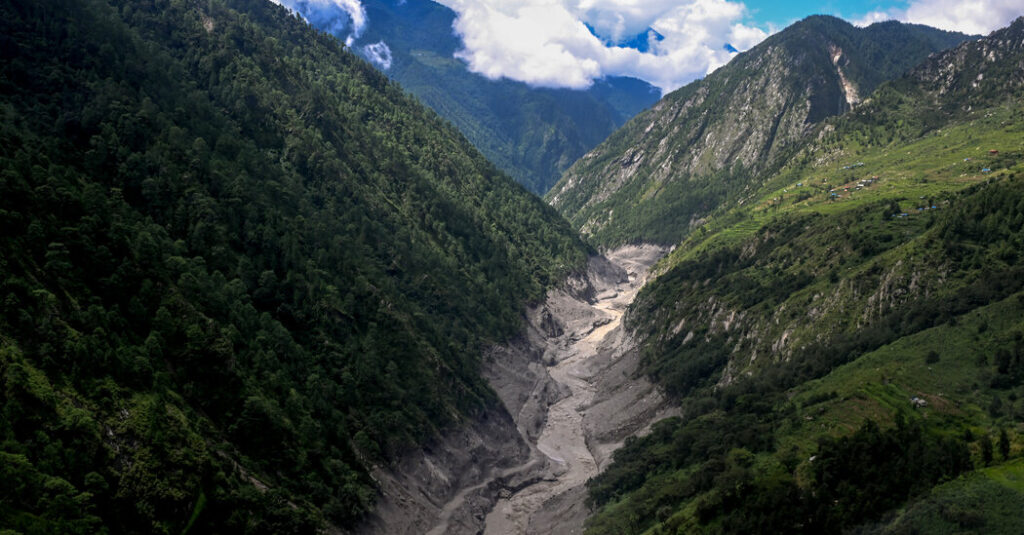
Industrial emissions have significantly warmed the snow-capped Himalayan region where a rock collapse caused devastating floods in Nepal and Tibet last month, researchers concluded in a report published Thursday in London. Rising temperatures very likely contributed to the disaster by destabilizing the ice and permafrost that underlay the mountain slopes, the report said.
The authors of the report, one of the first comprehensive scientific assessments of the catastrophe, acknowledged that climate change wasn’t the sole factor behind the floods.
A 2015 earthquake in Nepal might also have been a factor in priming the slope, near the country’s border with Tibet, to fall apart, the researchers said. The tumbling ice and debris combined with water and sediment in the valleys below last month to create a wall of mud that roared through towns, bridges and hydropower facilities.
Still, the new findings establish that human-caused warming had a “very strong linkage” to the disaster, said one of the report’s authors, Manjeet Dhakal, who leads the South Asia office of the research group Climate Analytics. Evidence of this connection could inform Nepal’s request for financial help from the United Nations’ fund for climate aid.
Three weeks after the disaster, the death toll stands at over 1,300. Thousands more people remain unaccounted for and are likely buried in the mud. Nepal estimates it will cost $5 billion to recover and rebuild.
The new assessment of the floods was prepared by two dozen researchers from around the globe and published by World Weather Attribution, a scientific initiative that evaluates the role of human-caused climate change in weather disasters. The report has not yet been published in a peer-reviewed journal.
The researchers found that the days leading up the floods were much warmer than usual around the northern face of Langtang Lirung, the mountain where the rock and ice avalanche occurred. At the elevation where the rock detached, roughly 17,000 feet, the high temperatures that week were around 54 degrees Fahrenheit, or more than 12 degrees Fahrenheit above normal, the researchers found. July and August in the area were unusually warm overall, as global temperatures tied the record for Earth’s hottest month.
Global warming driven by burning fossil fuels has raised the mercury significantly around the high peaks of this part of the Himalayas compared with preindustrial levels, the scientists found. Over the decades, that has exposed the permafrost within the rocky slopes to above-freezing conditions more frequently.
In high mountains, permafrost — a mixture of soil and sediment held together by ice — acts as a sealant, keeping water from percolating into cracks in the bedrock. So when permafrost thaws, more water can seep in. Then, when the water refreezes, it pries the cracks open wider and weakens the rock, said Walter Immerzeel, a mountain hydrologist at Utrecht University in the Netherlands who contributed to the new report.
Higher temperatures have also shrunk the glacier on Langtang Lirung that had been helping to support part of the mountainside, Dr. Immerzeel said. The glacier’s retreat occurred gradually for nearly two centuries before accelerating in 2010, when it began to lose around 2 percent of its area per year, he said.
Something else that may have added to the deluge caused by the plunging ice and rock was the exceptionally large amount of snow that fell in the region last October and November, the researchers said. Extra rain or melted snow can also infiltrate into the bedrock and make it more prone to collapse. But the researchers didn’t find clear evidence that human-caused climate change was increasing summer or winter precipitation in the region.
The post Warming Played ‘Very Strong’ Role in Himalayan Floods, Study Finds appeared first on New York Times.