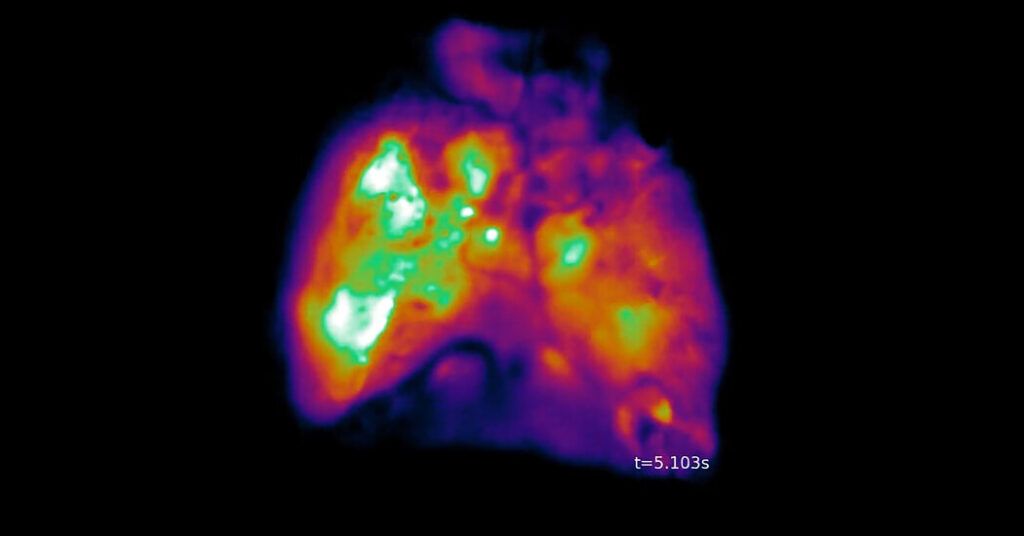
In order to learn more about brain disorders, scientists reported on Wednesday that they had created extraordinary mice whose brains are filled with millions of human neurons. The work marks a startling advance in replicating the complexities of the human brain outside the body.
The research, described in the journal Nature, also poses some profound questions. “Will there be some enhancement of function?” asked Dr. Sergiu Pașca, the Stanford University neuroscientist who led the work. “Will they do better than other mice?”
Dr. Pașca and his colleagues have consulted regularly with ethicists about the implications of their research. And they’ve kept careful watch on the mice, analyzing their behavior. So far, they behave mostly as if they had ordinary mouse brains.
“You wouldn’t be able to tell the difference,” Dr. Pașca said. Other experts not involved in the study agreed.
“It may have a large proportion of its brain made up of human cells, but none of its behavior is made up of human behavior,” said Madeline Lancaster, a developmental neurobiologist at the Medical Research Council Laboratory of Molecular Biology in the United Kingdom.
Dr. Pașca spent years creating these mice for one reason: It is bogglingly hard to study human brain diseases. Our brains contain about 80 billion neurons, joined by trillions of connections into intricate circuits.
Some scientists suspect that when those networks go awry, they give rise to conditions such as schizophrenia and autism. “Neuropsychiatric disorders are largely disorders of circuits,” Dr. Pașca said.
Mice have complex brains, too, and they are useful experimental subjects. But the similarities to human brains are limited.
Our brains are a thousand times bigger. They hold special types of neurons not found in most other animals, and they are organized into layers and other structures crucial to the human experience.
In the 2010s, scientists created a new way to study the human brain by growing tiny replicas in the lab called organoids. Neuroscientists use them to observe the early stages of brain development — and to see how that development can veer off course.
Dr. Pașca and his colleagues have used brain organoids to study a rare form of profound autism called Timothy syndrome. Neurons from these patients behave differently than cells from people without the disease.
These clues led Dr. Pașca and his colleagues to design a drug to restore the growth of brain cells in people with Timothy syndrome. The researchers have performed safety testing in animals and hope to start a clinical trial in the next few months.
But organoids aren’t perfect stand-ins for human brains. They are minuscule compared to the real thing, they don’t get signals from the outside world, and they aren’t nourished by blood vessels.
So, for a decade, scientists have been trying to improve human brain organoids by transplanting them into rodents. Neuroscientist Fred Gage and his colleagues at the Salk Institute for Biological Studies achieved the feat for the first time in 2018.
In a follow-up study published in 2022, the researchers implanted human organoids in the visual center of adult mouse brains. Flashes of light caused both mouse and human neurons to respond, the scientists found.
At Stanford, Dr. Pașca and his colleagues inserted human brain organoids into young rats. The organoids grew until each took up about a third of one side of a rodent’s brain, and the neurons grew longer. The rats were used to experiment with the drug for Timothy syndrome.
Even these transplants had their limits. The scientists had to surgically remove a piece of the rat brain to make room for the organoid, and rat neurons developed connections more quickly than the human ones.
Seven years ago, Dr. Pașca and his colleagues decided to take a new approach. They started by genetically engineering mice with parts of their brains missing.
The scientists altered the genes in mice that are essential for growing neurons in the brain’s outer layers, known as the cortex. The cortex is active when mammals make decisions and carry out other complicated kinds of cognition.
The cortex takes up a much bigger proportion of human brains than is the case in other species. It enables our sophisticated use of language and other forms of higher-order thinking.
“It’s the part of the brain that results in our humanness,” said John Evans, a bioethicist at the University of California, San Diego, who was not involved in the study.
The genetically altered mice had brains that were almost entirely missing the cortex. Fluid filled the space where half of their brains would normally have grown.
Then Dr. Pașca and his colleagues sought volunteers to provide skin cells that would be used to make brain organoids; the volunteers were told that these cells might end up in animals.
The scientists went on to create organoids made of cells of the human cortex. Those organoids were placed into the empty spaces in the brains of the engineered mice. (The mice were engineered without an immune system so that they wouldn’t reject human tissue.)
The organoids thrived, feeding on the fluid in the skull and then connecting to the blood vessels in the mouse brain. From a few hundred thousand cells, the human neurons multiplied to as many as 4 million.
“That’s a big proof of concept, saying it’s possible to create this kind of human-dominated cortex in a mouse,” said Hongkui Zeng, the director of brain science at the Allen Institute in Seattle, who was not involved in the study.
The human cells were still immature, Dr. Pașca’s team found, resembling the neurons inside the brain of a third-trimester fetus. But they still managed to connect with the mouse brain, becoming active as the mice went about their lives.
The researchers filmed the movements of the mice, finding only subtle differences from ordinary mice. And in tests of memory and other cognitive tasks, the mice with human brain cells fared about as well.
But the engineered mice were like humans in some crucial ways — ways that make them useful for studying brain disorders.
Babies that suffer a loss of oxygen around birth can experience devastating damage to the cortex. But mouse pups exposed to low oxygen usually escape injury.
Dr. Pașca and his colleagues found that a lack of oxygen damaged the human neurons in the mice. Afterward, the animals had difficulty walking, mirroring the effects of oxygen deprivation in humans.
“This is an ideal example of how you can study this devastating disorder,” Dr. Pașca said.
Dr. Pașca and his colleagues also discovered that some of the human brain cells in mice became quite large. These cells, the scientists discovered, are a special type, known as von Economo neurons.
They only develop in large, social animals like whales, elephants and humans. When scientists look at the brains of people who suffer from frontotemporal dementia, they find that the von Economo neurons are among the first cells to die.
Now that the scientists can make mice with von Economo neurons, they’re starting to investigate their connection to the disease.
“We’re trying to see whether mutations that are associated with frontotemporal dementia are making the cells uniquely susceptible to disease,” Dr. Pașca said. “And why? Why is this happening?”
The new study is the latest evidence of how quickly research into brain organoids is moving — far faster than regulations intended to keep the research from crossing any red lines.
In a report earlier this month, Dr. Pașca and other researchers warned that oversight from governments and universities is evolving far too slowly to keep up with the science.
If millions of human cortex cells can thrive in a mouse’s brain, Dr. Zheng wondered, what might happen if scientists transplanted brain organoids into pigs or monkeys, with much more space for the human cells to grow?
“There’s really need of ethical oversight and regulation,” she said.
The post These Mice Have Partly Human Brains appeared first on New York Times.