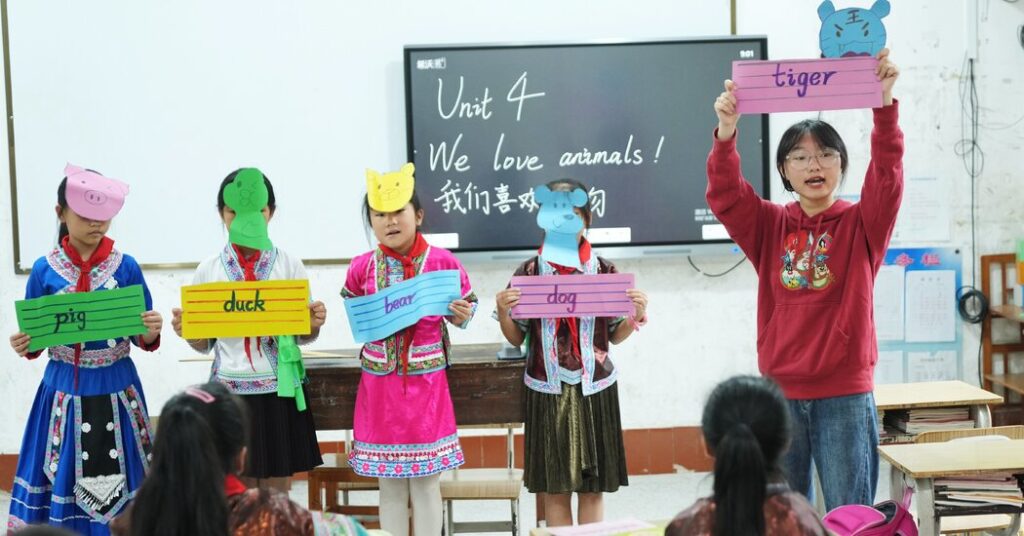
It started earlier this month when a math teacher in China posted a call on social media for the study of English to be made optional in schools across the country. Children were frantically learning English even before they had mastered their native tongue, he said, adding that Chinese people should stop their “blind worship of foreign imports.”
As A.I. translation tools improve and young people face uncertain post-grad prospects, the post from the teacher, Tang Jiafeng, set off a debate online that resurfaces every few years: Should schools cut back on mandatory English class time? Since the late 1970s, China has embraced teaching English, which is one of three core subjects along with math and Chinese, as crucial to its efforts to open up to the rest of the world. It takes up significant classroom time and counts heavily toward scores on the gaokao, the Chinese college entrance exam.
Some parents and teachers found Mr. Tang’s suggestion refreshing. The standard nationwide English curriculum, with its emphasis on grammar and testing, does not translate into English proficiency for many students. Some online commenters said that students, with their heavy workloads, would do better to spend that time on other subjects.
But for others, making English less of a priority would be a step backward. And Mr. Tang’s choice of words touched a nerve. “Blind worship” is a particularly inflammatory phrase in China that “can imply that you are compromising your own dignity in relation to a more powerful outsider,” said Wang Zichen, a foreign policy analyst at Beijing’s Center for China and Globalization.
Hu Xijin, the former editor of the Global Times, a Communist Party newspaper, said that the issue was being politicized by people looking to trumpet their nationalism. “The public should not be fooled by them, and I hope the education department will ignore them,” Mr. Hu wrote.
As youth unemployment grows and artificial intelligence upends many industries, people are questioning which skills will still be useful to students when they graduate.
The debate about English education taps into uncertainty about what the economy holds for China’s youth, said Gina Tam, an associate professor of history at Trinity University in San Antonio, Texas.
“When young people are feeling particularly economically precarious,” Ms. Tam wrote in an email, “Is the ability to engage with global audiences with English going to be a marketable skill for Chinese young people? Or is it going to be superfluous?”
Mr. Tang made his post shortly after Liaoning, a province in northeastern China, decided to remove history, biology and geography from its middle school entry test, in part to reduce student workload. The move prompted a wave of online complaints that the authorities were downplaying the country’s war-torn modern history, which many believe to be an essential part of a patriotic education.
The Chinese government has not commented on the debate about English-language education, but some schools have been dialing back English requirements in recent years. In 2021, education authorities in Shanghai barred final exams on English for elementary school children to reduce pressure on students. A government adviser also recommended that English be dropped from the gaokao because machine translation on smartphones could effectively resolve language barriers for most people, though no policy change followed.
Recent advances in A.I. have accelerated the transition away from prioritizing English. In July, a research university in Shenzhen announced that English language courses would be phased out, citing A.I.’s ability to generate translations in real time. (The university plans to replace them with courses focused on comparing Chinese and Western cultures.)
There are some signs that a decline in English investment is already having an effect. According to a ranking released by English First, an international education company, China in 2025 ranked 86 out of 123 countries in English proficiency, falling from 38th place in 2020.
Some parents also want the requirement to be dropped because they are frustrated with how English is taught, according to a social media video posted by an English teacher in Sichuan Province. For many students, the time and effort spent learning English does not make them proficient enough to use it, she said in the video.
Xiong Bingqi, the director of 21st Century Education Research Institute in Shenzhen, said the problem lies in a curriculum that emphasizes test scores rather than proficiency, resulting in “dumb English.”
And people who work in research or for international companies “are actually in the minority,” he said. “That’s why more people are questioning the value of foreign languages.”
But Cinderella Huang, an English teacher in Guangdong Province, said that because English proficiency is still an obstacle to using top A.I. models, getting around in foreign countries, and attending many of the highest-ranked global universities, removing English as a core subject would only widen the wealth gap.
“Rich people will keep hiring English tutors and sending their kids to international school,” she said. “But for children without money, the English they learn in schools is their only window.”
Professor Tam said that the debate reflects two visions of China: as a globally engaged leader or a powerful nation state that is more inward looking. “Whether excited or anxious, people realize we are at a global crossroads,” she said.
The post In the Age of A.I., Some in China Wonder if Learning English Is Worth the Trouble appeared first on New York Times.