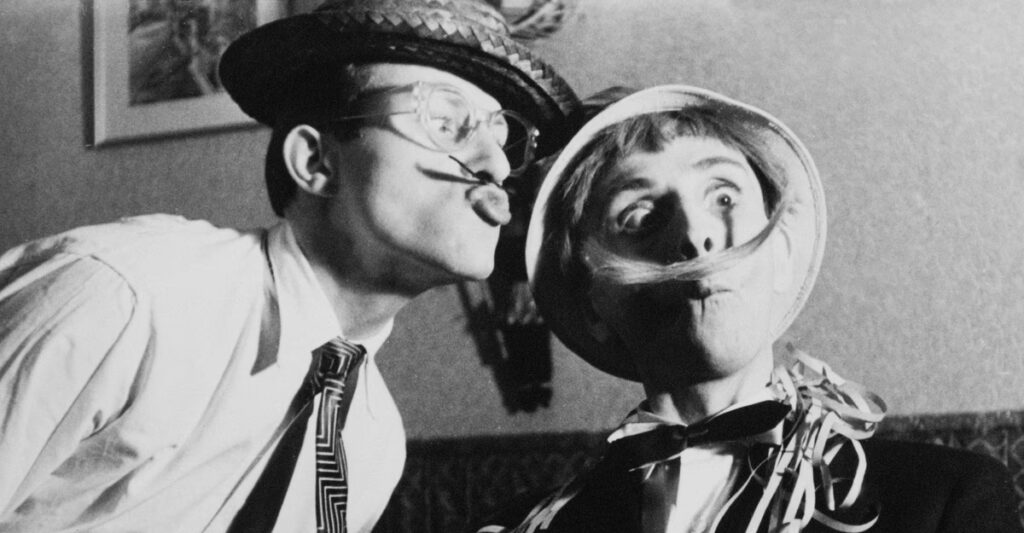
Silliness, in general, is not hard for me to come by: I have a toddler who is, as she declares often, a “silly person.” Still, the very pleasure I take in being silly with my child and her friends reveals to me its rarity in adult public life. Few social situations encourage or even allow unadulterated loopiness. In general, art made for adults tends to abide by this taboo. We get satire, scatological jokes, imitations, and absurdity, but rarely do we get silliness.
A new play, Bocking, reminds us that this is a mistake. A wild, sometimes surreal, and ultimately tenderhearted farce that premiered last month at Baltimore Center Stage, Bocking does not suggest at the outset that it will be silly.
It does, however, seem interested in provocation. It begins with a pair of glamorously behatted ladies moving through the crowd, thanking theatergoers for “coming to church.” When the show’s action begins, some of it is, indeed, a church service—but as a pastor delivers at the center of the stage a sermon that turns more and more homophobic, two other characters, a cisgender man and his trans wife, begin to have raucous sex at stage right. It’s a good bit, and it drew uproarious laughs the night I saw the play. In most regards, the scene sets up the show’s concerns well, if rather transparently: Bocking’s author, the young playwright Preston Crowder, wants to teach his religious characters some lessons about acceptance and sex positivity.
The show’s comedy tends to cater to a crowd that already agrees with its message. But Bocking has one scene that I found fairly transcendent—one that was not just dirty or gasp-inducing but was also silly to its very core. It’s also the best scene in the play.
The moment builds on Bocking’s oddest plotline: One of the characters, an anxious school guidance counselor named Erickson, suffered an unusual childhood trauma. When he was 8, he and his mother caught his stepfather having sex with—stick with me here—a hen. (Animal-rights activists may object to the levity with which this is portrayed; other people may be reminded of the Swedish Chef.) Erickson’s grief-stricken mother then attempted to turn into a hen herself, an event that the play shows as a descent into madness rather than a true transformation. Still, years after her death, the adult Erickson communes with her by “bocking”—that is, speaking in chicken.
For much of the play, he does so in private, which registers to the audience as an inexplicable subplot. But when the pastor’s wife, Tiana, visits him to express her marital woes, she winds up extracting the secret of his chicken talk from him—and then demands to give it a try. At first, Erickson is reluctant, but soon, the two begin bocking together. As dialogue, the exchange that follows is incomprehensible. As a moment of human connection, it’s undeniable. And as sheer silliness—not spectacle or satire like the rest of the play—it beats almost any recent piece of art I’ve heard, read, or seen.
[Read: What adults forget about friendship]
Crowder understands, clearly, that silliness is a vehicle for catharsis. By behaving ridiculously with each other, Tiana and Erickson get respite from their isolation and their troubles. In watching them behave ridiculously, the audience gets a break from the show’s moralizing and can, instead, connect directly to the characters’ emotions. As a result, the scene deepens the rest of the show.
Sketch comedy is typically the most frequent source of silliness in art and culture: Saturday Night Live is often silly, and in my view no one has ever been sillier on camera than the comedians of the legendary British sketch group Monty Python. Plenty of the Pythons’ work is satirical—consider their send-ups of English sexual repression—but what sets their comedy apart for me is their willingness to be purely silly. In the beginning of their sketch “The Ministry of Silly Walks,” a bowler-hatted, briefcase-carrying John Cleese, his back beautifully straight, gavottes down a London street. Viewers don’t know why he’s moving so ludicrously; it doesn’t matter. His silly walk undermines not only his dignified wardrobe but also the very idea of a professional persona. Just by changing his gait to something ridiculous, Cleese gives his audience a moment of release from the entire world of work.
But sketch comedy, even when it has recurring characters, cannot develop those characters in the way a full-length work can. Its silliness, therefore, cannot have the emotional impact of the chicken-talk scene in Bocking, or the hot-dogs-as-fingers segment in the movie Everything Everywhere All at Once. One of that film’s many interwoven strands involves an alternate universe in which the characters played by Michelle Yeoh and Jamie Lee Curtis move through their days, experiencing life and love, with frankfurters for fingers. It’s a ridiculous conceit, pointless except to force a visceral sense of frustration, followed by acceptance, into their scenes together—which it does quite well, just as Tiana and Erickson’s bocking creates a visceral sense of relief. Silliness, in both cases, circumvents cerebral experience.
No other means of getting a laugh goes so directly to the heart. Real silliness—serious silliness, if you will—lands in a sweet spot between the intellectualism of satire and the visual heft of spectacle. It strips away layers of adult logic, convention, and pretense, delivering grown-ups to the instinctive knowledge that toddlers possess: Work clothes are just costumes. Maneuvering a body through the world is both annoying and a cosmic joke. And communication, as Bocking so well demonstrates, often isn’t really about what gets said. Reasonably, this is tough for many writers, verbal creatures that we are, to admit, but in times of real emotional duress, words are rarely what counts. What matters are the feelings that lie underneath.
The post In Praise of Adult Silliness appeared first on The Atlantic.