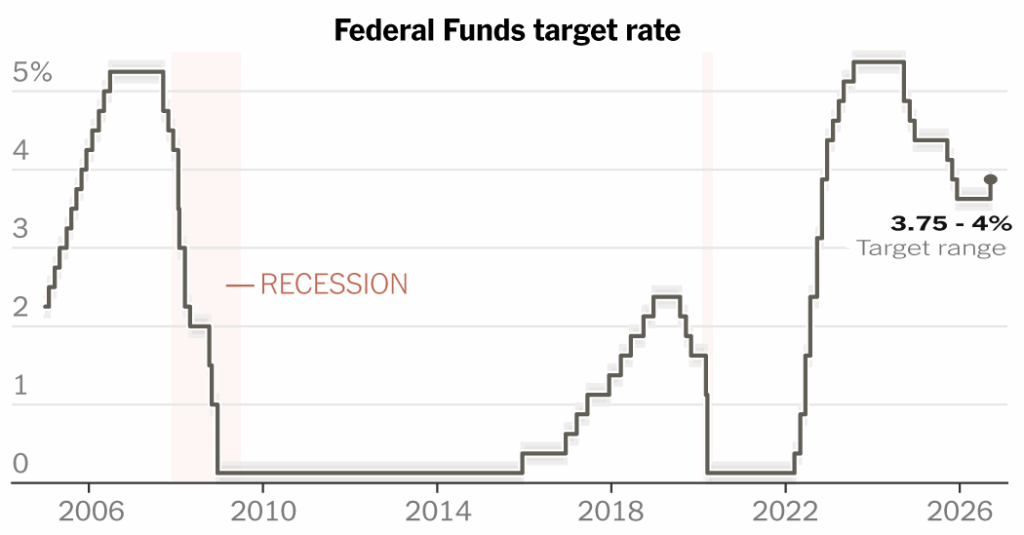
The Federal Reserve raised interest rates by a quarter of a percentage point on Wednesday, the first increase in more than three years and a significant step by Kevin M. Warsh, the central bank’s chairman, to combat elevated inflation.
The decision, which lifts rates to a new range of 3.75 to 4 percent, was supported by all 12 members of the Federal Open Market Committee.
“The plain fact is that inflation is too high and has been for too long,” Mr. Warsh said at a news conference after the decision was announced. He added that the U.S. economy remained strong and unemployment was low, justifying the Fed removing what he described as a “dose of accommodation.”
In a statement accompanying the rate decision, the Fed said Wednesday’s increase “will support a timelier return to the committee’s 2 percent goal.”
Mr. Warsh steered clear of providing any guidance about the path forward for rates after Wednesday’s move, however, saying that he did not want to “prejudge any future decisions we make.”
But in new forecasts, policymakers indicated that there would likely be additional increases. According to the latest “dot plot,” which tracks what officials think will happen to borrowing costs over the coming years, the vast majority of policymakers who submitted projections expect at least one more quarter-point move by the end of the year. Four officials thought rates would need to rise half a percentage point from here this year.
Stocks closed lower for the day, with the S&P 500 off 0.4 percent, the Nasdaq Composite inching lower and the Dow Jones industrial average down more than 1 percent.
Investors now anticipate three additional quarter-point interest rate increases through 2027. The two-year Treasury yield, which is sensitive to changes in interest rates, rose 0.6 percentage points. The 10-year Treasury yield steadied around 5 percent, while the 30-year Treasury yield nudged lower to 5.35 percent.
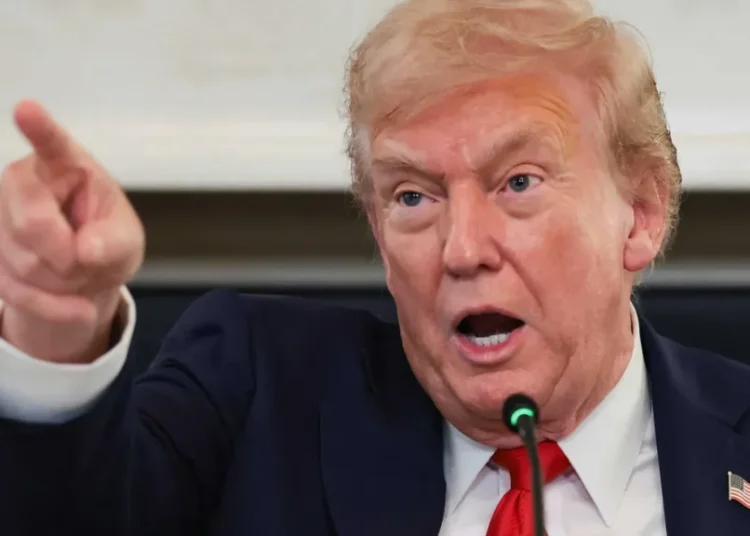
Wednesday’s decision is a momentous one for Mr. Warsh, who was selected by President Trump to lead the Fed and took over the top job just four months ago. During the selection process, Mr. Trump said he would only choose someone who supported lower borrowing costs, although he vowed during the swearing-in ceremony that he would respect Mr. Warsh’s independence.
Later on Wednesday, Mr. Trump reiterated that U.S. rates should 1 percent or less, “because we are the “Best Credit in the World — BY FAR.” He alluded to his early threat to cut off a broad swath of U.S. trade if the Fed did not soon reduce borrowing costs.
“LOWER THE INTEREST RATES FOR THE UNITED STATES OF AMERICA, AND FAST!” he said.
However, he did not publicly castigate Mr. Warsh for the decision to raise rates, a notable change from his approach to the previous chair, Jerome H. Powell, whom he repeatedly attacked for not complying with his demands.
Mr. Trump later suggested to reporters that he had spoken to Mr. Warsh, casting the blame on the other six members of the Board of Governors, some of whom were appointed by Mr. Trump in his first term.
The president said he told Mr. Warsh that he “might as well vote with the board because it’s just not going to matter. The board is very hostile. They’re very political. They’re doing the wrong thing.”
Asked repeatedly about Mr. Trump’s demand for lower rates, Mr. Warsh said the Fed’s job was to “stay in our lane.”
“Independence is a two-way street,” he added. “We let people that do trade policy and fiscal policy stay in their lane too.”
The case for cutting rates evaporated long before Mr. Warsh took the helm of the Fed in May. Mr. Trump’s war with Iran, which began in February and immediately sparked a surge in energy prices, upended the outlook for inflation and forced a rethink among officials at the central bank about their policy settings.
In the months since, growth has held up well, the unemployment rate has stayed low and consumers have continued to spend, suggesting that rates were not inflicting that much restraint on the economy and in turn, inflation. Financial markets have also undergone a rapid reset, with yields on longer-dated U.S. government bonds now trading at multiyear highs, raising borrowing costs across the economy.
That shift prompted Treasury Secretary Scott Bessent over the past month to embark on a series of interventions to force down borrowing costs. So far, those efforts have proven futile, with 10-year Treasury yields now trading around 5 percent.
Mr. Warsh ascribed the rise in longer-term borrowing costs to three factors. The first was higher growth prospects; the second, competition for capital as technology companies borrow heavily to finance the expansion of their artificial intelligence capabilities; and the third was geopolitics, or higher oil prices caused by the Iran war.
Importantly, he did not convey that concerns about the Fed’s credibility in fighting inflation or about the long-term fiscal sustainability of the U.S. government were behind the recent moves.
This backdrop, coupled with minimal signs that inflation was progressing steadily to the 2 percent target, gave the Fed limited latitude to do anything but raise rates on Wednesday.
Mr. Warsh’s decision to stake his reputation as chairman on getting inflation down also bolstered the case. Mr. Warsh reinforced his commitment as recently as last month, stating in a closely watched speech at the central bank’s annual conference in Jackson, Wyo., that the Fed “must be confident that underlying inflation is moving to our objective, clearly and at sufficient speed. Otherwise, we have work to do.”
Mr. Warsh on Wednesday said that he was most focused on the trends in inflation rather than specific data points, which he described as “noisy.”
“Data point dependence is a dangerous preoccupation,” he added. “It’s not something that concerns me. Markets over time will come to understand how this Fed makes its decisions, what’s relevant and not.”
Most officials see inflation, as measured by the Personal Consumption Expenditures price index, ending the year at 3.7 percent, slightly higher than officials thought just three months ago. They also revised up their estimates for “core” inflation, which strips out volatile food and energy items, to 3.4 percent.
As of the latest data in July, overall inflation stood at 3.7 percent compared with the same time last year. Core inflation was up 3.3 percent from a year earlier. The 2 percent target is not expected to be reached until 2029.
In 2027, the median estimate for rates stood at 4 percent to 4.25 percent, although there was a range of views. Eight policymakers forecast that rates would end the year a quarter of a percentage point higher than that, while four expected rates to be no higher than 3.5 percent to 3.75 percent.
Policymakers remained upbeat about the trajectory for growth and the labor market over this time period, projecting that the economy would expand 2.3 percent in 2026 and 2.4 percent in 2027. They see the unemployment rate slightly lower, at 4.1 percent, compared to three months ago, in line with today’s level.
The dot plot once again had fewer entries, with not all 19 policymakers submitting projections. Mr. Warsh in June declined to do so, reflecting his opposition to providing forecasts that he argues box the Fed in. One official submitted forecasts, but only through 2027.
The dot plot, along with other communication tools at the Fed’s disposal, is the focal point of one of five task forces Mr. Warsh created to look into issues that are central to the Fed. The other groups are looking into the Fed’s $6.7 trillion portfolio of government debt and mortgage-backed securities; the data sources the central bank prioritizes; productivity trends and jobs; and the models and measures officials use to understand inflation.
The post Fed Raises Rates in First Major Step by Warsh to Contain Inflation appeared first on New York Times.