At the Consulate General of Mexico in Los Angeles in MacArthur Park, Yaira Mejia pressed her inked thumb on a green document that granted her Mexican citizenship. What followed was a brief emotional embrace by her parents and words by the officiating consular officer, who with unwavering conviction declared that “being Mexican comes with great pride.”
“I used to think that just because I was born here, I only belonged here,” Mejia said as her family gathered to take pictures in the main lobby. “But now I can truly say I’m Mexican, because I belong to both places.”
Mejia was among the hundreds of Angelenos who obtained their Mexican citizenship that day, an entirely free process available to anyone who has at least one Mexican parent.
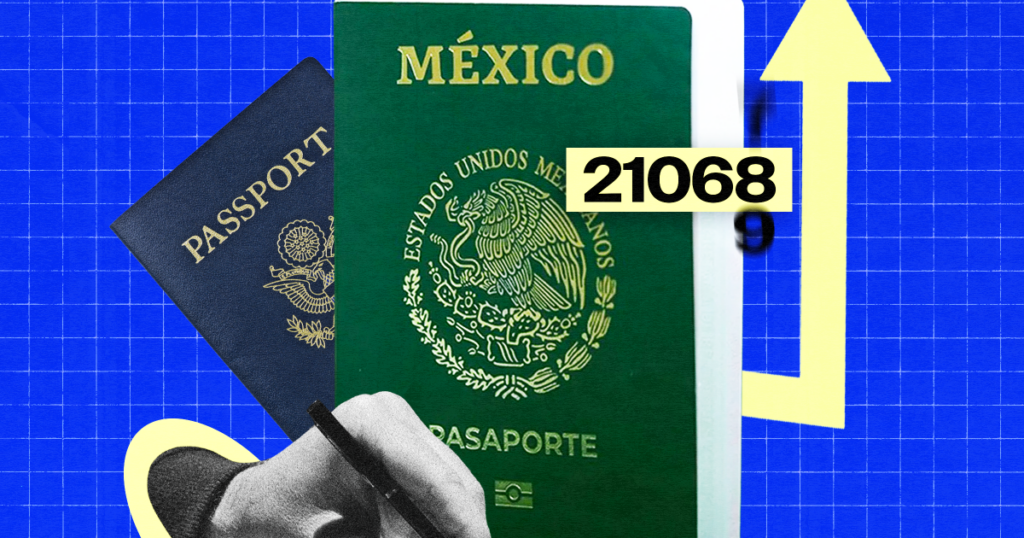
Between 2024 and 2025, registrations for Mexican citizenship skyrocketed by 161% at the Los Angeles consulate.
The number of applicants is expected to increase this year. According to data provided by the consulate, the average monthly number of applicants between January and August was 585 compared with last year’s monthly average of 528.
For Mejia, getting her dual citizenship will make it easier to travel to Mexico to visit her grandmother.
“The airport line gets so long and it’s easier to travel with a Mexican passport when you go there and the U.S. one when you come back,” Mejia said.
Her mother, Dalila Lopez, stood beside her daughter teary-eyed, stating that witnessing the citizenship process filled her with joy.
“I think [people are getting it] because they feel pride for the country where their parents are from,” Lopez said. “Given the current [political] situation, it’s better to have all your paperwork in order so you can come and go without any worries.”
According to the consulate, Mexican government officials predicted a surge in citizenship applications after the 2024 election of President Trump, who promised to carry out the “largest deportation operation in American history.” Before he took office a second time, the Los Angeles office expanded its internal operations, growing the civil registry department from two service desks to seven.
Although the Mexican government does not require aspiring nationals to state their reason for acquiring citizenship, Carlos González Gutiérrez, consul general of Mexico in Los Angeles, believes the cause for the uptick to be political.
“To the extent that this [Trump] administration decides to increase deportation proceedings for undocumented individuals from within the United States, it creates uncertainty,” González said.
In July alone, U.S. Immigration and Customs Enforcement arrested nearly 50,000 people nationwide, the highest monthly figure during Trump’s second term.
“U.S. citizens suddenly start considering the possibility of spending long periods of time in Mexico,” González said.
For those in mixed-status families, obtaining Mexican citizenship can alleviate the heartache of long-term family separation across borders in the event of a deportation — and eliminate the administrative headaches involved in applying for visas or paying border fees.
History of dual citizenship
In 2021, Mexico reformed its Constitution to allow Mexican nationality by birth for generations born outside Mexico, even if their parents were also born outside Mexico. That means Mexican nationality can continue in perpetuity even if future offspring never set foot in the country — so long as their parent was a Mexican national.
Before this change, the Mexican Constitution only recognized individuals with at least one Mexican-born parent as being able to claim nationality.
The prior law — which paved the way for dual citizenship beginning March 20, 1998— was progressive for its time, as it was introduced after a growing era of anti-immigrant sentiment in the United States sparked by California’s Proposition 187, a 1994 ballot measure designed to deny public education and other social services to undocumented immigrants, which passed in the state but was later struck by federal courts.
Before March 20, 1998, Mexican citizens would lose their nationality if they acquired citizenship in another country — including many who obtained U.S. citizenship after legalization through the Immigration Reform and Control Act of 1986.
Some political analysts believed the 1998 law could encourage a rise in the number of U.S. citizenship applications.
“That is where the Mexican government said, ‘We need to remove ourselves as an obstacle, so that immigrants can regularize their status and eventually fully integrate into the society,’” González said.
Other reasons for the registration uptick
The recent hike in new citizenship applications could also be attributed to baby boomers reaching retirement age and wanting to spend their last years in Mexico. Mexican citizenship allows individuals to purchase property within the country without needing to seek authorization from the Ministry of Foreign Affairs.
“There is also the fact that those baby boomers are not only retiring but also passing away,” González said.
For the deceased who leave behind an inheritance in Mexico, including land, the process for Mexican beneficiaries is streamlined through probate court. However, if a foreign heir without Mexican citizenship is set to receive property in a restricted zone (such as the coast or borders), the property will typically be held in a fideicomiso, or bank trust.
In 2023, Mexico’s Ministry of Foreign Affairs also introduced a WhatsApp messaging service that helps individuals book appointments without having to dial the general hotline. To help with more regional requests, the L.A. consulate launched its own separate WhatsApp scheduling service [(424) 499-0908] in April 2024, which boasts unlimited time slots.
“It was relatively easy,” said Saul Cruz, who booked an appointment through the messaging application for his 13-month-old daughter. The entire process from start to finish took one month for the family to complete.
Holding his toddler, the Sinaloa-born Angeleno added that obtaining dual citizenship is “simply about opening doors and options for your children.”
“We teach our children to remember where we are from,” Cruz said. “And they will be able to return with the same freedoms and opportunities as Mexicans in Mexico do.”
There are other benefits that come with becoming a Mexican citizen. People over the age of 18 have the ability to participate in the electoral process. It also becomes easier for individuals to open a bank account, apply for jobs, obtain a world-class education and rent a vehicle.
But González believes that individuals are also becoming interested in maintaining a link to their family’s country of origin, citing how Mexican American youth in the city came out in droves to support Mexico’s national team during the World Cup this summer.
“The way we see it, it’s perfectly compatible to be a loyal and honest citizen to this country while also wanting to nurture your ties and sense of belonging to the nation of your ancestors,” González said.
How to apply for Mexican citizenship
For those looking to apply for Mexican citizenship, there are two necessary appointments. Individuals must make the first appointment through the phone, WhatsApp messaging or the web. The first appointment ensures that the individual has all the required documents, which include:
- An original U.S. birth certificate
- Official IDs for all parties involved
- A Mexican birth certificate for the parent(s)
- If parents are married, a copy of the marriage certificate must be presented
Once an individual has obtained all necessary paperwork during the first appointment, the consulate will schedule them for their second and final appointment 1 to 2 weeks later, where a Mexican birth certificate will be issued.
For those who are 18 years and older, parent(s) do not need to be present, so long as there is a marriage certificate in existence.
In the event that the parents were not married — but a father is listed on the birth certificate — the father (Mexican or not) must show up to sign the birth certificate during the second appointment. If the father is unable to do so, the consulate would then explore the process of an “inscripción de nacimiento” or “process of birth registration” — meaning the U.S. birth certificate must be translated by a notary — although each scenario is handled by the consulate on a case-by-case basis.
Sometimes individuals who begin the legal process do not know the name of their grandparents, which is a section required in the solicitation process. In that case, the consulate suggests that individuals expedite the birth certificates of each parent, which does involve a cost of $20 per birth certificate.
In the event that both parents are deceased, individuals are still able to obtain Mexican citizenship as long as one parent was a Mexican national; the consulate would explore the “inscripción de nacimiento.”
There are third parties in existence that charge individuals to help manage their case, but there is no cost associated with individuals registering for Mexican nationality.
The post Dual citizenship requests are up at the Mexican consulate in L.A. Here’s why and how to apply appeared first on Los Angeles Times.