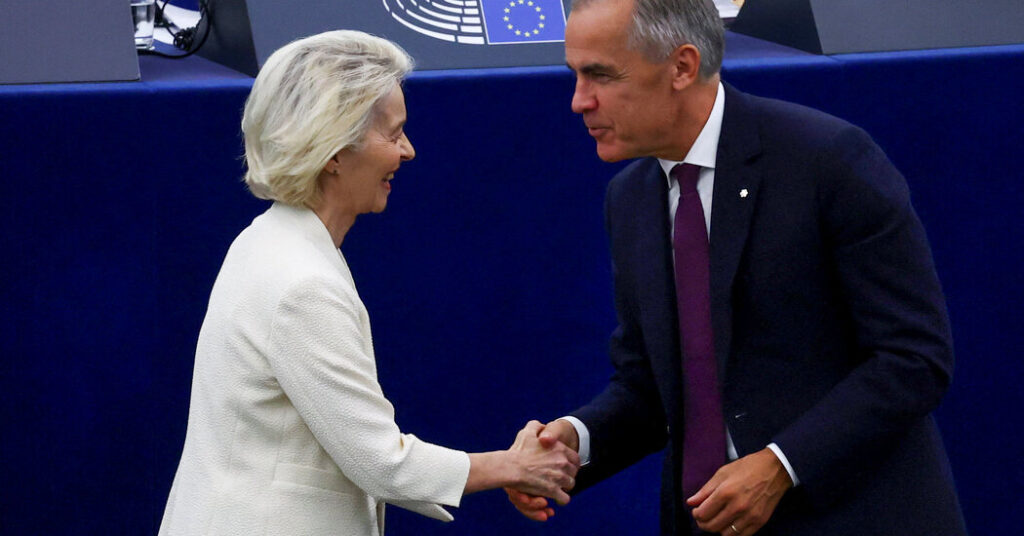
The European Union has invited Canada to work toward becoming the bloc’s first “associate member,” a title meant to underscore Canada’s growing closeness to the 27-nation union in a world of rising geopolitical risk.
Ursula von der Leyen, the president of the European Union’s executive arm, announced the plan on Wednesday during a speech in Strasbourg, France. Mark Carney, the prime minister of Canada, was at the event and seated directly to Ms. von der Leyen’s left as she made her address.
During the speech, Ms. von der Leyen said, “We must urgently reimagine our partnerships.” Directing her next line to Mr. Carney himself, she added, “I would like to work with you on opening the door for Canada to be the first associate member of the European Union.”
The declaration was met with a standing ovation from lawmakers, and Mr. Carney and Ms. von der Leyen shook hands warmly as she made the announcement.
Ms. von der Leyen said the proposal was “not a partnership against anyone else, but for our common strength.”
Details are scant, and the linkup is not a done deal, but the announcement was the boldest step yet in a joint quest by the European Union and Canada for tighter global partnerships. Both economies have been trying to build stronger alliances with a variety of countries as they find themselves caught between a competitive China and an at-times-hostile United States.
Mr. Carney gave a headline-grabbing speech at the World Economic Forum meeting in Davos, Switzerland, this year during which he argued that the world order that emerged from the Cold War was facing a “rupture, not a transition,” and that “middle powers must act together because if we’re not at the table, we’re on the menu.”
The move on Wednesday was a clear demonstration of that strategy.
Ms. von der Leyen did not lay out in detail what associate membership to the European Union might entail. But European diplomats and officials in recent days have made it clear that Canada and the European Union, which will meet for a summit at the end of October, are working toward closer cooperation on technology regulation, trade and the supply of critical minerals.
They are also working to team up on security and defense. Ms. von der Leyen highlighted that point in her remarks, noting that Europe had faced a recent series of drone incursions and other provocations, many of them attributed to Russia.
“Hybrid threats facing Europe are less and less hybrid, and less and less threats,” she said on Wednesday.
As Europe scrambles to respond, Ms. von der Leyen called for a European equivalent to NATO’s joint-defense provision, known as Article 4. The European Union already has a little-known collective defense guarantee, but Ms. von der Leyen pitched “Europe’s own Article 4” and said that when it was “triggered by one member state, all member states would convene.”
She also called for a new leaders’ group, the European Security Council, that would include non-E.U. partners in Europe like Britain, Norway and Ukraine, and also Canada.
Ottawa has reasons to want to draw closer to the European Union.
As Mr. Carney navigates a historic low in his country’s relationship with the United States, the destination for three-quarters of Canadian exports, he has been focused on bringing his country closer to the bloc.
Since trade talks between Canada and the United States collapsed last month, the two countries have been locked in a trade war. President Trump has also repeatedly called for Canada to become the 51st state, prompting a wave of patriotism among Canadians.
By contrast, polls suggest that four out of five Canadians want Mr. Carney to bring their country closer to the European Union and that more than half would like Canada to join the bloc as a member.
Mr. Carney often calls Canada “the most European non-European country.” Already, Ottawa and Brussels have a free-trade agreement, though the deal has not been approved by 10 of the 27 E.U. member states. Nonetheless, about 90 percent of trade between the European Union and Canada is tariff-free. Total trade between the two was $150 billion last year, compared with the United States-Canada trade relationship, which was worth more than $800 billion.
The post Canada Could Become the E.U.’s First ‘Associate Member’ appeared first on New York Times.