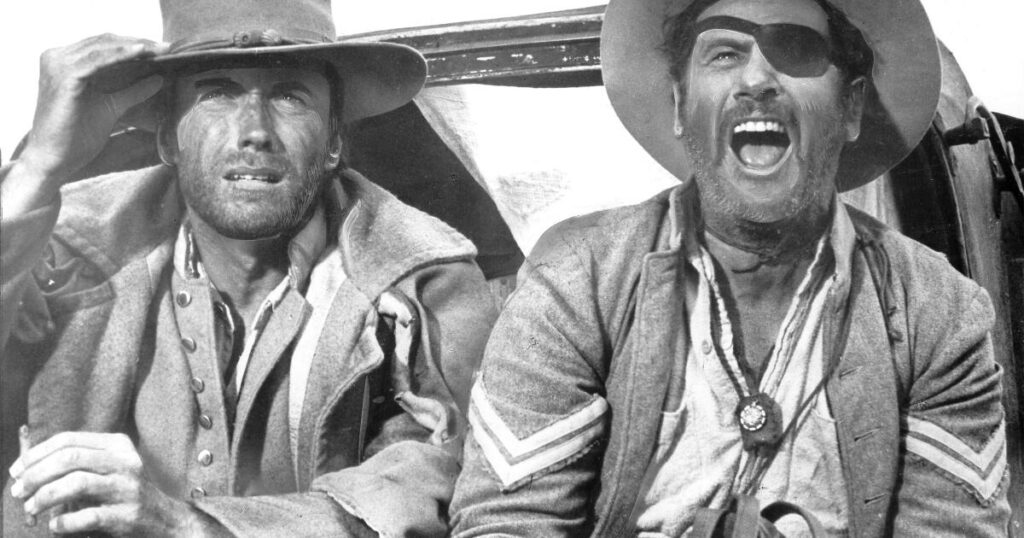
In 1966, Sergio Leone put three gunslingers in a desert scramble for buried Confederate gold and called it “The Good, the Bad and the Ugly.” No one in that film is innocent, and no one is purely evil. What separates them is the code each follows — or refuses to follow.
Understanding artificial intelligence requires the same three-way reading. AI isn’t one character; it’s all three, coexisting in the same model and sometimes the same product. Confusing them is how boardrooms and regulators keep getting surprised — and how AI’s believers and detractors oversimplify the thing they love or hate.
Start with the Good. Blondie — Clint Eastwood’s “Man With No Name” — is no hero in the conventional sense; he runs a bounty-hunting con for profit. But he operates by a private code of decency, showing mercy when there is nothing in it for him. That’s AI at its best: pragmatic, not sentimental, extending human capability rather than replacing it.
In a randomized trial of more than 80,000 women in Sweden, AI-supported mammography screening detected 20% more cancers than standard double reading while reducing radiologists’ screen-reading workload by 44%. That is the promise of this technology: not that AI “reads a scan a radiologist might miss,” but that it can help flag a finding that might otherwise be overlooked. It can also draft the note a clinician has no time to write or give a small business the market research only a large one could once afford. It doesn’t decide what matters to you; it clears space for you to decide. The best deployments keep a human genuinely in the loop, using AI to widen judgment rather than substitute for it.
Then there is the Bad. Angel Eyes, played by Lee Van Cleef, is the purest villain precisely because he has no code at all — only a contract. He tortures, betrays and kills with the same flat affect, because to him a job is just a job. That’s the AI risk that keeps me up at night: not malice, but indifference. An algorithm told to maximize engagement, approval rates or throughput will do exactly that — discriminating in a lending model, amplifying outrage in a feed, optimizing a health plan for cost instead of care — with no more conscience than Angel Eyes. The danger isn’t that the system is evil; it’s that it’s perfectly obedient to a narrow goal we forgot to make humane. That is a governance failure as much as a technology failure. Boards cannot treat AI oversight as a compliance afterthought; they are accountable for the objectives they authorize and the harms those objectives predictably create.
Finally, the Ugly. Tuco, Eli Wallach’s motormouth bandit, is the film’s most human character precisely because he is such a mess — resourceful, funny, self-preserving and prone to betrayal, yet loyal in his own way. He survives on wit more than truth. That’s today’s AI, warts and all: models that hallucinate facts with total confidence, inherit biases from their training data, and perform brilliantly in the lab only to stumble in deployment. The Ugly is also the AI divide itself — the rural hospital or small employer priced out of tools that flagship systems take for granted. Tuco doesn’t become trustworthy because we ignore his flaws; he becomes useful only when someone accounts for them.
Healthcare is where all three characters can show up in a single patient encounter. Picture a man newly diagnosed with localized prostate cancer. An AI tool, trained on average outcomes, recommends surgery as the surest path to removing the tumor. But the choice is not that simple. Randomized evidence comparing surgery, radiotherapy and active monitoring shows different long-term effects on urinary, sexual and bowel function. For one patient, minimizing progression risk may dominate; for another, preserving continence or sexual function may matter most. Built well, AI makes those trade-offs legible and helps the patient decide which consequences he can live with. Built carelessly, it turns population evidence into a verdict: The same data can yield a good or bad outcome depending on whether anyone asked what the patient valued.
That’s the real stakes of this standoff, and the gold isn’t fictional. It’s trillions of dollars in potential productivity. In healthcare alone, widely cited estimates suggest that a substantial share of U.S. spending is wasteful or produces little added benefit. Whoever decides how AI is built and governed decides who captures that value and who — spoiler alert — is left standing in the blast radius like Tuco.
Unlike the movie, there’s no clean cut where the Good outdraws the Bad and rides off; all three traits ship in the same system. Our job — whether we build AI, buy it, deploy it, govern it or simply use it — isn’t to root for a character. That last group can no longer be treated as incidental: About one-third of U.S. adults now turn to AI for health information or advice, including 29% for physical health and 16% for mental health. The public is already helping determine how this technology enters care. Our task is to give it the code the Wild West never had: transparency about what a model optimizes for, real testing before deployment, safeguards that constrain foreseeable harm, and a standing habit of asking, “Best for whom?” The technology has arrived as a package. The choice left to us is which traits we empower and which we restrain.
Jim Weinstein, co-author of “The Hub and Spoke Model,” is a spine surgeon, former chief executive of Dartmouth Health and vice president of Microsoft Health Futures.
The post AI models are the good, the bad and the ugly, all at once appeared first on Los Angeles Times.