Kent Hups, a high school science teacher in Colorado, was nursing a bad knee when he accidentally stepped into paleontology history.
He was volunteering on a fossil dig in the North Dakota badlands last year, while recovering from knee replacement surgery, and was walking gingerly on easier, flatter routes, to avoid steep terrain.
That was when he spotted a lumpy triangle of hardened sandstone that looked like giant toes. He thought it was a dinosaur track, and he was right.
“I got out my tape measure, and I started measuring the angles and everything started to fit,” Mr. Hups said. “That’s when I realized I had something really good. That’s when I discovered that was only the third adult T. rex track ever found.”
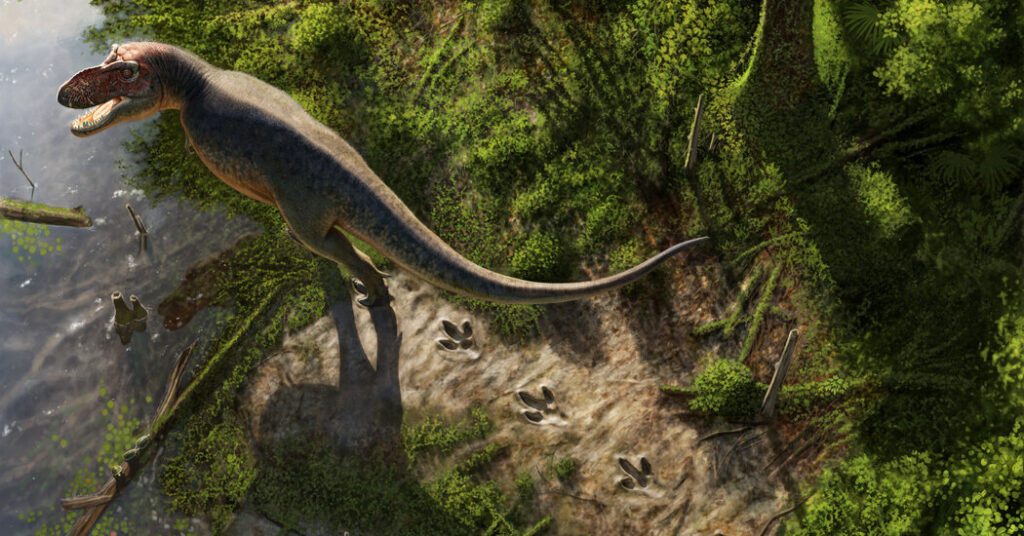
What Mr. Hups had stumbled across in the Hell Creek Formation, a prehistoric layer of rocks spanning the Northern Great Plains, was not just a single fossilized footprint, but a continuous 23-foot trail of four massive three-toed prints. It became the first confirmed walking trackway of a fully grown Tyrannosaurus rex ever discovered.
“It has been a little over 120 years that we’ve been collecting fossils and looking for trackways in the Hell Creek Formation, so this is very early in history,” said Thomas Carr, a paleontologist at Carthage College in Wisconsin who was not involved in the discovery. “I expect that in another 120 years, we will find, hopefully, a few more trackways of Hell Creek Tyrannosaurus.”
The tracks themselves are three feet long and two feet wide, and show a 13-foot stride between steps. The trackway allows scientists to better envision the T. rex, an animal that could weigh up to 10 tons, when in motion.
The sequence of tracks, or trackway, was found in July 2025 on federal land administered by the U.S. Forest Service near Marmarth, N.D., and the findings were published last week in the Journal of Vertebrate Paleontology.
Researchers estimate that the footprints were made 66.5 million years ago near a riverbank.
When Mr. Hups took a photo of them, he sent the image via text message to the excavation team leader. “Hey, I think we have T. Rex footprint!!!!!!!”
But the leader, Tyler Lyson, the senior curator of vertebrate paleontology at the Denver Museum of Nature and Science, was not so sure. “Initially, I was pretty skeptical because rocks can weather into all different shapes and sizes,” he said. “You have some that look like Florida, others that look like Texas, and some that look like T. rex footprints.”
Dr. Lyson, a co-author of the paper with Mr. Hups and others, leads excavations in his native North Dakota. His team identified the T. rex based on the footprints’ exceptional size and the narrow shape of the toes, along with the abundance of T. rex fossils found in the surrounding area.
“Prior to this discovery, there were only two T. rex footprints that had ever been found: one isolated footprint in Montana and one isolated footprint in New Mexico,” Dr. Lyson said.
The tracks are preserved as fine-grained sandstone concretions cemented with calcium carbonate that formed in the depressions of the footprints. So the footprint casts are harder than the surrounding rock, according to the paper.
The trackway records two left and two right footprints. Based on the strides’ length, researchers estimated that the animal was walking about 3.5 to 4.5 miles per hour, about the pace of a human’s power walk.
“This has no bearing on how athletic tyrannosaurs might have been,” said John Hutchinson, a professor of evolutionary biomechanics at the Royal Veterinary College in London who was not involved in the study.
“It tells us that, near the end of the age of dinosaurs, a T. rex took several very closely spaced, short steps, and thus was walking slowly.”
Dr. Hutchinson said that it would be hard to generalize, or be more specific, beyond that. He said that having the prints show how the T. rex’s feet were positioned during slow walking in mud was an extraordinary find, given how scarce such evidence is.
“Such a trackway might, with further due caution, be used with other evidence such as a computer simulation of locomotion of a whole T. rex, to estimate how such footprints might have been produced by the motions of limbs and body of the animal.”
Dr. Lyson’s team used high-resolution 3-D surface scanning to document each footprint and the full trackway. The digital models allow scientists to create physical 3-D reproductions.
The team received permits to excavate next month three of the heavy sandstone prints, which weigh from 800 to 1,000 pounds. They will be rolled onto a net that will be airlifted by a helicopter, before being placed on a trailer that will carry the fossils to the Denver Museum of Nature and Science.
“We will bring them into our lab, which is visible to the public,” he said, noting that visitors will be able to see the scientists at work.
“We’re hoping that the prints, after they’re clean, will give us a better idea of what the footprint, what the actual foot of a T. rex, looks like. For example, there’s a reasonably good chance that we might find skin impressions on the bottom. And I think that would be really, really incredible.”
Among those who will be visiting the fossils at the museum are the 30 students in Mr. Hups’s yearlong geology course at Northglenn High School, a public school in Northglenn, Colo.
“It’s so much fun to see them experience the excitement and passion that I am,” he said. “And let the kids see that, if you do it, and you do it right, you can find some amazing stuff.”
The best fossils, Dr. Lyson said, are still in the ground, waiting to be discovered.
“An amateur paleontologist, who was interested in fossils and being outside, made this amazing discovery and then reached out,” he said. “I think that’s really, really reassuring, and hopeful for kids and adults alike who want to go out and make a cool discovery.”
For Mr. Hups’s part, he felt transported to that day some 66 million years ago, and he tried to imagine: Where was the T. rex going? What was it doing? Why was it right here?
“It’s a time machine, and it’s the closest thing you’re going to get to a time machine when you see these things and you try to make sense of it.”
The post A T. Rex Walked Here: Teacher Finds Rare Footprints in North Dakota appeared first on New York Times.