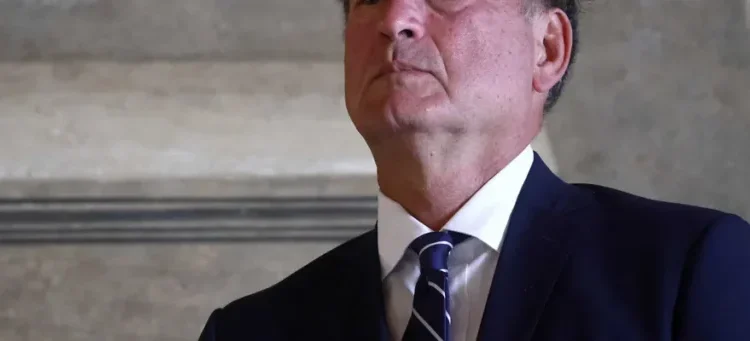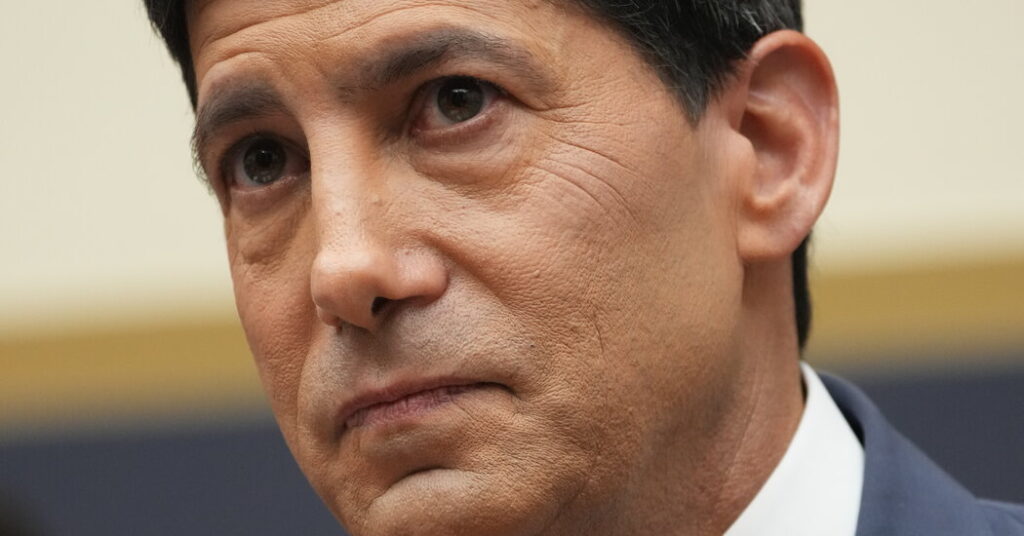
Days before President Trump named Kevin M. Warsh as his pick to run the Federal Reserve, he griped about his past experience picking the leader of the central bank.
“They’re saying everything I want to hear,” he told attendees at the World Economic Forum’s annual gathering in Davos, Switzerland in late January. “They get the job, and all of a sudden, ‘Let’s raise rates a little bit.’”
Four months in, Mr. Warsh is on the cusp of doing exactly that. The Fed is expected to raise interest rates by a quarter of a percentage point on Wednesday, as it tries to stamp out inflation that has overshot the central bank’s 2 percent target for five years. It would be the first increase since July 2023.
Raising rates from the current 3.5 percent to 3.75 percent level would directly defy Mr. Trump less than two months before midterm elections that will determine whether Republicans retain control of Congress.
Mr. Trump has long pressured the Fed to lower borrowing costs to boost economic growth and make interest payments on the national debt less costly. He repeatedly demanded this of Jerome H. Powell, whom the president elevated to chair in his first term. Mr. Trump’s Justice Department later opened a criminal investigation into Mr. Powell when he did not comply.
This week’s decision has morphed into a litmus test for Mr. Warsh, who had been staunchly critical of the central bank’s handling of inflation before taking the helm. As chairman, he vowed to vanquish it once and for all.
Now faced with an economy on solid footing, unemployment low and price pressures barely abating, Mr. Warsh and his colleagues on the policy-making committee appear boxed in to raising rates. Financial markets see an increase this week as all but guaranteed, driven in large part by Mr. Warsh’s own tough talk, which he delivered as recently as last month at the Fed’s annual conference in Jackson, Wyo.
Failing to follow through now risks eroding Mr. Warsh’s credibility and exacerbating a sell-off in U.S. government bonds that has already pushed yields on 10-year Treasuries this week to a multiyear high of 5 percent.
“He signed up for the job,” said Ellen Meade, who was a senior adviser to the Fed’s board of governors until 2021 and is now at Duke University. “He has to decide what’s important to him — his legacy as Fed chair or getting the approval of the administration.”
From Rate Cuts to Rate Hikes
When Mr. Trump tapped Mr. Warsh for the job in January, the Fed was considered more likely to lower rates than anything else. By May, when Mr. Warsh was officially sworn in, those prospects had evaporated. The culprit was Mr. Trump’s war with Iran, which upended the inflation outlook.
Expectations about the Fed’s appetite to raise rates firmed after Mr. Warsh decided to begin his tenure with a steely message on inflation. Markets were left guessing where exactly the new chairman stood in subsequent weeks, however.
Part of that was by design, with Mr. Warsh eschewing the typical kind of guidance that previous Fed leaders had given. But it also reflected the mixed signals the chairman inadvertently sent at the July meeting about how the Fed would achieve its goals. That forced him to reset the narrative during his Jackson Hole address.
Mr. Warsh, in ceding so much ground to markets to fill in the gaps about where the Fed is headed, now faces an intractable situation if he had not planned on raising rates this week.
Charles Evans, who served as president of the Federal Reserve Bank of Chicago from 2007 to 2023, said Mr. Warsh would have had more flexibility had he provided more substance around his own thinking.
This “framework guidance” is “bread-and-butter monetary policymaking,” said Mr. Evans. “If you were willing to talk more expansively about the different scenarios that you see, I think you could go into this meeting and explain either decision” regarding an increase or a hold.
Several top officials sought to carve out flexibility for the Fed ahead of September’s gathering. John C. Williams, who as president of the New York Fed is the vice-chair of the Federal Open Market Committee, conveyed little urgency to raise rates when he spoke this month. While he made clear that forthcoming policy decisions would depend on the data, he leaned into his forecast that inflation would decelerate later on this year.
Christopher J. Waller, a governor, was more blunt, questioning the efficacy of raising rates when there were reasons to be optimistic about cooling price pressures in the coming months. Still, he said a “hot” inflation report would probably tip him toward higher rates.
So when August’s inflation data, released on Friday, showed minimal improvement in price pressures, the Fed seemed bound to raise rates.
“It’s just going to sow confusion if you sound so tough all the time, but then don’t back it up,” said Jonathan Pingle, who used to work at the Fed and is now the chief U.S. economist at UBS. “At this point, a certain amount of credibility is on the line after throwing down the gauntlet.”
The Start of a Series?
When the Fed raises rates, it is rarely a one-off adjustment. It is often a series of moves carefully designed to achieve a specific economic goal.
How much the Fed lifts rates from here depends on what it is trying to achieve. Economists balk at the idea that a quarter-point increase on its own will do much to get inflation back to 2 percent. Mr. Warsh himself has spoken out against the Fed engaging in the “fine-tuning business.”
Slowing down economic activity enough to bring down inflation is likely to require a much more substantive move — somewhere in the ballpark of a full percentage point increase to rates, according to Mr. Evans.
But if the Fed’s goal is simply to protect against the possibility that inflation stays stuck at a stubbornly high level — or that expectations about inflation begin to shift notably higher — it might not have to do as much if it starts now.
Justifying a rate increase on Wednesday as a matter of risk management could be effective, said Kris Dawsey, head of economic research at the D.E. Shaw Group, a hedge fund.
“With uncertainty around inflation, erring on the side of more hawkish policy is a reasonable approach,” he said. “If we continue to observe inflation numbers that aren’t consistent with more progress toward 2 percent, they could be prepared to make further adjustments.”
Ms. Meade said that at minimum, the Fed needed to reverse the insurance it took out last year when it lowered rates three times to guard against a weakening labor market. Those cuts were a “mistake,” she said, and hadn’t left enough restraint on demand to keep a lid on inflation when new shocks emerged.
Providing specific guidance about the possible trajectory for rates, however, would go against Mr. Warsh’s own communication preferences. Without a signal, the risk is that markets begin to pile on bets that are far out of step with what Mr. Warsh believes is necessary to rein in inflation. That could translate to overly onerous borrowing costs that could imperil the labor market or snuff out growth.
One tool at his disposal on Wednesday will be an updated so-called dot plot, which aggregates on a quarterly basis what policymakers surmise will happen to rates over the coming years along with inflation, growth and unemployment.
But Mr. Warsh has sought to minimize its importance. When it was last published in June, and showed that officials were evenly split on the need to raise rates, Mr. Warsh opted against submitting projections. Now, it is expected to show another quarter-point increase this year after September’s move. That move is likely to come in December rather than at the Fed’s next meeting in October, which comes just days before the midterms. Further increases could also be penciled in for 2027.
“I don’t think they necessarily have a specific end point in mind,” said Mr. Dawsey. “If they were already planning a much more substantial adjustment, it wouldn’t make sense for an inflation print just slightly above expectations to be the thing that triggered it.”
Litmus Test
Even one rate increase is likely to anger Mr. Trump.
Lower borrowing costs have taken on newfound importance for the administration in recent months, reflecting the centrality that affordability issues are playing in the midterm elections. Since August, Treasury Secretary Scott Bessent has unilaterally tried to force down borrowing costs with a series of interventions. Those efforts have so far proved fruitless.
Perversely, there is an argument that if the Fed shows it is serious about tackling inflation and raises rates, it would help keep in check the longer-term borrowing costs that Mr. Bessent is trying to tame. July’s meeting, and the market rout that followed, confirmed how sensitive Treasury yields are to any perception that Mr. Warsh was wavering on his inflation pledge.
Joseph Lavorgna, who until recently served as an adviser at the Treasury Department, said this rationale could appeal to the administration. Mr. Warsh has the benefit of a close relationship with both Mr. Bessent and Mr. Trump, and many hope he will leverage those ties to handle the repercussions of going against the president’s stated wishes.
“He knows what he’s dealing with with the president,” said Mr. Lavorgna, now chief economist at SMBC Nikko Securities America. “However, he needs to do what he believes is in the best interest of the Federal Reserve, and right now inflation is a problem.”
The post Warsh Set for Showdown With Trump as Fed Faces Pressure to Raise Rates appeared first on New York Times.