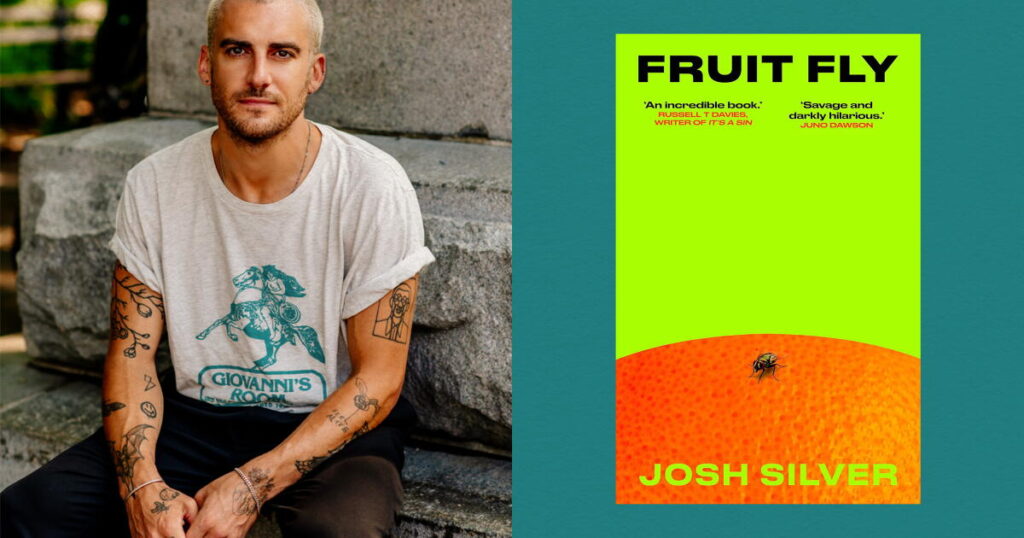
Readers are so obsessed with Josh Silver’s “Fruit Fly,” that the buzziest book of the summer sold out across online and major book retailers last month.
The satirical literary thriller follows Mallory, a celebrated but has-been author who’s had writer’s block for nearly a decade. She googles “How to write a bestseller,” and comes upon the Reddit advice to “Go gay. Go sad. Go dark.”
“Also — always remember: gay is in. Go gay. It’s cool now. It sells. However — here is the gold dust — the perfect blend is gay AND sad. You nail that, you’re minted. And probs an award winner,” Silver writes in the book.
Desperate to find a muse to inspire her next bestseller, Mallory comes upon Leo, a gay addict who lives under a bridge and sells sex on Grindr to support his drug habit. He’s perfect, she thinks, and the world needs his story, she needs his story. Oblivious to her own biases about who Leo is and why, Mallory poses as a therapist keen on saving his life, but uses their faux sessions to mine his story for literary gold.
“How much we think we know about a certain culture or demographic is based on what we’re presented by literature, films, movies, culture, and it’s not that the fault lies entirely in the person, but in the systems generating what they’re calling authentic,” Silver tells me over a recent call.
The London-based author has been on a press tour in New York, where he plans to move in the near future, and he’ll be in Los Angeles this week to discuss the book that broke the internet. After a bidding war, A24 UK landed the screen options and plans to turn the book into a miniseries with Silver serving as an executive producer. An actor-turned-mental health nurse, Silver previously penned three acclaimed YA titles, “Happy Head,” “Dead Happy” and “Erase Me,” which was selected for the 2026 YA Book Prize. “Fruit Fly” is his adult novel debut.
In the U.S., publishers of “Fruit Fly” have ordered nearly a dozen reprints totaling around 100,000 copies since it hit bookshop shelves in August, and the U.K. has sold tens of thousands since it published in April. Silver is slated to tour Australia next.
We spoke with Silver ahead of his Wednesday event hosted by Book Soup at First Congregational Church of Los Angeles.
The following conversation has been edited for length and clarity.
Mallory comes across the Reddit advice to “Go gay, go sad, go dark” when trying to write a bestseller, and it’s a great example of the trendification of trauma and marginalized identities. Did your experience in the current publishing landscape influence this theme?
I was interested in how gay became cool, and how in certain markets it can be seen as currency, and that it can be pushed and monetized. Then also with trauma — as a society, we like to view other people’s trauma. Today it feels like it’s an incredibly prominent theme. We’re obsessed with true crime documentaries, shows about serial killers and awful things that happen to people, and I’m interested in why we want to take that in, what emotional response we’re trying to get, and what proximity we have to the story. With Mallory, I just wanted to dunk her in the middle of the thing that she thinks she’s so well versed about.
Mallory decides she can inhabit the world of a down-and-out gay addict by throwing a naive character into this environment. What were you aiming to expose about the difference between posturing around these subcultures and the lived reality of them?
She thinks she has it down in a way, and then when she turns up thinking she’s going to a tea party, very naively being met with the reality of a chemsex party, and then the emotional response she has changes from one of, “I’m so excited to be a voyeur,” and “I’m so excited to be called mother by the gays,” and she is very starkly contrasted with the reality by dunking her in it. I wanted to see how she copes with the unmasking of perhaps a version of the gay experience that she’s gathered over time.
Does she care about Leo, or does she want to keep probing that pain and that trauma? She doesn’t actually want to experience it. She wants to be a voyeur to it.
You do an amazing job of this with the queer experience, but also with the experience of living with addiction and how dark that can be.
That was important to me to write about. I think in this age in the queer community now, in the wake of PrEP, which is a drug that gay men can take to prevent the transmission of HIV, it’s the most revolutionary thing as a gay man that’s happened in my life and what it has done to my community in terms of liberation and removing such a sense of fear and shame.
But then, from what I’ve noticed, I think it moved into a potentially new set of problems around sexual freedom and drug use coming into it. Actually, it is something that I’m aware of, and also myself got very much caught up in. I just wanted to show the point of view of a gay guy who’s experiencing that now, and whether Mallory, who represents a broader sense of society, is able to see it, understand it and have empathy rather than fetishize it or appropriate it.
There are some rehab/sober house scenes in this that feel so authentic, from the dynamic between the counselor and Leo to Leo’s push and pull to stay but still scheming to stay on his own terms and use drugs. Did your work as a mental health nurse influence your rendering of trauma and addiction?
Oh, absolutely, 100%. I trained as a mental health nurse, and I worked in different divisions. One of them was in a drug and alcohol detox. I loved the job because I could relate to some of the people coming in who were struggling with addiction, but also I could see the system from a different side, and that is something that really interests me — who makes the choices around other people’s well-being when it comes to mental health?
I would see lots of young gay men coming in, having to detox off G [GHB a.k.a. liquid ecstasy] and other drugs, and they’re in a very dangerous situation when they’re there, and it’s really scary seeing them. It’s a balancing act detoxing someone off of chemsex drugs, and it’s becoming more and more prevalent … I also notice there’s a lack of empathy towards it, from the wider world, and because it’s complicated for people to discuss because of the sex involved, I think it’s met with a level of stigma which is not helpful, and people struggle to talk about it because they don’t want to get judged.
When Mallory’s pushing it further and further on how far she’s willing to go to write this story and to get it published, and she sees it as this golden ticket for herself, it has these parallels to addiction — you cross one line that you don’t think you’re ever going to cross, and then all of a sudden you’re in this new territory, and then you’re teetering toward that next line. It’s a really interesting look at how things can unravel.
You could say that she’s in active addiction. She’s in fantasy addiction. She’s completely avoiding herself. She’s not only using his life to try and make some money. She’s just using it to escape her own, and she’s escaping herself in the way he is using drugs.
And different forms of addiction are very interesting to me as well. You know, now that I’m sober from drugs and alcohol, that s— doesn’t stop. It doesn’t go anywhere. It’s not based in the alcohol and the drugs. It’s based in me. And it’s like, where does that go? And just because she’s not using in a way that we see addicts doesn’t mean that she isn’t one in her own way. And that was really important for me to write.
I love to ask authors who write books, with characters who would widely be perceived as unlikable, what do you think are Mallory and Leo’s most redeeming qualities, and how did you empathize with them?
I grew up honestly believing that the point to life was to be liked by other people and to get other people’s approval. I think as I grew up and I learnt about myself a bit more and understood that that’s not going to work and that that shouldn’t be how I try and live my life, I decided that when I was writing my characters that I would never try and make them likable or unlikable, good or bad.
The term “unlikable character” is a term in publishing at the moment, and while I can see why people might not get on with Mallory, I have a lot of empathy for her and for Leo, for both of them, and I feel like their inner world, well, I can only speak from my own inner world in reference to this, it’s often at odds with how you present yourself and I think that contrast is really fun to play with.
I don’t really feel like my job is to get people to like them. I think my job is to get people to understand why they’re making the choices they’re making, even if they don’t agree.
Can you tell me about your inspiration in writing “Fruit Fly”?
“Erasure” by Percival Everett and “Yellowface” by R. F. Kuang are definitely some huge inspiration, I felt like they pushed the boundaries of how you can tell stories about storytelling and publishing and media, and I found that really liberating.
And then also just based on my own experience of being an actor, being told that being gay wouldn’t really help my career, and that I should be careful about who I told. Cutting to nine years later, when it was like, you can go into auditions and be gay, people want to hear that, in fact, they’re only casting for gay roles now. That narrative, the switch, the whiplash of that made me feel like OK, so these last nine years have been for what? It’s crazy. I thought I wasn’t allowed to — it was discombobulating, confusing, and then just kind of gross.
I’m interested in people’s motives behind storytelling and what’s in, what’s cool, what’s hot, what has currency, and what are the intentions of the people telling those stories? I fully believe in creative freedom. It’s really important that we have it. Imaginative and creative freedom needs to happen to create stories. We can’t just write autobiographies. But there is a question around if you’re writing a book about the experience of a community that you’re not directly part of, and the the hook hinges around a pain or a suffering or a trauma that is very specific to that community that you are not a part of, I’m intrigued as to why you are writing it.
Switching gears. This book is so meta. It’s a book about a book, and I love that. Those are my favorite. (Warning, spoiler ahead.)
Can I tell you a really meta thing that happened today? So in the end of the book, Mallory’s book has come out, and she has an interview that she’s done with Cosmopolitan magazine. And today, I found myself in Cosmopolitan magazine’s head office in New York City, doing a press thing, and writing a note to thank the editor in chief of Cosmopolitan, and I was just like this is literally wild because when I wrote this book two years ago, and I was like, I wonder which publication Mallory would be doing her press for? It was weird.
So, Mallory, she goes gay, sad, dark to write this bestseller. “Fruit Fly” is inherently gay, sad and dark, and it’s now sold out. It’s the buzziest book of the season, and I have to ask, did you manifest this?
Some people have wondered if I created some big master plan in order to create this. No, I did not manifest it. I always hoped that it would do well, but I did not expect this to happen, no one did.
Josh Silver will be in conversation with Gary Janetti to discuss and sign “Fruit Fly” at 7 p.m. Wednesday, Sept. 16, at a ticketed BookSoup event hosted at First Congregational Church of Los Angeles. 540 S. Commonwealth Ave., L.A.
The post The secret to Josh Silver’s bestselling book ‘Fruit Fly’? Go gay. Go sad. Go dark. appeared first on Los Angeles Times.