With so much attention being paid now to upcoming elections and candidates, a long-ago memory nudged me and made me think about what I would really like to hear from anyone running for public office.
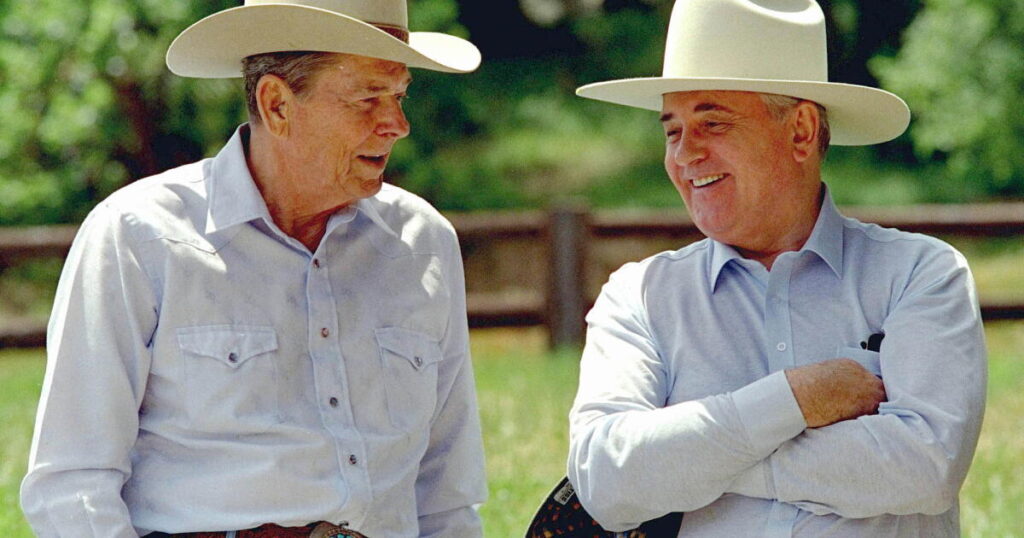
Deep into my father’s first term as president, I met my parents, Ronald and Nancy Reagan, at their ranch near Santa Barbara one weekend. It was my father’s favorite getaway — more than Camp David, more than anyplace. He loved saddling his horse, riding across hills on trails he had helped clear. Even with Secret Service agents following him and the weight of the presidency leaning on him, it was, as he often described it, “in the same ZIP code as heaven.”
On this weekend, my mother went to bed early one evening, leaving my father and me sitting by the fireplace together, just the two of us. He started talking about the beauty of the ranch, how it restored him, filled up his soul in a way that no other place could. He had, at that point, recovered from John Hinckley Jr.’s bullets, which almost killed him. But he used the word “healing” in a way that made clear it was a continuing process for him, one that green rolling land and the endless sky made possible. As the fire crackled beside us and coyotes yipped in the dark distance outside, I asked him why, if this place was so necessary for him, did he want to be president, a job that obviously took him far away and limited his time on the land he loved.
He told me that he believed God had a purpose for everyone and that he had prayed throughout his life for some illumination of what his might be. He said he earnestly felt that he could help make the world a more peaceful place, a more civil place. Especially in the relationship between the Soviet Union and America.
This visit would have been sometime in 1983. Leonid Brezhnev had died, Yuri Andropov had taken over as the Soviet leader, and tensions were high between the two countries. As has been reported, my father had sent two letters to Brezhnev while recovering from the assassination attempt. One was a handwritten four-page letter, a personal plea for a better relationship between America and the Soviet Union. The State Department objected to the personal nature of the letter and drafted a more formal one. Both letters were sent, but Brezhnev’s reply was not exactly conciliatory.
In our evening conversation, my father spoke about his wish — his prayer — that someone would rise up to lead the Soviet Union whom he could talk to, someone with whom he could forge a good working relationship. Years later, I thought about this and how he was almost imagining Mikhail Gorbachev before probably even knowing of his existence.
Why did this whole reminiscence surface for me now, in this year of consequential midterm elections, leading into a presidential cycle? Because it illustrates the question that should be asked of every candidate, especially those running for president: Why do you want to do this?
Obviously, some will have canned answers, political slogans that have been crafted for them and run through focus groups. But I think people are perceptive enough to distinguish between a rehearsed soundbite and an earnest answer. Dolly Parton’s recent passing showed how deeply people are moved by one person’s resolve to help others, to make the world just a little bit better with kindness and compassion. What struck me about my father’s answer is that he reached down into his soul and spoke a deeply personal truth. No matter what your politics are, no matter what side of the aisle you’re on, that matters.
Part of our disillusionment right now is that we don’t know whom to trust. We don’t know who has been varnished and rehearsed and coached until their real self is buried under a thousand layers. Perhaps that one question might travel down through some of those layers and give us an idea. Why do you want to do this? It’s a simple question, and we deserve a simple answer.
Patti Davis is the author of “Dear Mom and Dad: A Letter About Family, Memory and the America We Once Knew.”
The post The one question to ask anyone running for office appeared first on Los Angeles Times.