The world is furious — again — over rising energy prices caused by the American-Israeli war against Iran.
Since the latest surge pushed oil above $100 a barrel, protesters have burned tires and cars in Guatemala and Syria to express their rage.
Portugal’s roads have featured cars crawling in protest with honking horns after diesel reached a record high of more than $9 a gallon.
And especially in the developing countries of Asia, which are heavily reliant on Middle Eastern energy and deep in debt from earlier efforts to offset the war’s impacts, transport systems and governments are facing another round of enormous strain.
Fuel shortages and long lines at the pump are slowing economies along with strikes by taxi drivers and laborers who see no point in working when earnings barely cover energy costs.
Many countries are confronting a difficult question: Is it riskier to pass on price increases to a combustible public, accelerating inflation, or bolster subsidies and aid that would drive up public debt and possibly threaten the stability of national currencies?
“How much fiscal capacity does Asia or the developing world have in general to manage this geopolitical crisis?” said Sana Jaffrey, a lecturer at the Australian National University who researches conflict and state-building in Asia. “What happens to global financial markets when that capacity starts to run out?”
“At some point,” she added, “it’s going to become everyone’s problem.”
Here are some global flash points The New York Times is monitoring.
Indonesia
In Makassar, South Sulawesi, residents this week reported shortages of cooking gas, rolling blackouts and a sudden move toward gasoline rationing.
Across the provincial capital, drivers pushed motorbikes with empty tanks or left them in long lines near pumps with nothing to give. Taxi drivers held a protest on Monday against a new rationing system organized by odd and even license plate numbers.
Tensions have also been rising in Yogyakarta, in Java. Students demonstrated against surging fuel prices on Monday — only to have their rally broken up by aggressive pro-government organizations.
Discussions about ending subsidized fuel access for wealthy and middle-class households have been intensifying. The government’s calculations before the war assumed oil prices would be at around $70 a barrel, and public debt has soared since the conflict started.
The Philippines
Fishermen along Manila Bay who use boats powered by diesel or gas had hoped this week to venture out to sea after weeks of monsoon rains. Large numbers are now staying in port.
“Many were raring to go back to fish, but have no money to buy gas,” said Fernando Hicap, the national chairman of a major fishing association. “The new round of price adjustments have been choking many of us to death.”
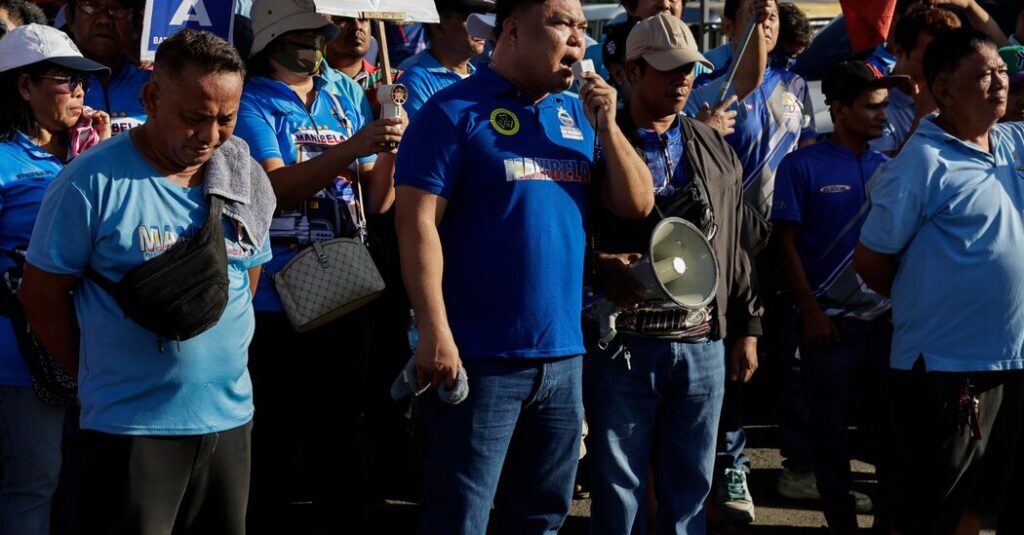
Bus and ride-share drivers have also been marching in Quezon City, and quietly protesting by not working — a trend also popping up elsewhere. In Vietnam over the weekend, drivers with Grab, a ride-hailing app, called for a boycott to protest low pay caused in part by rising fuel costs.
Modesto Floranda, the leader of a 70,000-strong group of Filipino bus drivers and owners, said that working 15 to 18 hours a day now only earns enough for a single meal.
The government has offered one-time payments of about $80 to public transportation drivers.
“It is not enough,” he said.
Guatemala
Transport workers and Indigenous activists marched through the streets of Guatemala City recently, demanding more than stopgap measures like price caps and subsidies.
Some groups have called for a suspension of fuel taxes and a shift away from fossil fuels, which critics see as a source for elite enrichment and environmental damage. Farmers across Latin America, heavily reliant on diesel for tractors, have been especially frustrated.
At one recent march in Guatemala, where videos showed a thick throng of workers, an organizer with a megaphone characterized the economic struggle as a contest between governments and the wealthy, and everyone else.
“They are in a place of luxury, that’s why they don’t think about our misery, hunger, or the cost of the basic food needs of the working class,” he said. “We will also continue to put pressure on them.”
A few days later, in Villa Nueva, just south of the capital, videos showed cars set ablaze in the streets.
Portugal
Organizing mainly on social media, Portuguese drivers gathered last week for several “buzinões” — protests with cars driving slowly while honking. They caused traffic jams across several key thoroughfares including the 25 de Abril Bridge in Lisbon.
In a sign of growing frustration with large oil and gas interests, one vehicle convoy blocked access to roads near a major refinery in Sines, according to a local news site.
Naomi Hossain, a political sociologist at the University of London who has studied the impacts of energy shocks, said that it was common for people to assume that fossil fuel costs and inflation rise “because of collusion between political elites and businesses.”
“There are good reasons to believe that untamed inflation is pushing voters to the right,” she said. “Centrist governments don’t seem to be able to do much to protect people against these shocks, and there are no realistic left alternatives in most places. So one consequence is it’s feeding populism.”
Bangladesh
Bangladesh imports more than 90 percent of the petroleum it uses, and most of it comes from the Middle East.
Shortages in the liquid natural gas needed to produce electricity have led to rationing and the temporary closure of garment factories — the main engine of the country’s economy. Many turned to diesel after the war in Iran started in February, only to see those prices now rising.
Robiul Hasan Mehedi, an officer at a garment factory in Bangladesh’s garment hub, Gazipur, said Tuesday that power cuts are now happening four or five times a day.
Several hours of work stoppage — multiplied by dozens of factories and thousands of workers — is now the norm.
Nahid Islam, an opposition leader, said in a protest rally in Dhaka this month that the crowds were marching in part “against those who are forming syndicates around gas, oil and electricity and trying to increase prices.”
Sri Lanka
Sri Lanka’s government sets fuel prices each month, but fuel distributors that sell to gas stations have started restricting supply as they wait for an expected surge.
“They’re operating at a loss,” Kumara Rajapaksha, the chair of the Filling Station Owners’ Association, told reporters on Monday.
Anura Karunathilaka, Sri Lanka’s energy minister, said that officials were considering whether to raise official prices and add subsidies. The country’s debt to gross domestic product ratio is already among the highest in the developing world.
Syria
Just a few hours after the government said that it would temporarily raise prices for gasoline, diesel and other petroleum products by as much as 40 percent, Syrians took to the streets.
Angry crowds in several cities gathered in squares, blocked traffic, and set tires on fire, calling for the price surge to be canceled.
In one video posted online, a man poured what he said was gasoline over his head and threatened to set himself on fire before a crowd intervened.
Government officials said that they had no choice but to raise prices because of the war.
Reporting was contributed by Tiago Carrasco in Lisbon; Rin Hindryati in Bogor, Indonesia; Jason Gutierrez in Manila; Saif Hasnat in Dhaka, Bangladesh; Pamodi Waravita in Colombo, Sri Lanka; Raja Abdulrahim in Amman, Jordan; Hari Kumar in New Delhi; and Tung Ngo in Hanoi, Vietnam.
The post Rising Fuel Prices Set Off Anger and Protests Around the World appeared first on New York Times.