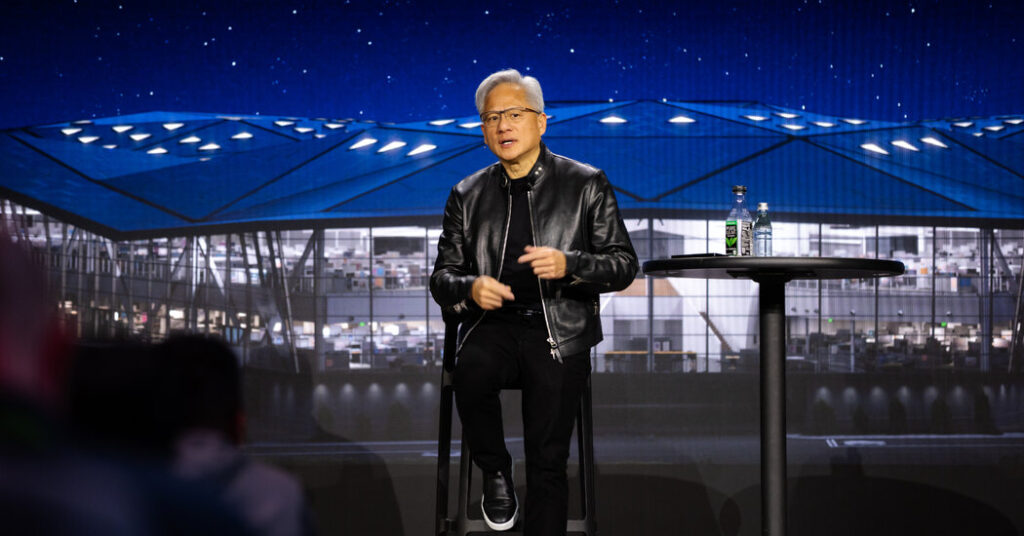
Jensen Huang, Nvidia’s chief executive, was talking about artificial intelligence at a conference in Los Angeles on Monday when he was interrupted by a phone call. President Trump was on the line.
He wanted to discuss A.I., and wasn’t thrilled about all the recent talk of the dangers of A.I. and how the government needed to step in and do something about it.
“It’s a hoax,” Mr. Trump said during the five-minute call, which Mr. Huang put on speaker. “The robots are not going to be taking over the world. That’s not going to happen.”
The theatric phone call from Mr. Trump made it clear that in Silicon Valley’s roiling debate over what to do about A.I., the president is very much on the side of executives who argue worries about safety are overblown and the government should avoid regulation. His disinterest in government involvement runs counter to pleas from leading A.I. companies like Anthropic.
Mr. Trump’s call was the latest, surprising twist in a tech industry feud that has taken what was an esoteric discussion among tech experts into the mainstream, quickly becoming a key issue in the upcoming midterm elections.
Mr. Huang was speaking at the All-In Summit in Los Angeles, a conference organized by a group of venture capitalists who host a popular podcast. (One of the podcast’s hosts, David Sacks, is a technology adviser for Mr. Trump and the White House’s former A.I. and crypto czar.) After Mr. Huang held a microphone next to his phone, Mr. Trump echoed a social media post he shared earlier Monday, which aggressively disagreed with the idea of A.I. regulation.
“They’re just playing right into the hands of a lot of people that don’t want to see it happen,” Mr. Trump said, without specifying whom he was referring to. “That could be political people, and also China.”
Mr. Trump, who made several other social media posts about A.I. on Monday, suggested he was unwilling to intervene in A.I.
“We have to be a little bit careful,” Mr. Trump said. “We have to, apparently, you know, we have to do things, and we have to do them prudently, but that doesn’t mean we’re going to stop an industry.”
It was not immediately clear what led Mr. Trump to call Mr. Huang while he was onstage. But Mr. Huang, whose chipmaking company has become the most valuable in the world thanks to the A.I. boom, has grown closer to Mr. Trump since his return to the White House. Mr. Huang is also a skeptic of A.I. safety concerns, and has frequently complained that those fears aren’t based in reality.
Mr. Trump’s comments followed intense backlash over the weekend to an appeal by Dario Amodei, the chief executive of Anthropic, to slow down A.I. development and for tighter government regulation.
In an essay posted on Saturday, Dr. Amodei said that A.I. was advancing too quickly for researchers to continue building it safely. He proposed that A.I. labs have independent auditors who monitor their safety work and that regulators greenlight their efforts to coordinate safety standards.
Leaders of other big A.I. labs, including OpenAI, SpaceX and Google’s DeepMind, backed his concerns, though they differed on their proposals.
Last week, an Anthropic researcher resigned and said in social media posts that Anthropic and OpenAI were not responsibly developing A.I. and gambling with people’s lives. Another Anthropic researcher said he believed A.I. had a more than 10 percent chance of killing all humans within the next decade.
Mr. Huang questioned whether that conclusion was based on any hard facts. “Whistle-blowing is fine,” Mr. Huang said. “The scientific prediction about the future is less fine because it’s not grounded in science, obviously.”
Mr. Huang said A.I. labs like Anthropic and OpenAI could slow down without government intervention. “Pausing, pacing, those are all voluntary things they could do if they feel that their company is out of control,” he said.
Microsoft on Monday released a 15,000-word draft of what it called a “code of conduct” for its own A.I. The company called for limits on the technology, though it stopped short of saying the industry needed to slam on the brakes. It said the document was a work in progress and would be implemented next year.
A day earlier, Satya Nadella, Microsoft’s chief executive, said in a social media post that the benefits of A.I. needed to be spread broadly, but he cautioned that “the key is that this cannot be controlled by a handful of entities, but must have broad representation.”
A.I. executives have spent weeks debating the risks of antitrust scrutiny if they should work too closely together on A.I. safety, according to two people familiar with the discussions. OpenAI’s executives have worried that if the company and its peers agreed to slow down A.I. development at the same time, they could open themselves to accusations of collusion, the people said.
This week, Anthropic and OpenAI executives are expected to meet with lawmakers in Washington to convince them to do more to safeguard their technologies.
Sarah Heck, Anthropic’s head of public policy, plans to meet with members of Congress to discuss a regulatory framework for A.I., according to two people familiar with the discussions. Ms. Heck’s proposal could share characteristics with Dr. Amodei’s suggestions in his essay, one of the people said. Anthropic also plans to stress that any slowdown would still focus on maintaining the United States’ lead in A.I. over China, one of the people said.
Chris Lehane, OpenAI’s top policy executive, is expected to meet with members of Congress and reporters in Washington, according to people familiar with his plans. Mr. Lehane plans to discuss OpenAI’s safety approach and proposals for handling A.I. risks.
Sam Altman, OpenAI’s chief executive, is also on the lobbying circuit. Last week, Mr. Altman met with Mr. Trump backstage during the Republican midterm convention, according to people with knowledge of the meeting, to stress that A.I.’s abilities are rapidly accelerating. In recent days, Mr. Altman also reached out to members of Congress to discuss A.I. risks and a potential regulatory framework, the people said.
On Sunday, just one day after he agreed on the need for a slowdown, Mr. Altman started to distance himself from Dr. Amodei. Without naming Anthropic, he said in a social media post that there was a threat of “one lab ending up with too much power.”
The post President Trump Is on the Line About an A.I. Slowdown appeared first on New York Times.