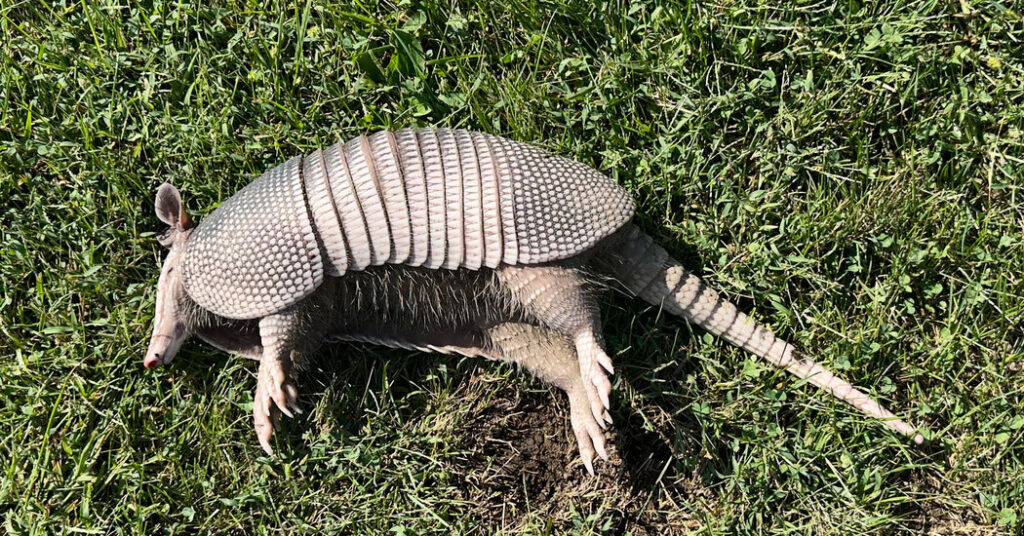
The armadillos are in Ohio.
The leathery mammals, mostly associated with dry, sweltering locations like Texas, have been creeping northward over the last century or so. But last week researchers collected a dead armadillo by the roadside four miles east of Oxford, Ohio, near the Indiana border — the first formally documented armadillo to have migrated to the state.
“I was hoping they were going to make it here,” said Tereza Jezkova, an associate professor of biology at Miami University in Ohio. “Simply because I like armadillos.”
Armadillos had been known to dwell in South and Central America until sometime around 1880 to 1890, when they were observed over the Rio Grande in Texas, according to Dr. Jezkova. And they didn’t stop there.
Every dozen years or so, armadillos have popped up in a new U.S. state. In 2017, they reached Southern Illinois, and it seemed only a matter of time before they turned up in Ohio.
The armadillo, which was found on Sept. 6, is a male, which would have been expected, according to Dr. Jezkova. “Males almost always travel more and farther and show up first in new places,” she said. Her university has taken possession of the armadillo, presumed to have been killed by a vehicle, and expects to send his body to the Hefner Museum of Natural History on campus.
So will armadillos soon be strolling up Broadway or sunning on the steps of Faneuil Hall? The animals normally cannot deal with cold weather, but Dr. Jezkova said researchers aren’t sure how far north they could go.
“They need to stop sometime, but so far, they keep going,” Dr. Jezkova said of their northerly migration. “We don’t know how they do that and what’s changed that suddenly they can withstand harsh winters.”
A few armadillos have been spotted in Ohio before, and even Minnesota. But they were so far from others of their species, researchers figured they had hitched a ride on a human-driven vehicle (armadillos enjoy hiding). This armadillo, however, was not too far from verified sightings in Kentucky and Indiana, so it seems likely he crossed the border himself.
There are around 20 species of armadillo, but only one has made it to the United States, the Mexican long-nosed armadillo. About two feet long and a bit less than 10 pounds, they are unusual beasts.
“They represent a very old lineage of mammals related to sloths and anteaters,” Dr. Jezkova said. “An armadillo doesn’t even look like a mammal. It has a shell, scales and very little hair. It looks ancient.”
Armadillos are sometimes called “living fossils,” Dr. Jezkova said, because “they look like the fossils we dig out. They pretty much stayed the same for millions of years.”
While primates, hoofed mammals and felines have greatly diversified, armadillos seemed to decide, “Nah, we’re good.”
Their unusual appearance is part of why armadillos seem to pique the public’s curiosity, especially in Texas. One of politics’ most-cited truisms comes from Jim Hightower, the progressive Texas commissioner of agriculture, who once chided centrists by saying, “There’s nothing in the middle of the road but yellow stripes and dead armadillos.”
In 1927, The New York Times related a tale about the author Rudyard Kipling, who was given an armadillo while visiting Rio de Janeiro, but returned it after a day, saying that hotel life “is too terrible a fate for an armadillo.”
In 2011, there was more disquieting news: Researchers found that armadillos could transmit leprosy to humans.
But Buckeyes can rest easy. While some armadillos in Texas and Florida have been found to carry the disease, none of the more northern travelers have, though researchers are not sure why that is.
The post An Armadillo Arrives in … Ohio? appeared first on New York Times.